
Table of Contents
Introduction
Have you ever wondered if a metal detector can actually find valuable objects underground?
For beginners in the USA, buying a detector can feel like a big decision. You may see impressive finds online and wonder if those results are realistic. The truth depends on more than the detector itself.
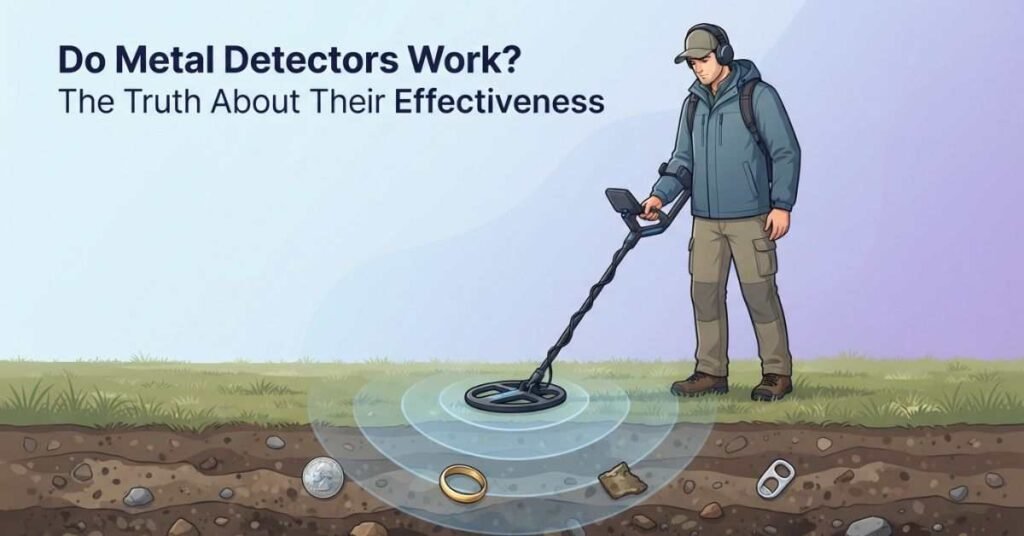
Do metal detectors work? Yes, they do. Metal detectors can locate coins, jewelry, relics, and other metal objects beneath the ground. Their performance varies with soil conditions, detector quality, target size, and user experience.
In this guide, you’ll learn how well metal detectors work in real-world conditions. We’ll also explain what affects detection performance and why some detectors outperform others. You’ll discover when detectors work best and when results may disappoint.
By the end, you’ll understand what metal detectors can realistically find. You’ll also know how to get better results from your detector and avoid common beginner mistakes.
Situations Where Metal Detectors Are Highly Effective
Metal detectors work especially well when the target matches the detector’s strengths. Location, soil conditions, target type, and detector settings all affect results. Beginners often get the best results by choosing realistic targets and learning their detector before increasing sensitivity.
Coin & Jewelry Hunting
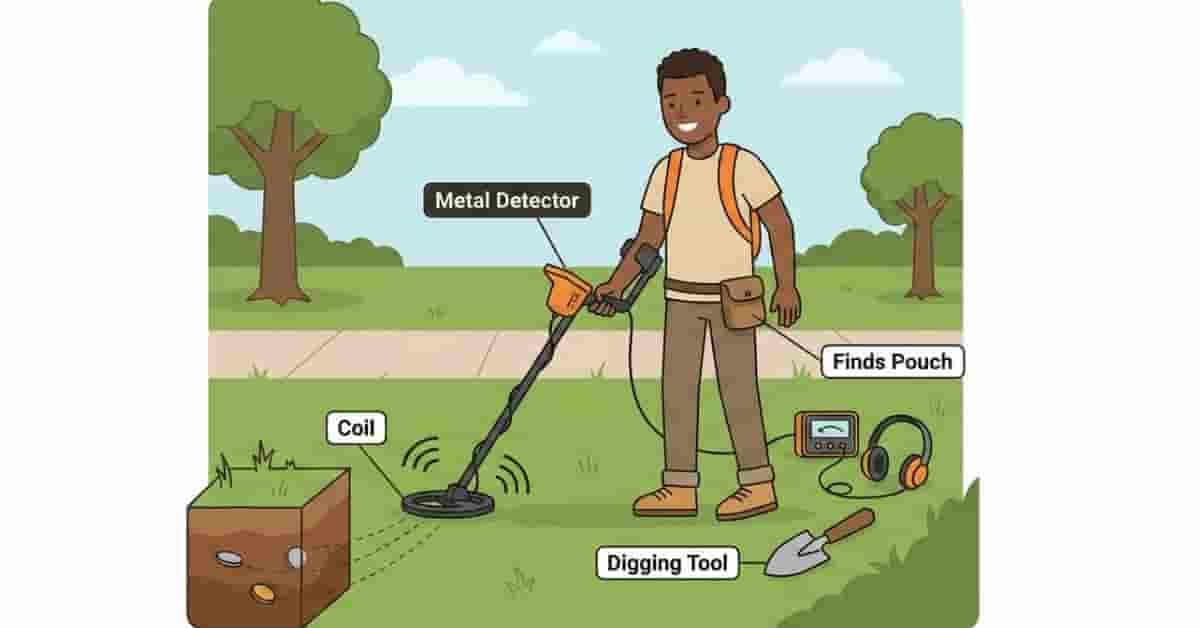
Coin and jewelry hunting remains one of the most practical uses for metal detectors. Common targets include coins, rings, bracelets, and other small metal items.
Parks, yards, old gathering areas, and public beaches can contain lost items. However, local laws and permission rules vary. Always check regulations before detecting on public or private land.
A detector’s target identification can help distinguish likely coins from unwanted metal. Still, target IDs aren’t perfect. Deep or oddly positioned objects can produce less reliable readings.
Pro Tip: Start with moderate sensitivity and learn how your detector responds to common coins. Good technique often matters more than maximum sensitivity.
Beach Detecting
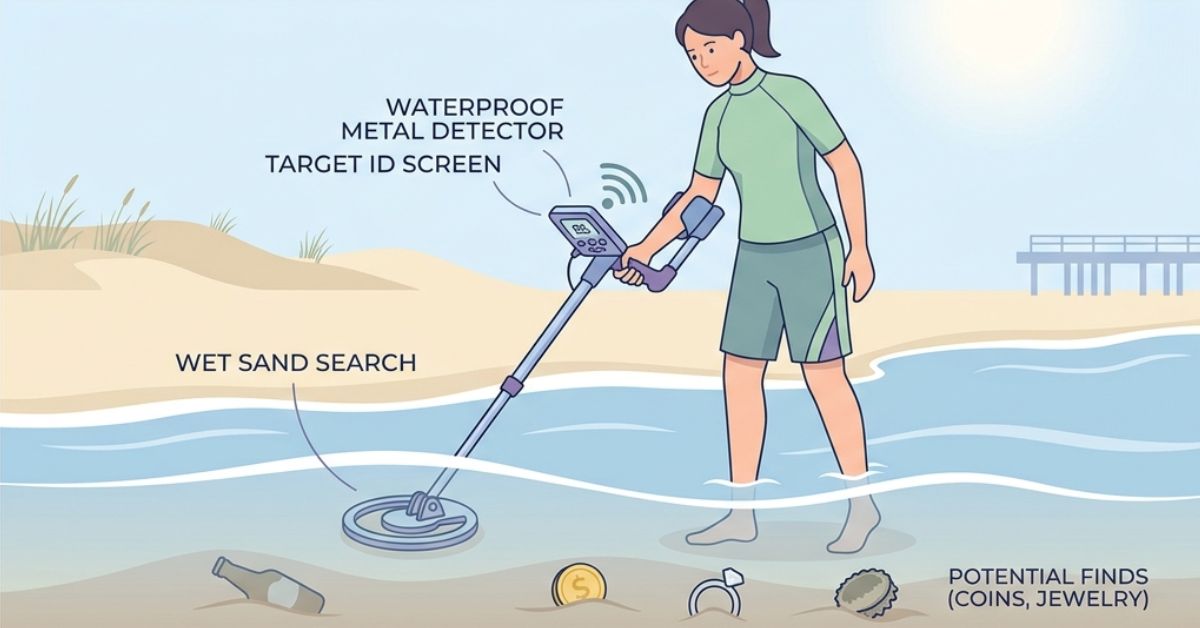
Beaches can be productive because people frequently lose coins and jewelry near swimming and recreation areas. Dry sand is often easy to detect when it contains little mineralization.
Wet sand can present a bigger challenge for some detectors. Saltwater and conductive wet sand may cause unstable signals on certain detector types.
Choosing a detector designed for beach conditions can make a major difference. Proper settings also help reduce false signals and improve stability.
Always check local beach regulations before detecting. Some beaches restrict metal detecting or require permission.
Pro Tip: Learn your detector’s beach settings before searching wet sand. Don’t assume the settings that work on dry sand will work equally well.
Relic Hunting
Relic hunting involves searching for historical objects such as old tools, buttons, buckles, and other metal artifacts. Old homesites, fields, and historic areas can produce interesting finds.
Relic hunting requires more patience than simply searching for modern coins. Older sites may contain heavy iron contamination and many unwanted targets.
Detectorists should also respect property rights and heritage laws. Some historic locations prohibit detecting or protect archaeological resources.
A detector with good target separation can help identify desirable signals among nearby metal objects. However, no detector can guarantee that every target will be identified correctly.
Gold Prospecting With the Right Detector
Gold prospecting can work well with a detector designed specifically for natural gold. Small gold nuggets can produce weak signals, especially when buried in difficult ground.
Specialized gold detectors often use technologies and settings suited to mineralized soils. A standard coin detector may not perform as well in these conditions.
Location also matters enormously. Detecting in an area without naturally occurring gold can produce no results, regardless of detector quality.
Realistic expectations are essential. Gold prospecting can involve long periods without a valuable find. Research, experience, proper equipment, and understanding local geology all improve your chances.
Why Some People Think Metal Detectors Don’t Work
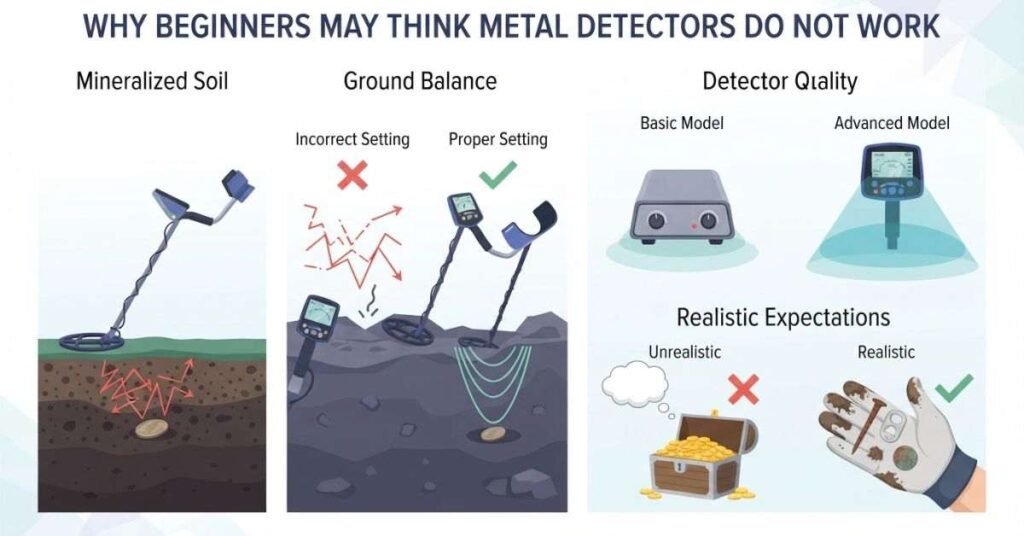
Metal detectors can work reliably, yet poor conditions can make their performance seem disappointing. Beginners may expect every buried object to produce a clear, strong signal.
Real-world detecting differs from controlled demonstrations. Soil minerals, electrical interference, target depth, orientation, and detector settings can all affect signals.
Understanding these limitations helps you judge detector performance fairly. It also makes troubleshooting much easier when your detector appears to miss targets.
Highly Mineralized Soil
Highly mineralized soil can interfere with a detector’s ability to identify buried targets. This problem commonly affects areas containing high concentrations of iron minerals or other conductive materials.
The detector may produce unstable signals or struggle to separate useful target responses from ground noise. Increasing sensitivity can sometimes make the problem worse.
Ground balance helps the detector account for changing soil conditions. However, ground balance cannot completely remove every challenge caused by difficult ground.
Some detectors handle mineralized conditions better than others. Specialized gold detectors are often designed with these environments in mind.
Poor Ground Balancing
Ground balancing helps a detector reduce the response caused by natural soil minerals. Incorrect ground balance can create false signals or reduce detecting stability.
Different locations can have different ground conditions. A setting that works well in one area may not work equally well somewhere else.
Many modern detectors offer automatic or manual ground-balancing options. Beginners should learn which method their detector uses and when adjustment may be necessary.
Poor ground balance doesn’t mean the detector has stopped working. It often means the detector needs settings adjusted for the ground beneath the coil.
Pro Tip: Recheck ground balance when soil conditions change significantly. Small adjustments can improve stability without sacrificing useful sensitivity.
Cheap or Low-Quality Devices
Low-cost detectors aren’t automatically useless. Some affordable models can find shallow coins and other common metal targets.
However, very basic devices may offer fewer controls, weaker target identification, or less effective ground handling. These limitations can become noticeable in challenging conditions.
A beginner should judge a detector by its intended use rather than its price alone. A simple detector may work well for casual coin hunting.
Problems arise when a basic device gets compared with advanced equipment designed for specialized detecting. Different detectors serve different purposes.
Pro Tip: Check independent testing and real-world reviews before buying. Focus on the features you actually need rather than flashy claims.
Unrealistic Expectations
Unrealistic expectations cause many beginners to believe their metal detector doesn’t work. Online videos can make detecting look easier and more predictable than it really is.
A detector may not find every buried object. Deep targets can produce weak signals, while nearby metal can complicate detection.
Target size also matters. A large metal object generally produces a stronger response than a tiny object at the same depth, but conditions still vary.
Experienced detectorists improve their results through practice. They learn their detector’s sounds, target responses, settings, and limitations.
Real-World Performance vs Marketing Claims
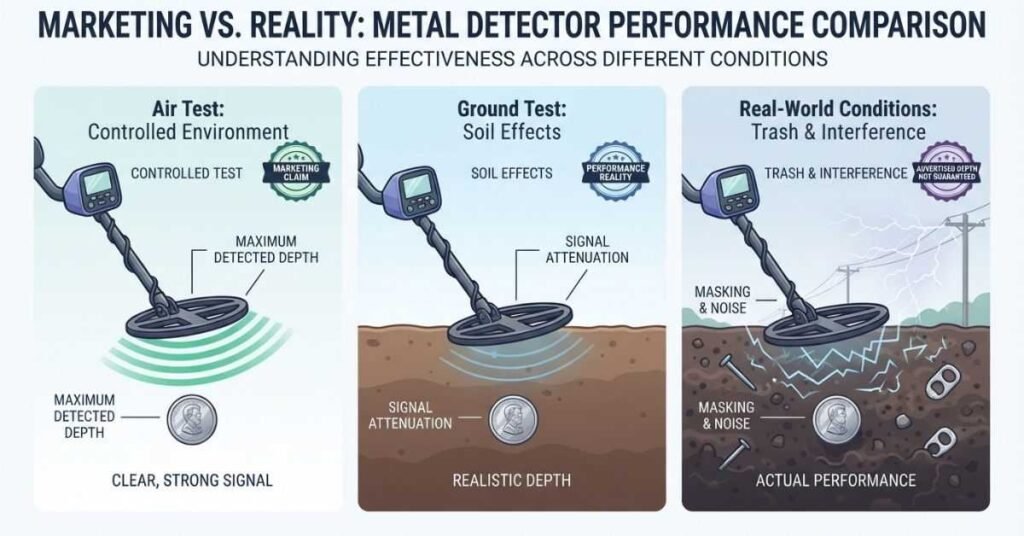
Metal detectors can perform well, but real-world results rarely match ideal testing conditions. Marketing demonstrations often use clean targets, controlled environments, and carefully chosen settings.
For beginners, the key is understanding why advertised performance can differ from what happens outdoors. Your detector may still work correctly even when its results seem less impressive.
Air Tests vs Ground Tests
An air test checks how a detector responds to a metal target without soil between the coil and target. It’s useful for confirming basic operation and comparing signals.
However, air tests don’t fully represent actual detecting conditions. Soil can weaken or distort signals, especially when it contains significant mineralization.
For example, a detector may produce a clear signal from a coin during an air test. The same coin can produce a weaker response when buried in difficult soil.
Air tests are best treated as a basic equipment check. They shouldn’t be used as a guarantee of maximum in-ground detection depth.
Lab Depth vs Soil Depth
Controlled tests can provide useful information about detector capabilities. However, actual detection depth varies considerably between locations.
Soil composition, moisture, mineralization, target orientation, and surrounding metal can all influence results. A clean test environment removes many of these variables.
For example, a small coin placed flat in clean soil may produce a stronger signal. The same coin positioned at an angle may respond differently.
This is why advertised depth should be viewed as a reference rather than a guaranteed result.
Influence of Trash & Interference
Metal trash can make detecting much harder. Nails, bottle caps, foil, and other objects may surround desirable targets.
Electrical interference can also create unstable signals. Nearby power lines, electronic equipment, or another detector may affect performance.
A detector with good target separation can help in heavily contaminated areas. Lowering sensitivity may also improve stability when interference becomes severe.
8 Factors That Impact Metal Detector Performance
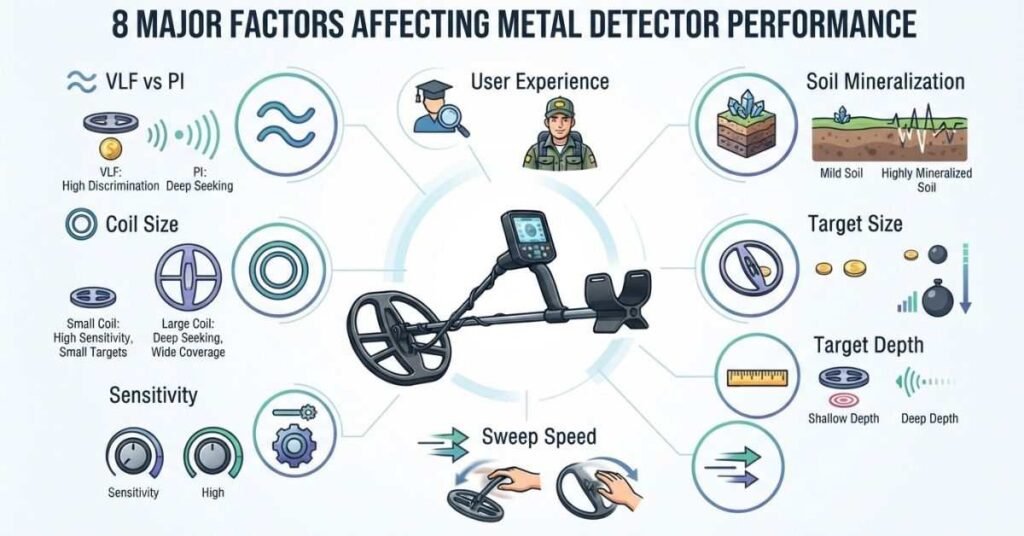
How well do metal detectors work? The answer depends on several factors working together. Even an advanced detector can struggle when conditions are difficult.
Understanding these factors helps beginners choose better settings and develop realistic expectations.
1. Detector Type: VLF vs PI
VLF and PI detectors use different technologies and suit different detecting situations.
VLF detectors are popular for coin, jewelry, and general-purpose detecting. They can provide useful target identification and discrimination features.
PI detectors can perform well in highly mineralized ground. They’re also commonly used for certain beach and gold prospecting applications.
Neither technology is automatically better for every situation. The right choice depends on your location and target type.
2. Coil Size
The search coil affects coverage, sensitivity, and target separation.
Larger coils can cover more ground during each sweep. Smaller coils can provide better control around trash and tight spaces.
A larger coil isn’t always the best choice. Difficult ground or heavy target contamination may favor a smaller coil.
3. Sensitivity Settings
Sensitivity controls how strongly the detector responds to targets and surrounding conditions.
Higher sensitivity can improve responses to some targets. However, excessive sensitivity can increase false signals and instability.
The best setting is usually the highest stable level for your specific ground conditions.
4. Soil Mineralization
Natural minerals in soil can interfere with detector signals. Highly mineralized ground can make target detection and identification more challenging.
Proper ground balancing and suitable detector technology can help manage these conditions.
5. Target Size
Target size strongly influences signal strength. Larger objects generally produce stronger responses than very small objects under similar conditions.
However, target shape and composition also matter. A tiny gold nugget can behave very differently from a larger coin.
6. Target Depth
Greater depth usually means a weaker target response. Soil conditions and target characteristics also influence how deep a detector can detect an object.
Don’t assume one advertised depth applies to every target. Real-world detection depth varies considerably.
7. User Experience
Experience can significantly improve detecting results. Skilled users learn subtle audio changes and understand when a signal deserves further investigation.
Beginners often ignore weak or unusual responses. With practice, those same signals become easier to recognize.
Pro Tip: Spend time learning your detector’s sounds before constantly changing settings. Familiarity can improve your decisions in the field.
8. Sweep Speed
Sweep speed affects how a detector processes targets. Moving the coil too quickly can reduce the quality of target responses on some detectors.
A controlled, consistent sweep gives the detector more opportunity to process signals properly.
Always follow your detector’s recommended sweep speed when available.
Is Price Equal to Performance?
A more expensive metal detector can offer better performance, but price alone doesn’t guarantee better finds. Different detectors target different users, locations, and detecting goals.
For beginners, an entry-level detector can handle basic coin and jewelry hunting. It may offer fewer features, but those features may be enough for casual detecting.
Mid-range detectors usually provide more control and improved target handling. They may offer better target identification, ground handling, recovery speed, or search modes.
Professional detectors often add advanced technology for demanding conditions. These features can matter when detecting mineralized ground, beaches, goldfields, or trash-heavy locations.
However, performance gains usually become less noticeable as prices rise. Moving from a basic detector to a capable mid-range model can provide meaningful improvements. Moving from mid-range to premium equipment may provide more specialized benefits.
The best detector depends on your needs, not simply your budget. A premium detector won’t compensate for poor technique, unsuitable locations, or unrealistic expectations.
Real Finds That Prove Metal Detectors Work
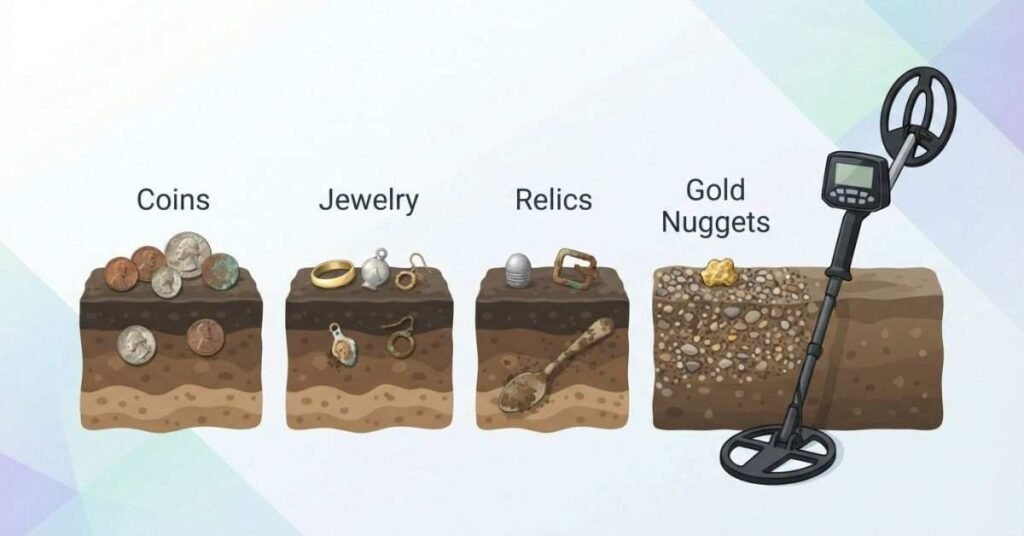
Real-world finds provide simple evidence that metal detectors can locate buried and lost metal objects. You don’t need dramatic treasure stories to understand their value.
Coins are among the most common targets. Detectorists regularly search parks, fields, yards, and other permitted locations for lost coins.
Jewelry is another realistic target. Rings, bracelets, earrings, and other items can become buried or hidden beneath soil and sand over time.
Relic hunters may recover old buttons, buckles, tools, and other historical metal objects. These finds can reveal interesting details about past activity in an area.
Gold nuggets provide another example, although gold prospecting requires suitable locations and specialized equipment. Finding natural gold can be challenging, and many detecting trips may produce nothing valuable.
The important point is simple: metal detectors don’t need to find spectacular treasure to prove their usefulness. Finding ordinary lost or buried metal objects demonstrates their practical purpose.
Always research local laws and obtain permission before detecting. Some areas restrict metal detecting or protect historical resources.
How to Test If Your Metal Detector Is Working
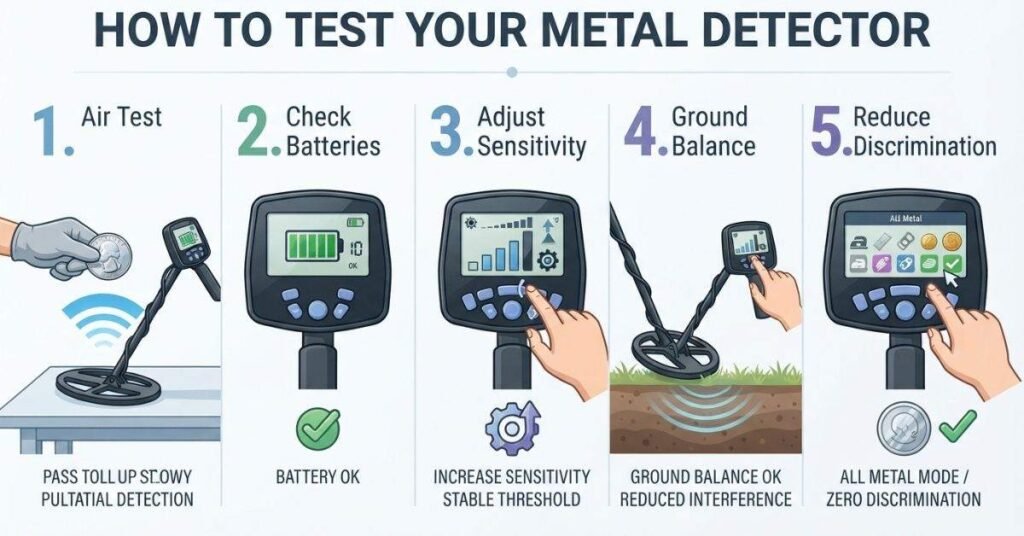
Before assuming your detector has a problem, perform a few simple checks. Most basic issues involve power, settings, or incorrect ground adjustment.
Perform an Air Test
An air test can confirm that your detector responds to metal targets. Turn the detector on and pass a known metal object across the coil.
Keep the target several inches away from the coil. Listen for a clear response and check whether the display reacts as expected.
Don’t treat the air-test distance as your detector’s actual ground depth.
Check the Batteries
Weak batteries can cause unstable performance or prevent proper operation. Make sure the batteries are charged or replaced according to the manufacturer’s instructions.
If your detector uses rechargeable power, confirm that it has charged correctly.
Adjust Sensitivity
Start with a moderate sensitivity level. Increase it gradually while listening for stability.
If the detector becomes noisy without a target nearby, reduce sensitivity slightly. Maximum sensitivity isn’t always the best setting.
Ground Balance Properly
Ground balance helps your detector account for natural soil mineralization. Follow the manufacturer’s instructions for automatic or manual ground balancing.
Recheck the setting when soil conditions change.
Reduce Discrimination
Excessive discrimination can cause you to ignore targets you might actually want to investigate. Start with moderate discrimination and learn how different targets sound.
When troubleshooting, reducing discrimination can help determine whether your settings are filtering useful signals.
Conclusion
Final Verdict – Do Metal Detectors Work?
Yes, metal detectors work. They can locate coins, jewelry, relics, and gold when conditions and equipment are suitable. Their performance depends on several factors, including detector quality, target size, soil conditions, settings, and depth.
A more expensive detector can offer useful advantages, but price doesn’t guarantee better results. Even advanced equipment can struggle in mineralized soil or areas with heavy metal trash.
Skill also matters. Learning proper sweep speed, sensitivity, ground balance, and target signals can improve your results. With practice, you’ll better understand which signals deserve investigation.
The most important factor is having realistic expectations. A metal detector isn’t a treasure guarantee. It’s a tool that works best when you match the detector, location, settings, and target.
So, do metal detectors work? Absolutely. Choose equipment that fits your goals, learn how to use it, and give yourself time to build experience.
Frequently Asked Questions
Yes, metal detectors can detect metal objects buried underground. They create an electromagnetic field and respond when conductive metal disturbs that field. However, detection depth varies with target size, soil mineralization, detector type, coil size, settings, and target orientation. A detector’s advertised depth doesn’t guarantee the same result in real soil.
Metal detectors can work well for gold when you use equipment designed for natural gold. Specialized gold detectors can handle mineralized ground better and detect small nuggets. Standard coin detectors may struggle in the same conditions. Your location also matters because detecting in an area without natural gold won’t produce results.
Your detector may be working correctly even when you aren’t finding targets. Check your sensitivity, ground balance, discrimination, sweep speed, and coil position. The location also matters because some areas simply contain fewer targets. Try a known metal object during an air test to confirm that the detector responds properly.
Yes, some affordable metal detectors work well for basic detecting. They can locate shallow coins, jewelry, and other common metal objects. However, cheaper models may have fewer features and less effective target identification or ground handling. Choose a detector based on your intended use rather than price alone.
No, metal detectors cannot detect every object equally well. Detection depends on the object’s metal content, size, shape, depth, and surrounding conditions. Very small or deeply buried targets can be difficult to detect. Soil mineralization and nearby metal trash can also affect the signal.
Metal detectors can work in many soil types, but some conditions make detecting more difficult. Highly mineralized soil can create ground noise and interfere with target signals. Proper ground balancing can reduce some of these effects. Detectors designed for challenging ground may perform better in heavily mineralized areas.
Not necessarily. More expensive detectors often provide better features, target separation, ground handling, or specialized performance. However, price doesn’t guarantee greater depth in every situation. Soil conditions, target size, coil choice, settings, and detector technology all influence actual detection depth.
There is no single detection depth that applies to every metal detector. Depth depends on the detector, coil, target size, target orientation, soil conditions, and settings. Air-test results can also differ from real ground performance. Treat advertised depth as a reference rather than a guaranteed in-ground result.
Start by checking the batteries and making sure the coil and connections are secure. Perform an air test with a known metal object to confirm the detector responds. Then check sensitivity, ground balance, and discrimination settings. If the detector responds normally during testing, the problem may be your location or settings.
No. Higher sensitivity can sometimes improve responses to weak targets, but excessive sensitivity can create false signals and instability. The best setting is usually the highest level that remains stable in your current environment. Soil mineralization, electrical interference, and nearby metal can all affect the ideal sensitivity level.
Both VLF and PI detectors can be useful for gold, but they have different strengths. Specialized VLF detectors can provide good sensitivity to small gold and useful target information. PI detectors can perform well in highly mineralized ground. The best choice depends on the type of gold, soil conditions, and detecting location.
Yes. Beginners can find coins, jewelry, relics, and other targets with a suitable detector. Good results depend on learning the equipment, choosing legal and productive locations, and using sensible settings. Practice also helps you recognize target sounds and understand how your detector behaves in different ground conditions.
False signals can result from high sensitivity, mineralized soil, electrical interference, poor ground balance, or nearby metal objects. Start by lowering sensitivity slightly and checking your ground balance. Make sure the coil cable and connections are secure. If the problem continues, test the detector away from possible sources of interference.
Metal detectors can work very well on beaches, especially in suitable dry sand. Wet sand and saltwater can create additional challenges because they are electrically conductive. Some detectors handle these conditions better than others. Always check local regulations before detecting on beaches, as certain areas may restrict the activity.
Metal detecting can be rewarding if you approach it with realistic expectations. You may find coins, jewelry, relics, or other interesting objects, but valuable finds aren’t guaranteed. A suitable beginner detector, proper technique, legal detecting locations, and regular practice give you a better chance of enjoying the hobby and improving your results.

Ethan Callaway is a passionate metal detecting enthusiast based in Savannah, Georgia, USA. Currently pursuing a B.S. in Archaeology & Historical Preservation at the University of Georgia, he combines his love for treasure hunting with research-backed insights on metal detecting techniques, safety practices, and site guidance.
Through MetalDetectingUSA.com, Ethan shares practical tips, honest product reviews, and beginner-friendly advice to help both new and experienced detectorists explore metal detecting across the United States with more confidence and understanding.