
Table of Contents
Introduction
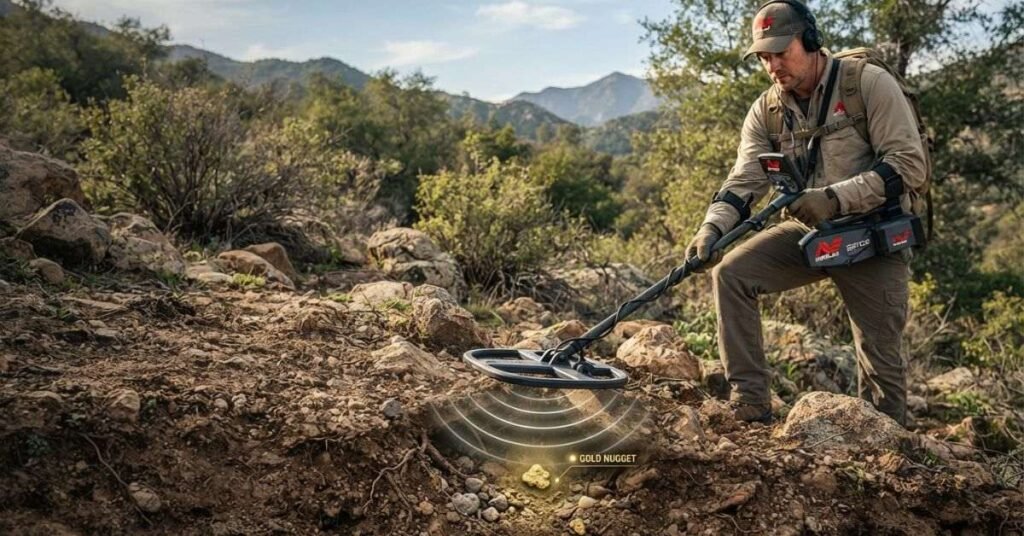
Could that old metal detector really find a gold nugget buried beneath the ground?
If you’re new to metal detecting in the USA, you may wonder whether your detector can actually find gold. The answer is yes, but gold can be much harder to detect than coins or larger metal targets.
The question “do metal detectors work on gold” depends on several factors. Gold size, detector frequency, soil conditions, and search settings all affect your results. Small gold nuggets can produce weak signals that beginners may easily miss.
This guide explains how gold metal detectors work and why some detectors perform better than others. You’ll learn about VLF and pulse induction technology, detection depth, ground balancing, and common mistakes.
You’ll also discover what conditions are best for gold hunting. By the end, you’ll know what to look for in a gold detector and how to improve your chances of finding real gold.
Why Is Gold More Difficult to Detect Than Other Metals?
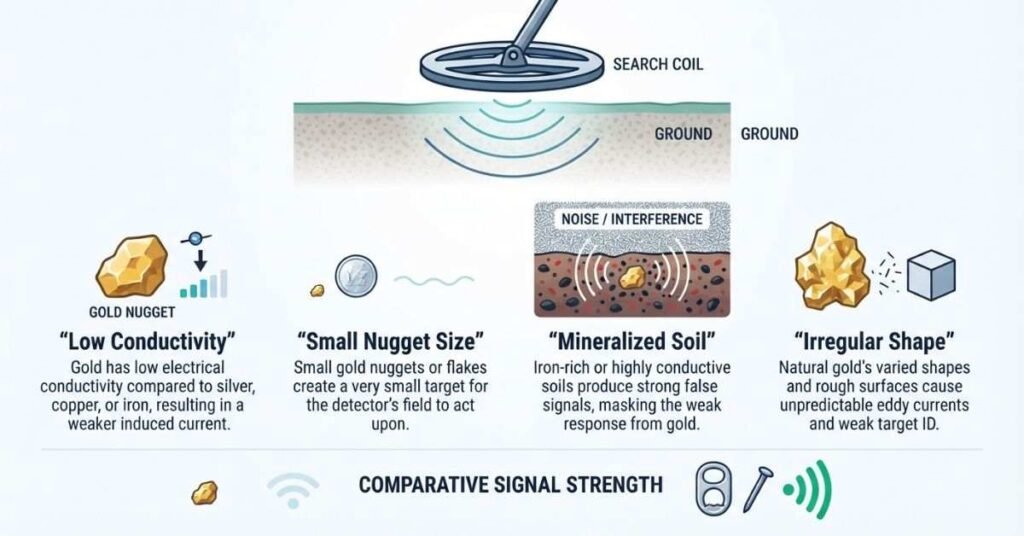
Gold can be surprisingly difficult to detect, especially when you’re searching for small natural nuggets. Gold has different electrical properties than many common targets, and its small size makes the signal weaker. Natural gold also appears in challenging environments, where mineralized soil can create strong interference. These factors can make gold hunting frustrating for beginners.
Gold’s Low Conductivity
Gold conducts electricity, but small natural gold targets can still produce weak detector responses. The detector needs enough electromagnetic interaction with the target to create a usable signal.
This becomes especially challenging with tiny gold pieces. A small nugget contains very little metal, so its response may sound faint or inconsistent. Detector frequency also affects how well the machine responds to different target sizes.
Higher-frequency detectors often provide better sensitivity to small gold targets. However, frequency alone does not guarantee detection. Detector design, coil size, sensitivity, soil conditions, and settings all influence performance.
For beginners, the key lesson is simple: a detector that finds coins well may not perform equally well on tiny gold.
Small Nugget Size
Natural gold can occur as tiny flakes, small nuggets, thin pieces, or larger masses. Smaller targets generally produce weaker signals than larger targets at the same depth.
A tiny gold nugget may also fall within the detector’s noise level. This makes it harder to separate the target response from background interference.
Search coil choice matters too. Smaller coils can improve sensitivity and target separation in difficult ground. They can also make pinpointing small targets easier.
When searching for gold, beginners should avoid assuming every weak signal is junk. A subtle, repeatable response can deserve investigation, especially in a known gold-bearing area.
Gold Often Occurs in Mineralized Soil
Many gold-bearing areas contain highly mineralized ground. Soil can contain iron-rich minerals that produce their own strong detector responses.
This ground response can mask weak signals from small gold. It can also cause false signals, unstable operation, or reduced sensitivity when the detector uses unsuitable settings.
Ground balancing helps the detector compensate for changing soil conditions. Proper adjustment can make the machine more stable and improve the operator’s ability to hear subtle targets.
For beginners, learning ground balancing is often just as important as choosing the right detector. A capable machine can still struggle when the ground settings are wrong.
Gold’s Shape and Irregular Surface
Natural gold rarely has a perfect shape. Nuggets can have rough surfaces, flattened edges, or unusual forms created by natural processes.
Their shape and orientation can affect how the detector responds. A gold nugget may produce a different signal when lying flat compared with standing at another angle.
This means beginners should not expect every gold target to sound identical. Signal behavior can change with target size, depth, orientation, and surrounding soil.
Pro Tips
Don’t judge a detector by coin performance alone. Gold prospecting requires sensitivity to small targets and good performance in mineralized ground.
How Do Gold Metal Detectors Work?
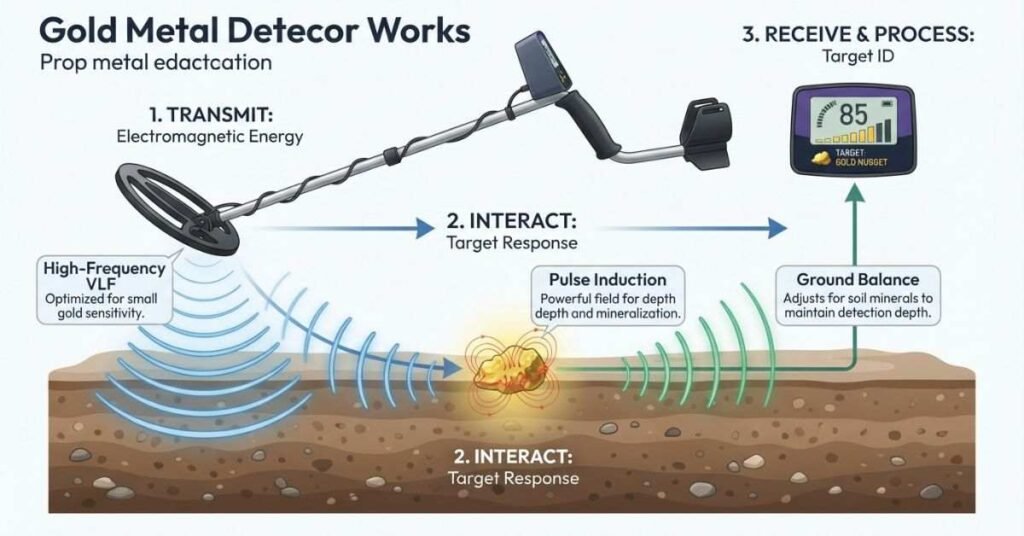
Gold metal detectors use electromagnetic fields to locate conductive metal targets beneath the ground. The detector’s search coil transmits electromagnetic energy into the soil and responds when that energy interacts with a metal target.
The detector then processes the returning response and produces an audio or visual signal. The strength and character of that signal depend on several factors.
Target size, depth, orientation, soil mineralization, coil design, and operating frequency can all affect detection. That’s why learning how do gold metal detectors work requires more than understanding the basic electronics.
Gold detectors commonly use very-low-frequency technology, pulse induction technology, or other advanced systems. Each approach has different strengths for natural gold.
High-Frequency Technology
Higher operating frequencies can improve a detector’s sensitivity to small, low-conductivity gold targets. This makes high-frequency VLF detectors popular for detecting small nuggets and fine gold in suitable ground.
However, higher frequency does not automatically mean greater depth. Detector performance depends on the target, coil, soil, settings, and overall detector design.
For beginners, high-frequency VLF technology can be particularly useful when small gold is the main target.
Pulse Induction Technology
Pulse induction, or PI, detectors work differently from conventional VLF machines. They transmit short pulses into the ground and measure the resulting response.
PI technology can perform well in heavily mineralized soil. This makes it valuable for gold prospecting in challenging ground where mineralization can overwhelm some VLF detectors.
PI detectors can also provide strong performance on larger or deeper gold targets. However, they may offer less target identification than many VLF machines.
Ground Balancing Systems
Ground balance helps a detector reduce the response caused by natural soil minerals. This becomes especially important in goldfields with highly mineralized ground.
Some detectors offer manual ground balance, while others provide automatic or tracking systems. The best choice depends on the detector and conditions.
A properly balanced detector can run more smoothly and make subtle target signals easier to recognize. Beginners should learn this control before increasing sensitivity aggressively.
Which Technology Works Best for Gold?
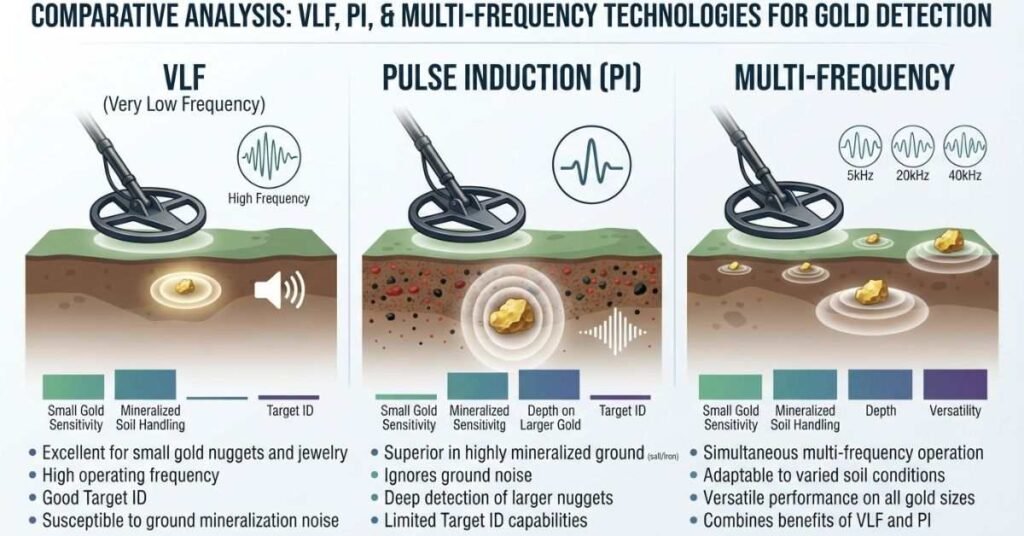
There isn’t one best metal detector technology for every gold-hunting situation. The right choice depends on gold size, target depth, soil mineralization, and your hunting location.
VLF and PI detectors each have important advantages. VLF detectors often suit small gold, while PI detectors can perform better in heavily mineralized ground.
VLF Detectors for Small Gold
Very-low-frequency (VLF) detectors are popular among gold prospectors because they can provide excellent sensitivity to small targets. Higher operating frequencies often improve a VLF detector’s response to tiny gold nuggets.
VLF machines also commonly provide useful target information through audio responses or visual identification. This can help beginners investigate promising signals and understand different targets.
However, mineralized soil can challenge VLF detectors. Highly mineralized ground may create strong responses that compete with weak gold signals.
A good ground-balance system can help reduce this interference. Smaller search coils can also help when searching for tiny targets among rocks and other metal objects.
For beginners targeting small nuggets in manageable ground, a high-frequency VLF detector can be a practical starting point.
Pulse Induction (PI) for Deep Gold
Pulse induction (PI) detectors use a different detection method from VLF machines. They can perform particularly well in mineralized ground, which makes them valuable for many goldfields.
PI technology is less affected by certain mineralization effects that can challenge VLF detectors. This allows prospectors to maintain useful detection performance in difficult soil.
PI detectors can also be effective when searching for larger gold targets at greater depths. However, depth still depends heavily on target size, soil conditions, coil design, and detector settings.
Many PI detectors provide less detailed target identification than some VLF models. Beginners may therefore need more digging and experience to interpret signals correctly.
Multi-Frequency Systems
Multi-frequency detectors operate across more than one frequency. This approach can provide flexibility when conditions or target types change.
Some modern detectors use simultaneous multi-frequency technology. These systems can offer useful performance across different types of targets and soil conditions.
However, multi-frequency does not automatically make a detector superior for every gold prospecting situation. Dedicated gold detectors may still offer advantages for specific conditions.
VLF vs. PI: Quick Comparison
| Feature | VLF | PI |
|---|---|---|
| Small gold sensitivity | Excellent on suitable models | Good, depending on model |
| Mineralized soil | Can be challenging | Generally stronger |
| Target identification | Often better | Usually more limited |
| Deep larger targets | Good in suitable ground | Often advantageous |
| Beginner learning curve | Usually easier | Can require more practice |
| Best use | Small gold and versatile detecting | Difficult ground and deeper targets |
Do Regular Metal Detectors Work on Gold?
Yes, regular metal detectors can detect gold, but their performance varies significantly. A detector designed mainly for coins may respond to larger gold objects, yet struggle with tiny natural nuggets.
The main issue isn’t whether the detector can recognize gold as a metal. The bigger challenge involves the target’s size, conductivity, depth, and surrounding soil.
Coin Detectors vs. Gold Prospecting Detectors
Many general-purpose detectors are designed for coins, jewelry, relics, and other common targets. They often prioritize target identification and versatility.
Gold prospecting detectors focus more heavily on sensitivity to small gold and performance in mineralized ground. They may offer higher frequencies, specialized search modes, stronger ground balancing, or PI technology.
A regular detector may still find gold jewelry or larger gold pieces. However, that doesn’t mean it will perform well on tiny natural nuggets.
If your main goal is finding gold nuggets, a purpose-built gold detector usually makes more sense.
Why Cheap Detectors Can Struggle
Low-cost detectors can have limited sensitivity, weaker ground-balance systems, or fewer adjustment options. These limitations become important when searching for small gold in mineralized soil.
Some inexpensive detectors may also produce unstable responses in difficult ground. Beginners can mistake this noise for valuable targets or ignore weak signals.
Price alone doesn’t determine performance. Detector design, coil technology, operating frequency, ground handling, and proper settings all matter.
How Does a Metal Detector Work for Gold?
A metal detector sends electromagnetic energy into the ground through its search coil. When that energy interacts with conductive metal, the detector measures a resulting response.
The machine converts that response into an audio signal, visual reading, or both. Gold can produce a detectable response when the target is large enough and conditions are suitable.
Where Do Metal Detectors Work Best for Gold?
The best places for gold detecting combine known gold potential with conditions your detector can handle. Location research matters because even the best detector cannot find gold where none exists.
Gold can occur in different environments across the United States. Desert regions, historic goldfields, exposed bedrock, dry washes, and some river environments can all offer opportunities.
Desert Regions
Desert areas can provide favorable detecting conditions because exposed ground may reveal geological features associated with gold deposits.
Dry washes and old drainage channels can concentrate heavy materials. However, local laws and land access rules vary, so always confirm permission before detecting.
Hot, dry environments can also create practical challenges. Carry enough water, protect your equipment, and plan your search around safe conditions.
Riverbeds and Dry Washes
Gold is much heavier than common sediment. Moving water can transport and concentrate heavier material in certain locations.
Crevices, natural traps, and areas behind obstacles can sometimes collect heavier materials. Detecting these areas requires careful research and knowledge of local geology.
Don’t assume every river contains detectable gold. Focus on locations with documented gold history and legal access.
Known Goldfields
Historic goldfields can provide some of the strongest opportunities for gold prospecting. Old mining areas, placer deposits, and documented gold-bearing regions can guide your research.
Research geological maps, historical mining records, and land ownership before detecting. Public access does not automatically mean metal detecting is permitted.
Highly Mineralized Soil Challenges
Goldfields often contain mineralized soil that can interfere with detector performance. Iron-rich minerals may create strong ground responses and make small gold harder to hear.
This is where proper ground balancing becomes critical. PI detectors may also offer advantages in particularly challenging mineralized conditions.
Gold Detection Depth Explained
How deep a metal detector can find gold depends on several factors. Gold size, detector technology, soil conditions, coil size, and settings all affect detection depth.
There is no guaranteed depth for every gold target. A tiny flake may only produce a detectable response close to the surface. Larger nuggets can produce stronger signals at greater depths.
As a rough guide, very small gold flakes may only be detectable within a few inches. Small nuggets may sometimes produce detectable signals around 4–8 inches in suitable conditions.
Larger nuggets can potentially be detected much deeper. Some PI systems may detect large gold targets at depths of 1–3 feet or more under favorable conditions. These figures should not be treated as guaranteed performance.
Target shape and orientation also matter. A nugget lying at an unfavorable angle may produce a weaker response than expected.
Soil mineralization can further reduce practical depth. Highly mineralized ground can interfere with weak gold signals, especially from small targets.
What Affects Gold Detection Depth?
Several factors determine how deep a detector can realistically detect gold:
- Gold size: Larger targets usually create stronger signals.
- Detector technology: VLF and PI systems behave differently.
- Operating frequency: Frequency affects sensitivity to different target sizes.
- Search coil: Coil size and design influence depth and sensitivity.
- Soil mineralization: Difficult ground can reduce usable detection depth.
- Ground balance: Correct settings can improve stability in mineralized soil.
- Target orientation: Nugget shape and position can change the signal.
- Detector settings: Sensitivity and discrimination affect performance.
The most important point is simple: larger gold can usually be detected deeper than tiny gold.
Takeaways
Don’t choose a detector based on a single advertised depth figure. Real-world gold detection depends on the complete combination of target, detector, coil, settings, and soil.
Common Mistakes in Gold Detecting
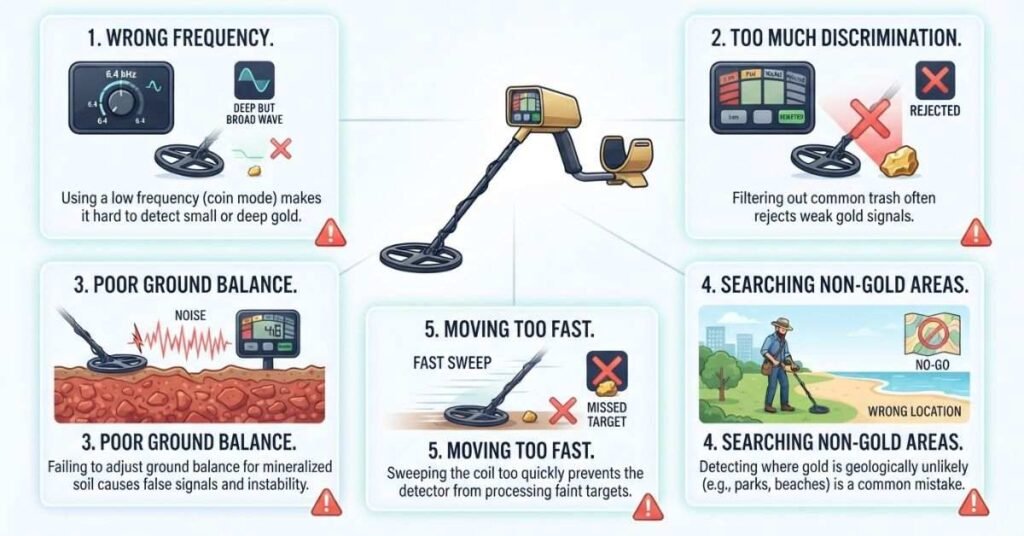
Finding gold requires more than owning a capable detector. Beginners often struggle because small changes in technique can hide weak signals.
The biggest mistake is expecting a detector to do all the work. Successful gold prospecting combines the right equipment, proper settings, location research, and patient searching.
Using the Wrong Frequency
Operating frequency affects how a detector responds to different target sizes. A detector designed mainly for larger targets may struggle with very small gold.
High-frequency VLF detectors can provide strong sensitivity to small nuggets. However, frequency should always match your target and ground conditions.
Using Too Much Discrimination
Discrimination can help reject unwanted metal targets, but excessive discrimination can create problems during gold prospecting.
Small gold can produce weak or unusual responses. Aggressive discrimination may cause you to ignore targets worth investigating.
For this reason, many gold prospectors use minimal discrimination and rely more heavily on audio responses.
Skipping Ground Balancing
Mineralized soil can create strong detector responses. Without proper ground balancing, the detector may become unstable or produce excessive ground noise.
Learn how your detector handles ground balance before searching difficult goldfields. A stable detector makes subtle target responses easier to recognize.
Searching in Non-Gold Areas
Even the best detector cannot find gold where gold isn’t present. Beginners sometimes spend hours detecting random locations without researching their area’s gold history.
Look for documented gold-bearing regions, geological information, and historical mining activity. Always verify land access before detecting.
Moving Too Fast
Gold nuggets can produce subtle signals, especially when they are small or deep. Sweeping too quickly can make weak responses easier to miss.
Slow, controlled sweeps give your detector more time to respond to potential targets.
7 Tips for Detecting Gold Successfully
Gold detecting becomes easier when you combine suitable equipment with consistent technique. These seven tips can help beginners improve their chances without relying on complicated settings.
1. Use a High-Frequency Detector
If small gold is your main target, consider a detector designed for high sensitivity to small nuggets.
Higher-frequency VLF detectors can be especially useful for small gold in suitable ground.
2. Reduce Discrimination
Use minimal discrimination when prospecting for natural gold. Small nuggets can produce weak or unusual responses.
Reducing discrimination gives you a better chance of hearing targets that might otherwise be rejected.
3. Ground Balance Properly
Ground balance helps your detector handle mineralized soil. Take time to adjust it before beginning your search.
If the ground changes, check your balance again. Stable operation makes weak signals easier to interpret.
4. Sweep Slowly
Keep your coil close to the ground while maintaining a controlled sweep speed. Avoid lifting the coil at the end of each pass.
Overlap your sweeps slightly to reduce the chance of missing small targets.
5. Research Gold Locations
Research before you detect. Look for areas with documented gold production, suitable geology, and legal detecting access.
Historical information can help you focus your time on locations with genuine potential.
6. Use Headphones
Headphones can make faint audio responses easier to hear. This becomes particularly useful when searching for small gold with subtle signals.
Choose comfortable headphones that work correctly with your detector.
7. Dig Repeatable Signals
A weak signal deserves attention when it repeats from different sweep directions. Small gold can produce subtle responses that don’t sound impressive at first.
Check promising signals from multiple angles before deciding they are trash.
Conclusion
Yes, metal detectors do work on gold, but results depend on the target, detector, soil, and settings. Small gold can be challenging because it produces weaker signals and often occurs in mineralized ground.
A high-frequency VLF detector can be a strong choice for detecting small gold. Pulse induction detectors can offer advantages when searching deeper targets or heavily mineralized soil. However, technology alone won’t guarantee success.
Proper ground balancing, low discrimination, slow sweeping, and good location research can make a major difference. With practice, beginners can learn to recognize the subtle signals that gold can produce.
If you’re ready to start gold detecting, choose equipment that matches your targets and local conditions. Share your gold-detecting experience or explore more metal detecting guides for practical tips.
Frequently Asked Questions
Yes, metal detectors can detect real gold. However, detection depends on the gold’s size, depth, shape, and surrounding soil. Larger gold objects usually create stronger signals than tiny nuggets. A detector designed for gold prospecting can improve results, especially in mineralized ground. High-frequency VLF detectors often suit small gold, while PI detectors can perform well in difficult soil.
Some highly sensitive gold detectors can detect very small gold pieces, but tiny flakes are difficult targets. Their small size creates a weak signal that may disappear into ground noise. Detection also depends on the flake’s size, depth, orientation, soil conditions, and detector settings. Don’t expect every standard metal detector to reliably detect fine gold flakes.
Several factors can prevent your detector from finding gold. You may be using the wrong frequency, excessive discrimination, poor ground balance, or unsuitable sensitivity settings. The gold may also be too small or too deep for your detector. Location matters too. Even an excellent detector won’t find gold in an area without suitable gold-bearing geology.
You don’t always need a specialized detector to find gold. Regular metal detectors can detect larger gold objects, including some gold jewelry. However, dedicated gold detectors are designed to handle small nuggets and mineralized soil more effectively. If natural gold is your primary target, a gold-prospecting detector can provide useful advantages over a basic coin detector.
Higher frequencies generally provide better sensitivity to small gold targets. This makes high-frequency VLF detectors popular for small nugget hunting. However, frequency isn’t the only factor that matters. Soil mineralization, coil design, detector technology, sensitivity, and ground balance also affect performance. The best frequency depends on your target size and local ground conditions.
A cheap metal detector may detect larger gold targets, but it can struggle with tiny natural nuggets. Budget models often provide fewer controls for handling mineralized soil and weak signals. Price alone doesn’t determine performance, but detector design matters greatly. If you’re serious about finding natural gold, choose a model designed for gold prospecting rather than relying on price alone.
Yes, VLF metal detectors can find gold, particularly small nuggets. High-frequency VLF models can provide strong sensitivity to small gold targets. However, highly mineralized soil can make VLF detecting more challenging. Proper ground balancing and suitable settings become especially important in goldfields.
PI detectors aren’t automatically better for every gold-hunting situation. They can perform particularly well in heavily mineralized soil and may offer advantages for larger or deeper targets. VLF detectors can be more useful when small gold sensitivity and target information are priorities. Your target size and ground conditions should guide the choice.
Gold detection depth varies greatly with target size, detector technology, soil conditions, coil design, and settings. Tiny flakes may only be detectable close to the surface. Small nuggets can sometimes produce signals around several inches deep. Larger nuggets may be detectable much deeper, especially with suitable PI detectors. Advertised depth should never be treated as guaranteed.
Yes, proper ground balancing can make gold detecting more effective in mineralized soil. Natural minerals can create strong signals that interfere with weak gold responses. Ground balance helps the detector compensate for this soil response. Learning to adjust ground balance correctly can improve stability and make subtle targets easier to investigate.
Yes, many general-purpose metal detectors can detect gold jewelry. Rings, chains, bracelets, and other larger gold objects can produce detectable signals. However, thin chains and very small jewelry pieces can be more difficult to detect. Detector frequency, target size, orientation, depth, and soil conditions all influence the response.
No, finding gold with a metal detector requires patience, research, and practice. Small nuggets can produce weak signals, while mineralized soil can create additional interference. Beginners should research gold-bearing areas, use appropriate settings, ground balance carefully, and sweep slowly. The right detector helps, but good technique and location research remain essential.

Ethan Callaway is a passionate metal detecting enthusiast based in Savannah, Georgia, USA. Currently pursuing a B.S. in Archaeology & Historical Preservation at the University of Georgia, he combines his love for treasure hunting with research-backed insights on metal detecting techniques, safety practices, and site guidance.
Through MetalDetectingUSA.com, Ethan shares practical tips, honest product reviews, and beginner-friendly advice to help both new and experienced detectorists explore metal detecting across the United States with more confidence and understanding.