

Introduction
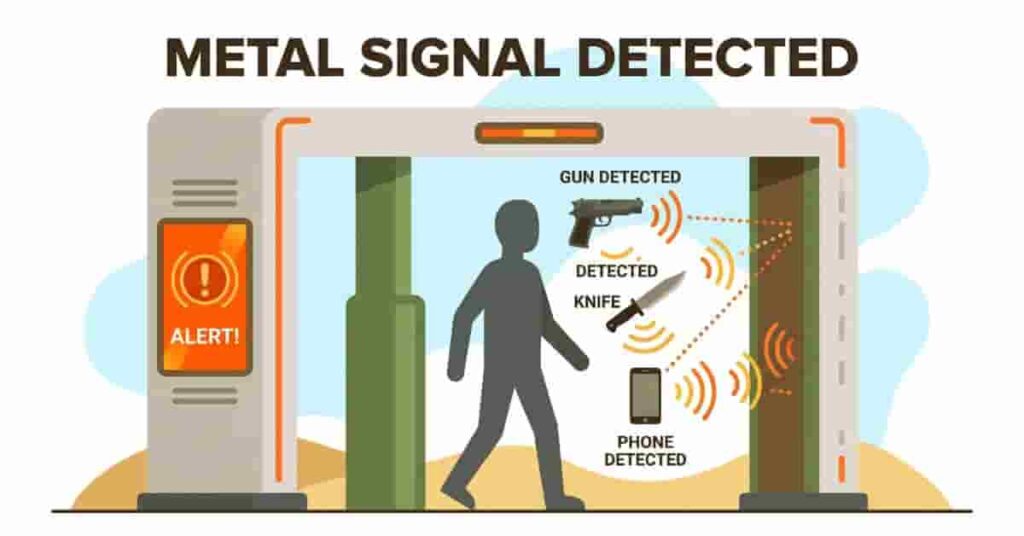
Can a gun go undetected by a metal detector?
Many people ask this after seeing viral videos, movies, or online myths. If you travel often or go through security, you may also wonder why your phone sometimes passes quietly. These questions cause confusion about how metal detectors miss guns, knives, or phones—and whether security systems really work for people like you.
Most online claims ignore physics and how detection works. Security scanners, handheld wands, and hobby detectors differ. Sensitivity, calibration, and metal content all affect detection.
For those new to security in the United States—especially travelers and event-goers—this topic matters more than you might think. Metal detectors are used daily in airports, courthouses, stadiums, and public events. Knowing how they work helps you separate science from rumors online.
This guide explains the truth in simple terms for people who want to better understand security technology. You’ll learn how metal detectors detect objects, why phones sometimes stay silent, and why “undetectable weapons” are mostly a myth. No hype. No conspiracy theories. Just clear, fact-based explanations for readers like you.
To understand this properly, it helps to first know about metals that metal detectors cannot detect and why some materials produce weak signals.
How Security Metal Detectors Actually Work
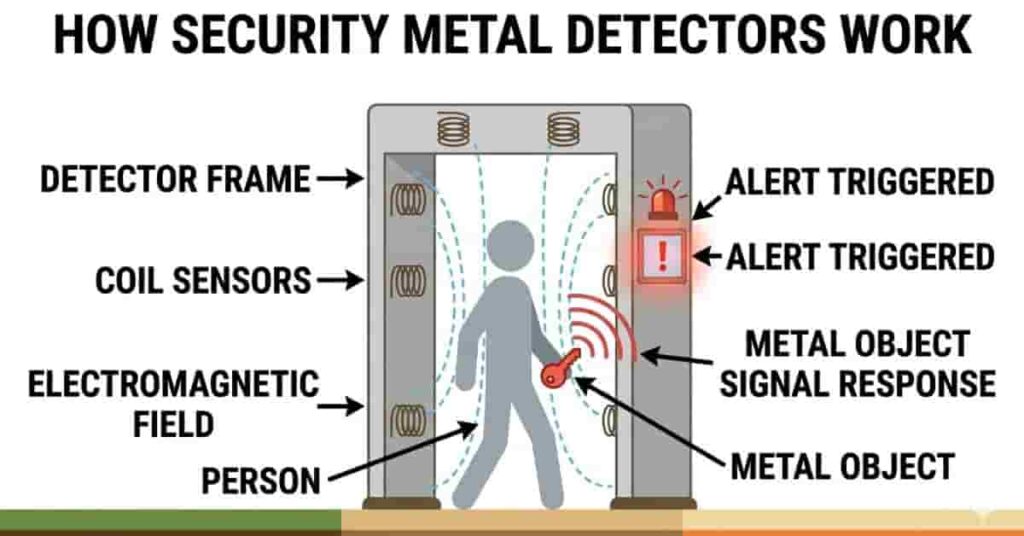
Security metal detectors use electromagnetic fields to find metal objects. When metal enters that field, it changes the signal. The detector senses that change and triggers an alert.
Most modern systems work through electromagnetic induction. A coil inside the detector sends a low-frequency magnetic field around the scanning area. When metal passes through that field, it generates its own small electrical current. This current slightly disturbs the original field. The detector measures the disturbance and identifies the presence of metal. Larger or more conductive metal objects create stronger signals.
That’s why a large object like a firearm usually triggers an alarm quickly. Smaller items such as coins or phones may produce weaker signals. Detector sensitivity and calibration also affect how easily objects trigger alerts.
Security systems use this principle in many environments, including:
- Airports and courthouses
- Event entrances and stadiums
- Schools and government buildings
Each detector adjusts its sensitivity depending on the location and threat level.
Key Takeaways
- Metal detectors use electromagnetic fields to detect metal objects.
- Metal disrupts the field, creating a measurable signal change.
- Larger metal objects produce stronger signals.
- Sensitivity settings control how easily alarms trigger.
Walk-Through Metal Detectors (Airports, Courthouses)
Walk-through metal detectors appear at airports, courthouses, and many government buildings. These systems create a vertical electromagnetic field between two panels. When a person walks through, the detector scans their entire body. Multiple coils inside the frame monitor different height zones. This allows the system to detect where metal appears on the body. For example, a belt buckle may trigger the lower zone, while a phone may trigger the waist area. Modern systems focus on identifying threat-level metal objects. Security staff adjust the sensitivity to ignore very small items while detecting larger metal objects.
For example, many airports use detectors configured to detect weapons or dense metal objects. Small items like coins may not always trigger an alarm, depending on the settings.
In the United States, many airport checkpoints follow standards set by the Transportation Security Administration. These standards help ensure that security scanners detect common metallic threat items. Walk-through detectors work quickly and can scan hundreds of people each hour. That speed makes them ideal for busy public security checkpoints.
Pro Tips
- Remove keys, phones, and large metal items before entering.
- Walk straight through without stopping or touching the frame.
- If an alarm triggers, security usually performs a secondary scan.
Handheld Wands
Handheld metal detector wands provide a second layer of screening. Security staff use them after a walk-through alarm triggers. These devices help pinpoint the exact location of metal on a person. A handheld wand contains a small detection coil that produces its own electromagnetic field. When the wand passes near metal, the signal changes. The device then vibrates or emits a beep to alert the operator.
Because the scanning area is small, handheld wands detect objects very precisely. Security staff slowly move the wand around the body to locate the metal source.
These detectors are common at:
- Airport secondary screenings
- Concert and stadium security
- Courthouses and government buildings
- Event entrances
Handheld wands also allow security teams to inspect bags or objects more closely. The close scanning distance increases detection accuracy.
Pro Tips
- Stand still during a wand scan to avoid repeated alerts.
- Remove obvious metal items beforehand to speed up screening.
- Keep arms slightly raised so staff can scan efficiently.
Industrial & Hobby Detectors (Difference Explained)
Not all metal detectors operate in the same way. Security detectors differ from industrial and hobby detectors used by professionals or treasure hunters. Security detectors are designed specifically to detect metal objects carried by people. They prioritize quick screening for potential weapons and generally use fixed sensitivity settings for consistency. Detectors are used to inspect products and materials in factories. For example, food processing plants use them to detect metal contamination.
Hobby metal detectors, often used in parks or on beaches, work differently. These devices search for buried metal underground. They usually include adjustable sensitivity and metal identification features. Hobby detectors also use larger coils designed to scan soil. Many models help users distinguish between iron, aluminum, and valuable metals.
Despite these differences, all detectors rely on the same basic principle: metal changes an electromagnetic field. The detector reads that change and alerts the user.
Pro Tips
- Security detectors prioritize speed and reliability.
- Industrial detectors focus on product safety.
- Hobby detectors allow deeper scanning and metal identification.
Can Metal Detectors Miss Concealed Firearms?
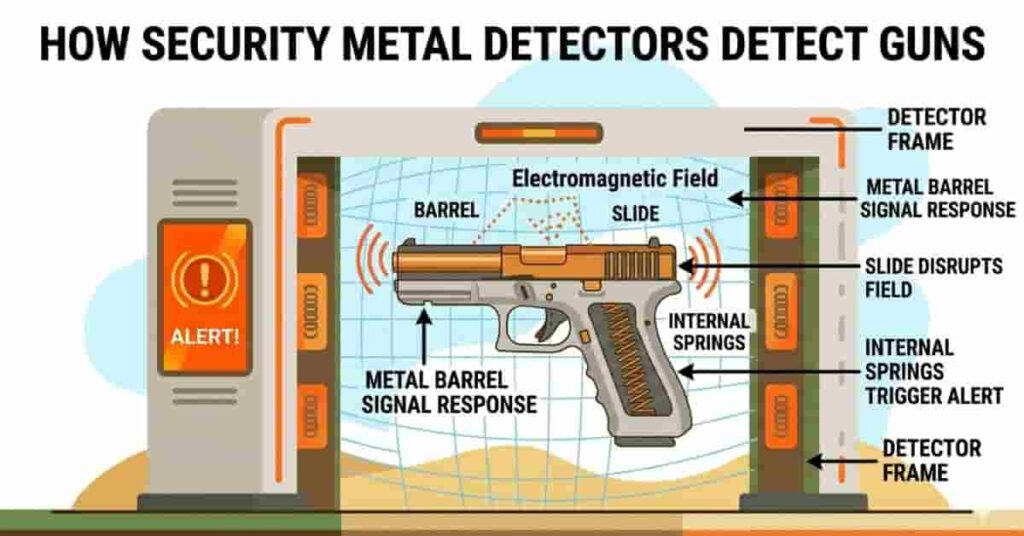
Many wonder if metal detectors miss guns or if firearms can go unnoticed. Movies and online myths suggest “undetectable guns,” but modern detectors are designed to sense metallic threats.
Most firearms have several essential metal components for safe, reliable operation. These parts usually trigger a strong signal when passing through a detector’s electromagnetic field.
Common metal components in firearms include:
- Barrel
- Slide or frame components
- Springs and firing mechanisms
- Internal pins and pressure parts
These metal parts interact strongly with detectors’ magnetic fields, making them much easier to detect than small items like coins or jewelry. Confusion often arises from polymer-framed firearms, which use polymer to reduce weight. However, critical firing components remain metal.
Barrels, slides, and firing pins must stay metal to handle pressure and heat. Without them, the firearm would not function safely.
In the U.S., security systems use standards from the Transportation Security Administration and are calibrated to detect metallic threats during screening.
Key Takeaways
- Firearms have multiple essential metal components.
- These metal parts trigger strong responses in security detectors.
- Polymer frames do not remove crucial internal metal parts.
- Fully undetectable guns are a myth, not a reality.
Real-World Curiosity: Pop Culture vs Reality
Movies and video games often exaggerate the detection of weapons. Characters may sneak weapons past scanners without alarms. A popular game like Red Dead Redemption 2 features dramatic scenarios that involve hidden weapons. While entertaining, these scenes often ignore real detection technology.
In real security, scanners are calibrated, and operators adjust sensitivity to detect metallic objects associated with weapons. Even small firearms have enough metal to create a strong signal. Security staff use handheld scanners for secondary checks if needed.
This layered approach makes modern screening more reliable than fiction suggests.
Pro Tips
- Remove all metal items before passing through security checkpoints.
- If an alarm sounds, staff may use a handheld scanner to locate the metal source.
- Security systems combine technology and human inspection for better accuracy.
What About Knives and Small Blades?
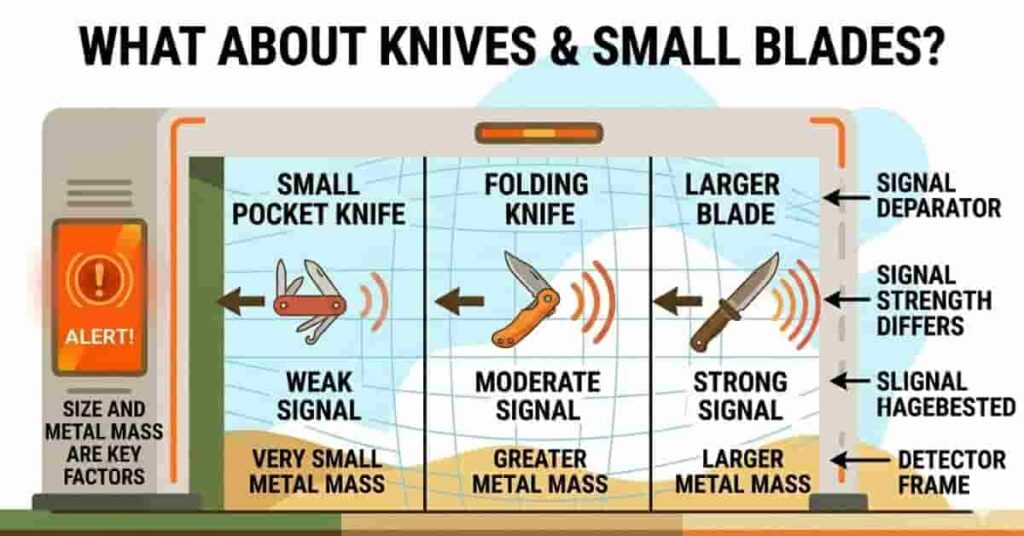
Many people also ask whether metal detectors miss knives or small blades. The short answer is that most standard knives contain enough metal to trigger detection systems. Blade material plays a major role. Most knives use stainless steel or other conductive metals. These materials interact strongly with the electromagnetic field created by security detectors.
Metal in the field disrupts the signal, triggering an alert from the detector. Knife blades, being made of solid metal, often produce a strong signal. Size and position matter too. Larger blades make stronger signals. Small blades can create weaker signals, especially if detector sensitivity is low.
For example, pocket knives, folding knives, and kitchen knives typically contain enough metal to be detected by metal detectors. These items include both a metal blade and internal metal components.
Very small metal objects behave differently. Thin pieces or fragments create weaker signals. Detection systems may ignore very small objects based on calibration. Still, everyday knives usually contain enough metal for detection.
Key Takeaways
- Most knives use conductive metals such as stainless steel.
- Metal blades strongly disturb the detector’s electromagnetic field.
- Larger knives create stronger detection signals.
- Extremely small metal objects may produce weaker signals.
Why Blade Material and Position Matter
Knife detection depends on more than metal type; blade orientation and position affect signal strength. Metal detectors use coils to generate magnetic fields. When a blade passes through that field, the metal interacts differently depending on its angle of approach.
A flat blade aligned with the field may create a different signal than a vertical one. Security systems use multiple detection zones for this. Walk-through scanners use several internal coils to monitor different body areas for greater accuracy.
Security teams use handheld wands as needed to pinpoint metal sources during secondary screening.
Most typical knives have enough metal to be detected during screening.
Pro Tips
- Remove knives or metal tools before approaching security checkpoints.
- Empty pockets and bags to reduce unnecessary alarms.
- Follow posted security rules at airports, courthouses, and events.
Why Do Phones Sometimes Not Trigger Alarms?
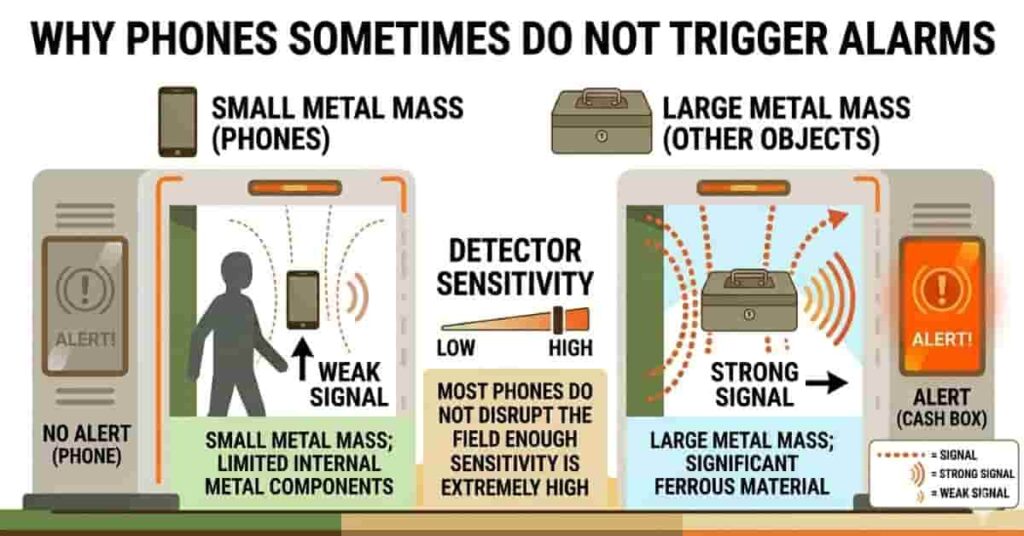
Many people notice something strange at security checkpoints. Sometimes a phone triggers an alarm. Other times, it passes through quietly. This often leads to the question: Do metal detectors miss phones?
In most cases, the answer relates to metal mass and detector settings. Phones contain metal parts, but the total amount of metal is smaller than that of many other objects.
A firearm, for example, has dense metal parts, such as barrels and springs, that generate strong electromagnetic disturbances. Phones usually have thin frames, circuit boards, and small connectors.
Because of this difference, phones produce weaker detection signals (fainter electronic responses from the detector)s than larger metal objects do.
Detector calibration matters too. Security teams set sensitivity based on the environment. Busy locations prioritize larger threats over small objects.
A detector may ignore small metal items to reduce constant alarms, helping lines move faster while still catching larger metal objects.
Not all materials produce the same signal strength, which is why it helps to know which metals metal detectors cannot easily find.
Key Takeaways
- Phones contain metal, but usually in smaller amounts.
- A smaller metal mass creates weaker detection signals.
- Sensitivity settings decide what triggers an alarm.
- Security balances accurate detection with checkpoint efficiency.
How Security Settings Affect Phone Detection
Security checkpoints use different sensitivity levels to focus on higher-risk objects.
For example, detectors may ignore very small metal items such as:
- Coins
- Small keys
- Thin electronics
Phones sometimes fall near this threshold, depending on the model and the amount of metal it contains. The threshold is the lowest amount of metal that activates an alarm.t.
Operator decisions can also influence the process. Security staff may allow small electronic devices to pass through the detector if they do not trigger an alert. If a signal is detected, they may perform additional screening with handheld scanners.
Airports in the United States follow procedures set by the Transportation Security Administration, aiming to detect threats while keeping lines efficient.
Because of these factors, a phone may sometimes trigger an alarm and sometimes not.
Pro Tips
- Place phones in trays when required by security rules.
- Remove metal items from pockets before walking through scanners.
- Follow instructions from security staff during screening.
Can Carbon Fiber or Polymer Weapons Avoid Detection?
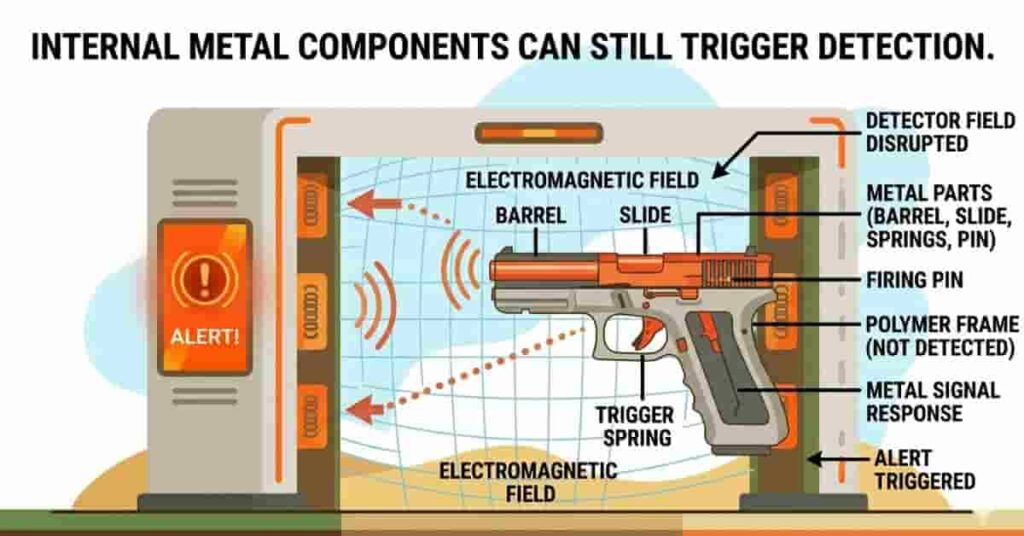
Some online posts claim that carbon-fiber or polymer weapons can bypass security scanners. This idea appears often in online forums and movies. In reality, the science behind security metal detectors tells a different story. Carbon fiber itself is mostly non-conductive. Polymer materials also contain little or no metal. Because of this, people sometimes assume that a weapon made from these materials would be invisible to metal detectors.
But weapons need key metal components for safe, reliable use.
Common metal components include:
- Springs
- Firing pins
- Pressure-bearing chambers
- Internal pins and mechanical parts
These metal parts must handle heat, pressure, and stress. Metal parts trigger detectors by disturbing electromagnetic fields.
Completely metal-free functional weapons are unrealistic. Even polymer weapons still use metal parts.
Key Takeaways
- Carbon fiber and polymer contain little or no metal.
- Functional weapons still require critical metal components.
- Metal parts interact with the detector’s electromagnetic fields.
- Fully undetectable functional weapons are a myth; essential metal parts remain detectable.
Why Metal Parts Are Still Required
Mechanical systems need materials that resist heat and pressure. Non-metals usually can’t handle that force alone.
Firing mechanisms use springs and hardened pins to operate. Without strong metals, these fail quickly. Security detectors focus on metal. Even small pieces make signals as they pass through scanners.
Screening systems use many layers. Walk-through detectors, hand wands, and staff together find threats.
Pro Tips
- Do not rely on internet myths about “invisible” weapons.
- Security detectors focus on metal components, not outer materials.
- Always follow security rules at airports, courts, and public events.
Do Metal Detectors Detect Through Clothing or Bags?
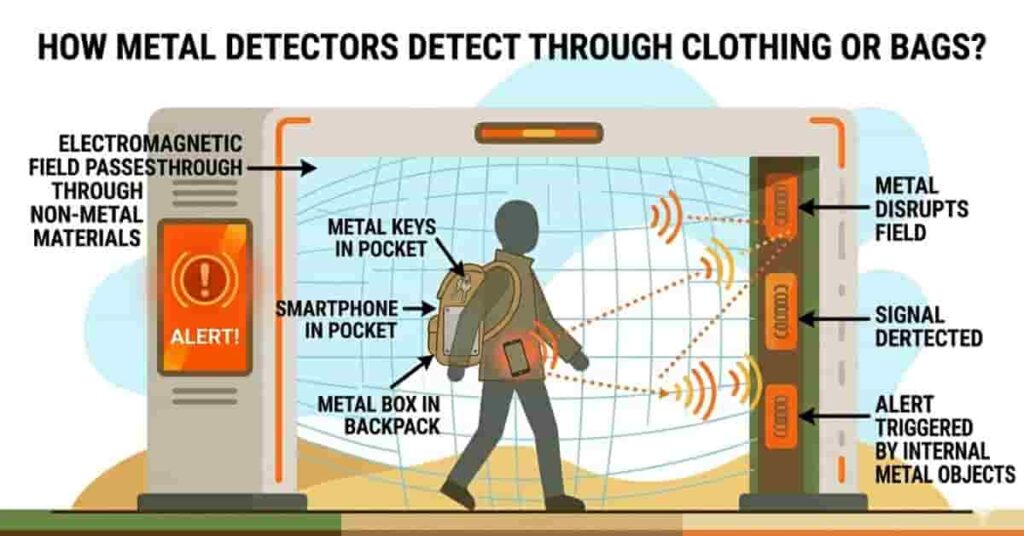
Yes. Security metal detectors can detect metal through clothing, backpacks, and most bags. Non-metal materials do not block the electromagnetic field used for detection. Metal detectors create a magnetic field around the scanning area. When metal enters that field, it changes the signal. The detector senses the change and alerts the operator.
Clothing materials such as cotton, denim, or synthetic fabrics do not interfere with the field. The same applies to many bag materials, such as nylon, leather, or canvas. Because these materials are non-metallic, the signal passes through them easily. That is why security checkpoints do not require people to remove clothing items like jackets. The detector can still identify metal objects underneath.
However, material thickness can slightly affect signal strength. Thick bags, multiple layers of fabric, or dense objects may slightly weaken the signal. Even so, they usually cannot completely hide metal items.
Security systems are set to detect common metal objects. They work even if items are inside pockets or bags.
Key Takeaways
- Metal detectors detect objects through clothing and most bags.
- Non-metal materials do not block electromagnetic fields.
- Thick materials may weaken signals slightly.
- They cannot fully hide metal objects from detection.
Why Metal Still Triggers Detection
Metal interacts with magnetic fields differently from fabrics or plastics. When metal passes through the field, it produces a small electrical response. Security detectors measure this response to check for metal. Larger metal objects disturb the field more strongly.
Hiding metal in a pocket or bag usually does not prevent detection. The electromagnetic field still reaches the metal and triggers a signal. Security teams use multiple screening methods. If a detector alarm sounds, officers may also use handheld scanners for extra checks.
Pro Tips
- Remove large metal objects before entering security checkpoints.
- Empty pockets to reduce unnecessary alarms.
- Follow instructions from security staff during screening.
What Determines Whether Metal Is Detected?
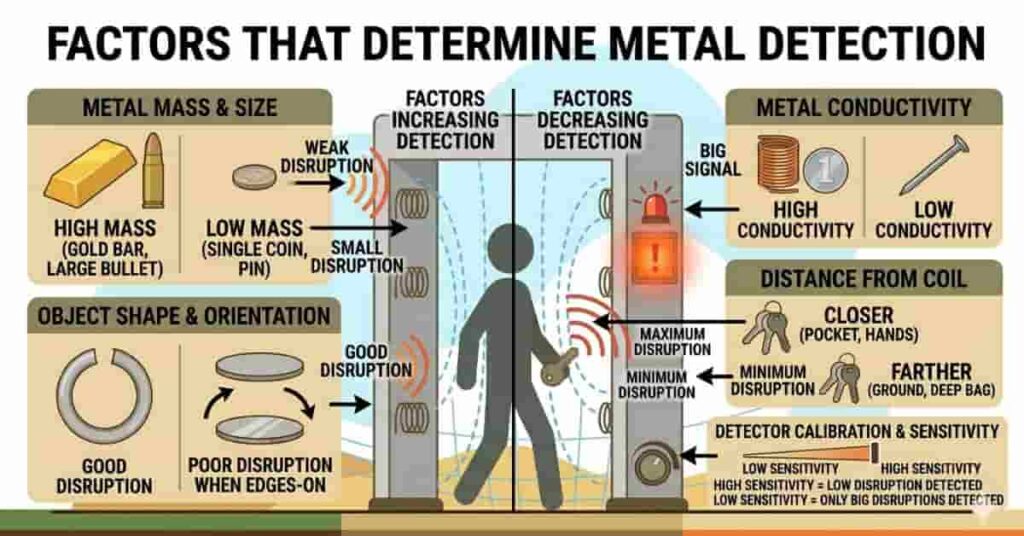
Metal detectors do not respond uniformly to every metal object. Several physical characteristics determine whether a detector senses an object or ignores it. Recognizing these characteristics clarifies why security metal detectors detect some items easily while others elicit weaker signals.
Metal detectors work by producing an electromagnetic field. When metal enters that field, it creates a disturbance that the detector can measure. The strength of that disturbance depends on the metal’s properties and position.
Five main factors influence detection:
- Metal mass
- Conductivity
- Shape and orientation
- Distance from the coil
- Detector calibration
Each factor affects the strength of the metal’s interaction with the detector’s field. Larger, more conductive objects usually produce stronger signals. Smaller or poorly positioned objects may produce weaker responses. Security systems adjust sensitivity levels to focus on objects that matter most. For example, many checkpoints prioritize detecting larger metallic threat items rather than tiny objects like coins.
Understanding these detection characteristics also clarifies why two similar objects can behave differently during screening.
Key Takeaways
- Metal detectors respond to the physical properties of metal.
- Larger and conductive metals produce stronger signals.
- Object position and distance influence the strength of detection.
- Detector calibration determines sensitivity levels.
Metal Mass
Metal mass plays a major role in detection strength. Simply put, larger pieces of metal produce stronger signals. When a large metal object enters the detector’s electromagnetic field, more electrons respond to the magnetic energy. This creates a stronger disturbance that the detector easily recognizes.
Small objects behave differently. Items like coins, jewelry, or tiny fragments contain less metal. Because of this, they create weaker signal changes. Security systems often use calibration settings to filter out very small signals. This helps prevent constant alarms from harmless items.
For example, a dense metal component such as a firearm part generates a stronger signal than a small metal button.
Pro Tips
- Larger metal objects are easier for detectors to identify.
- Multiple small metal items together may still trigger an alert.
- Sensitivity settings control how detectors respond to small objects.
Conductivity
Not all metals conduct electricity equally. Conductivity refers to how readily electrical energy passes through a material. Highly conductive metals interact powerfully with electromagnetic fields. This results in stronger signals inside metal detectors.
Examples of highly conductive metals include:
- Copper
- Aluminum
- Silver
These metals enable electrical currents to flow easily, making their signals easier to detect. Less conductive metals can still trigger detectors, but their signals are typically weaker.
Security detectors do not rely solely on conductivity. Instead, they evaluate several factors together to determine whether metal is present.
Pro Tips
- Highly conductive metals usually trigger stronger detection signals.
- Conductivity depends on the metal’s size and position.
- Detector sensitivity can compensate for weaker signals.
Shape & Orientation
The shape and orientation of metal also affect detection strength. When a metal object enters a magnetic field, its alignment with that field influences the signal. Flat or wide metal objects may interact differently from narrow objects. Long shapes sometimes produce stronger responses when aligned with the detector field.
Orientation also matters during walk-through scans. If metal sits at an unusual angle, the signal may appear slightly weaker. Security detectors address this issue using multiple detection zones. These zones allow detection of metal from various directions as a person passes through the scanner.
Handheld detectors add another layer of precision. Security staff can scan specific areas to more accurately locate metal objects.
Pro Tips
- Metal orientation can slightly affect detection strength.
- Modern detectors use multiple coils to improve accuracy.
- Secondary scans help confirm object location.
Distance From Coil
The distance between the metal object and the detector coil strongly affects signal strength. The closer the object is to the coil, the stronger the interaction becomes. Walk-through metal detectors generate a field between two panels. Metal objects nearer these panels tend to produce stronger signals.
Objects positioned near the center of the scanning area may create slightly weaker signals. Still, modern systems employ multiple coils to maintain coverage. Handheld wands can pinpoint metal sources because their coils sit very close to objects.
This is why secondary scanning with handheld detectors often identifies the exact location of metal items.
Pro Tips
- Closer objects produce stronger detection signals.
- Walk-through detectors use multiple coils to maintain coverage.
- Handheld scanners improve detection precision.
Detector Calibration
Detector calibration determines the system’s sensitivity to metal signals. Security teams adjust these settings depending on the location and security level.
For example, busy public entrances often balance security with speed. Extremely sensitive settings could cause constant alarms from harmless items. Calibration enables detectors to concentrate on objects with sufficient metal to present a potential threat. In the United States, many security environments follow screening practices influenced by the Transportation Security Administration. These procedures help ensure consistent detection standards.
Because of calibration settings, the same object may trigger an alarm in one location but not another.
Pro Tips
- Detector sensitivity depends on security needs.
- High-security areas may use stricter calibration settings.
- Calibration helps reduce unnecessary alarms while maintaining detection capability.
Can Security Metal Detectors Ever Miss Something?
Security metal detectors are highly reliable, but no system is perfect. Under certain conditions, detectors may fail to detect very small metal objects, which reflects the need to balance sensitivity, speed, and real-world conditions.
One factor is metal size. Extremely small metal fragments can produce very weak signals. These signals may fall below the detector’s sensitivity threshold. Security systems often filter these signals to prevent constant alarms from harmless objects. Another factor is sensitivity settings. Security teams calibrate detectors depending on the location and security level. In busy environments, slightly lower sensitivity settings may be used to keep screening lines moving efficiently. Higher-security areas often use stricter settings.
Human operation also plays a role. Security checkpoints combine technology with trained staff. Operators monitor alarms and perform additional screening when needed. However, human oversight can occasionally affect how quickly alerts receive attention. Environmental conditions may also influence detector performance. Electrical interference, nearby metal structures, or dense crowds can sometimes affect signal clarity.
Key Takeaways
- Security metal detectors work reliably but are not guaranteed to detect every metallic object.
- Very small metal fragments might not be detected if their signals are too weak for the system to detect.
- Security environments set sensitivity levels, which affect what the detectors can find.
- Human operation and environmental factors affect screening.
How Modern Security Systems Reduce Missed Detections
Modern security systems use multiple layers to improve detection accuracy. Walk-through scanners serve as the initial screening step. If a detector alarm triggers, security staff perform additional checks.
Secondary screening may include:
- Handheld metal detector scans
- Visual inspection by trained staff
- Bag or item checks
This layered approach helps reduce the chance that a metallic threat object goes unnoticed.
In many U.S. transportation hubs, screening procedures follow the Transportation Security Administration’s guidelines. These procedures combine technology, operator training, and inspection protocols to improve reliability.
Because of these safeguards, modern screening systems remain one of the most effective tools for detecting metallic objects in public security environments.
Pro Tips
- Follow security instructions at checkpoints to speed up screening.
- Remove metal items before entering detectors when possible.
- Secondary screening helps confirm alerts and improve accuracy.
Airport, Courthouse, or Event Security: What’s the Real Difference?
Security metal detectors don’t always follow the same rules. These differences stem from varying security priorities and risk assessments across locations. Some places require extremely strict screening, while others emphasize moving crowds efficiently.
For example, airports usually maintain the most structured screening process. Here, passenger checkpoints follow procedures guided by the Transportation Security Administration. These procedures aim to detect metallic threat objects while maintaining consistent safety standards across U.S. airports.
Similarly, courthouses also maintain strong security because they handle sensitive legal matters. Visitors typically pass through walk-through metal detectors, and security staff may inspect bags or personal items. The goal is to prevent weapons from entering controlled government spaces.
Event venues, such as stadiums and concert venues, often balance security with speed. Large crowds must enter quickly, so screening procedures may move faster. Staff may use walk-through detectors, handheld wands, or bag checks depending on the event.
Key Takeaways
- Different locations use similar detector technology.
- Screening strictness depends on risk level and crowd size.
- Airports typically follow the most structured procedures.
- Courthouses and events adjust their screening based on their environments.
Why Security Procedures Vary
Airports juggle crowds and global security risks, demanding strict protocols and razor-sharp teams. Courthouses guard their own—judges, staff, and visitors—with a sharp focus on spotting weapons before anyone steps inside.
Public events bring fast-moving crowds into play. Security adjusts detectors and routines to keep both energy and safety front and center.
No matter the place, the tech stays steady. Metal detectors emit electromagnetic fields to detect hidden metal.
Pro Tips
- Follow posted security rules at each location.
- Remove metal items before entering the detectors.
- Expect slightly different procedures at airports, courts, and events.
Common Internet Myths About “Undetectable” Weapons
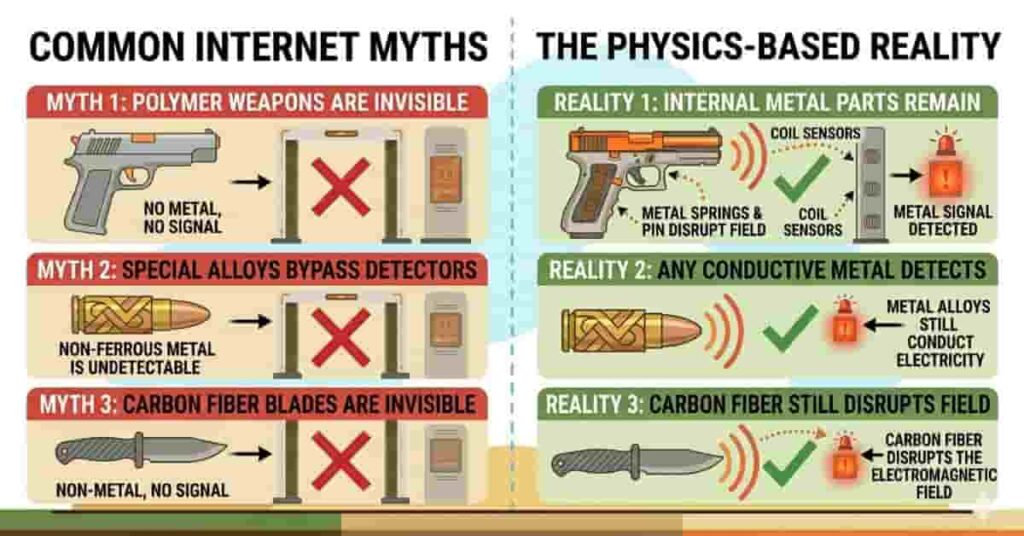
Dramatic claims about “undetectable weapons” spread rapidly online, but most ignore how security metal detectors truly function.
Metal detectors do not rely on appearance or brand. They respond to how metal interacts with an electromagnetic field. When metal enters that field, it creates a measurable disturbance. Because of this principle, many popular myths about undetectable weapons do not withstand scientific scrutiny.
Below are some common claims and what physics actually tells us about them.
Key Takeaways
- Most online claims about undetectable weapons are exaggerated.
- Metal detectors respond to metal properties, not appearance.
- Functional weapons usually require metal components.
- Physics limits the idea of fully invisible weapons.
Myth 1: Polymer Guns Are Invisible
Many people believe polymer guns cannot trigger metal detectors. They misunderstand the role of metal in these firearms, since polymer frames contain very little metal.
Yet essential parts—barrels, springs, firing pins—must be metal to function under pressure and heat.
As a result, polymer-framed firearms still contain detectable metal.
Myth 2: Special Alloys Defeat Scanners
Some claim special alloys evade detectors. However, detectors measure conductivity and magnetism. Different metals may produce slightly different signals, but detectors still measure the disturbance in the electromagnetic field. As long as the object contains conductive metal, it can create a detectable response.
Security systems are designed to detect a wide range of common metals.
Myth 3: Carbon Fiber Blades Bypass Alarms
Claims about carbon fiber blades passing unnoticed rely on carbon fiber’s low metal content.
Practical cutting tools usually include metal components. Designers often combine carbon fiber with metal edges or internal support structures. Even small metal components can interact with the detector field, producing a measurable signal.
Pro Tips
- Always take online weapon myths with a grain of salt.
- Metal detectors respond to the physical properties of metal.
- Functional devices often require metal parts that remain detectable.
Conclusion
So, can metal detectors miss guns, knives, or phones? In most real-world situations, modern security systems are designed to reliably detect metallic threat objects.
Throughout this guide, we explored how security metal detectors work and what actually determines detection. Factors such as metal mass, conductivity, detector calibration, and object position all influence signal strength.
The idea of a fully “undetectable” functional weapon is largely a myth. Most real-world devices still require metal components such as springs, barrels, or pressure parts. These components interact with electromagnetic fields and trigger detection systems.
Sometimes missed targets are not about security limitations but simple device problems. Check this guide explaining why your metal detector might not be working properly.
Modern screening tools used at airports, courthouses, and events are specifically calibrated to detect metallic threat items. While no technology is perfect, these systems remain highly effective in real security environments.
If this guide clarified how metal detectors work, share it now with friends or colleagues who are curious about security systems. Discover more beginner-friendly guides and expand your understanding of security technology on our site.

Ethan Callaway is a passionate metal detecting enthusiast based in Savannah, Georgia, USA. Currently pursuing a B.S. in Archaeology & Historical Preservation at the University of Georgia, he combines his love for treasure hunting with research-backed insights on metal detecting techniques, safety practices, and site guidance.
Through MetalDetectingUSA.com, Ethan shares practical tips, honest product reviews, and beginner-friendly advice to help both new and experienced detectorists explore metal detecting across the United States with more confidence and understanding.