
Table of Contents
Introduction
How deep can you really expect your metal detector to find something buried underground?
If you’re new to metal detecting, depth can be confusing. Advertised depths often sound impressive, but real-world results can vary widely. Soil conditions, target size, coil design, and detector technology all affect performance.
So, how deep can a metal detector work in realistic conditions? Most hobby detectors can find coin-sized targets around 6–12 inches deep. Larger objects may reach 2–4 feet, while professional and pulse induction (PI) systems can detect certain targets deeper.
In this guide, you’ll learn what affects detection depth and what ranges you can realistically expect. We’ll cover coins, jewelry, relics, gold, and larger buried objects. You’ll also learn how soil, frequency, sensitivity, and coil size change performance.
By the end, you’ll know how far down metal detectors work in real ground. You’ll also understand why advertised depth claims don’t always match field results.
Detection Depth Based on Object Size
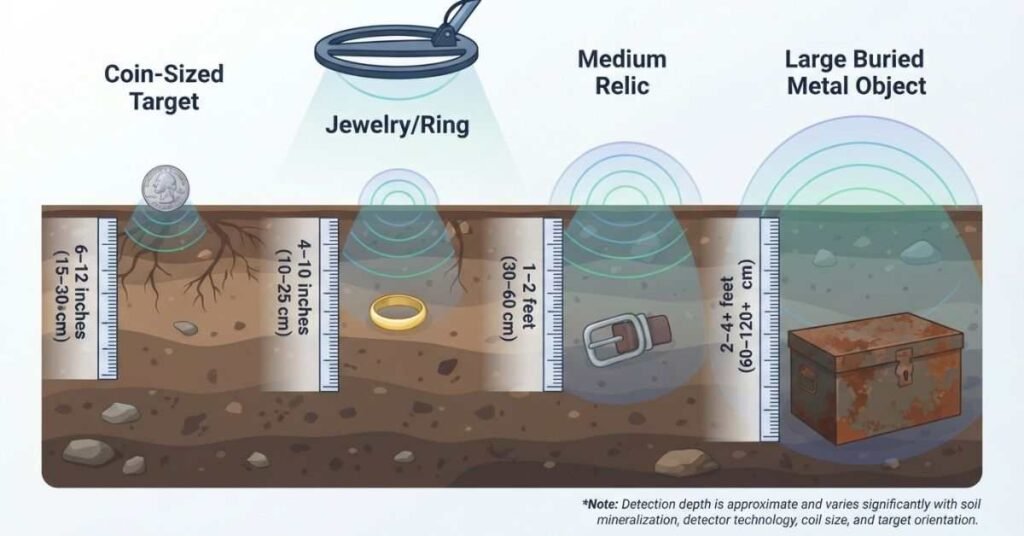
Object size plays a major role in how deep a metal detector can identify a target. Small objects produce weaker signals, while larger metal objects usually create stronger responses. That’s why a detector may find a large buried object deeper than a coin.
These depth ranges offer realistic starting points, not guaranteed limits. Your actual results can change with detector quality, coil size, soil mineralization, target composition, and orientation.
Coin-Sized Targets
Coin-sized targets commonly represent the depth most beginners care about. Many hobby detectors can detect coins around 6–12 inches deep under favorable ground conditions. Highly mineralized soil can reduce this range.
Target position also matters. A coin lying flat often produces a stronger signal than one positioned on its edge. Detector settings and coil selection can also affect the usable depth.
Jewelry & Rings
Jewelry and rings often fall within a shallower range because many pieces contain relatively small amounts of metal. A typical detection range may fall around 4–10 inches.
Thin chains can prove especially difficult because their shape produces a weaker signal. Larger rings or heavier jewelry may produce stronger responses at greater depths.
Relics & Medium Objects
Medium-sized relics can often produce stronger signals than coins. Depending on their size and composition, detection may reach roughly 1–2 feet in suitable conditions.
Old tools, buckles, hardware, and similar objects can vary greatly. Their metal type, shape, orientation, and surrounding soil all influence detection depth.
Large Buried Objects
Large metal objects can produce strong signals from significantly greater depths. In favorable conditions, some large objects may register around 2–4 feet or more.
However, this doesn’t mean every detector can reliably reach those depths. Large-object detection depends heavily on target size, coil design, soil conditions, and detector technology.
Pro Tip: Treat depth ranges as practical expectations rather than guarantees. Test your detector in your local soil to learn its real performance.
7 Factors That Affect How Deep a Metal Detector Works
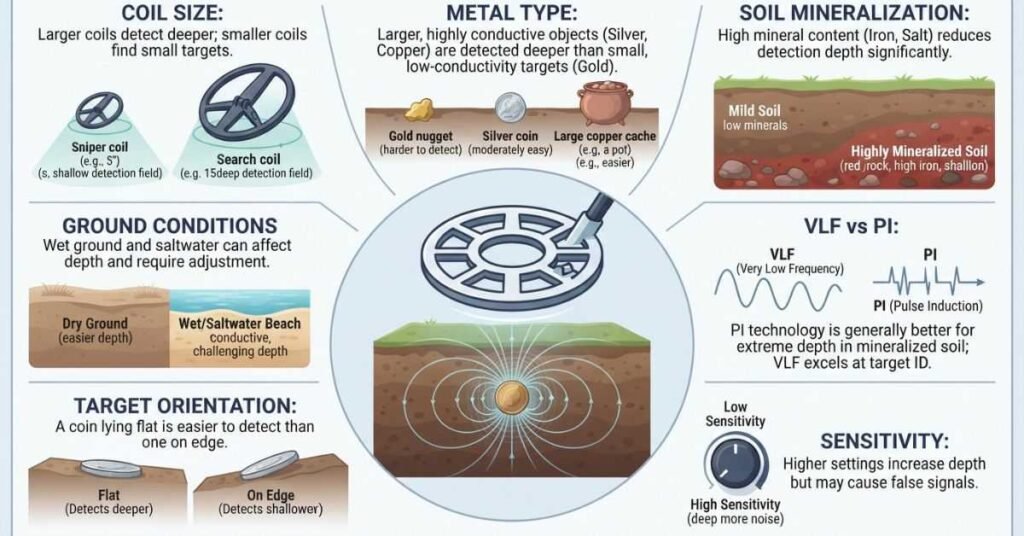
A metal detector’s depth depends on more than its advertised specifications. Several factors work together during every search. Even a powerful detector can lose depth when ground conditions or settings create interference.
Understanding these factors helps beginners set realistic expectations. It also makes it easier to adjust a detector for parks, beaches, fields, and other common hunting locations.
1. Coil Size
Coil size can affect both detection depth and ground coverage. Larger coils can detect larger targets deeper under suitable conditions. They also cover more ground with each sweep.
However, bigger doesn’t always mean better. Large coils can become harder to use in trashy areas or highly mineralized soil. Smaller coils often provide better separation between nearby targets.
2. Metal Type
Different metals respond differently to a detector’s electromagnetic field. Conductivity, size, and shape all influence signal strength.
Highly conductive targets can sometimes produce stronger signals than small or low-conductive objects. However, detector settings also influence how the machine identifies each target.
3. Soil Mineralization
Mineralized soil can interfere with a detector’s electromagnetic response. This interference can make deeper targets harder to identify accurately.
Ground containing high levels of iron minerals often creates more challenging conditions. Proper ground balancing can help reduce this interference.
4. Frequency Type: VLF vs PI
Detector technology also affects performance. VLF detectors work well for many coins, jewelry, and general-purpose searches.
Pulse induction (PI) detectors can handle highly mineralized ground better. They can also perform well when searching for certain deeper or larger targets.
5. Detector Sensitivity Settings
Higher sensitivity can improve responses from weak targets. However, excessive sensitivity may increase false signals and ground noise.
Set sensitivity as high as the ground allows while keeping the detector stable. A clean signal is often more useful than maximum sensitivity.
6. Target Orientation
The position of a buried object affects its electromagnetic response. A coin lying flat may produce a different signal than the same coin standing on edge.
Irregular objects can behave differently as well. Their shape and position can change the signal strength and target identification.
7. Ground Conditions
Wet, dry, sandy, and clay-heavy soils can produce different detecting conditions. Saltwater environments can create additional challenges for many detectors.
Ground conditions also change across locations. Beach sand, dry fields, clay soil, and rocky terrain may require different settings and techniques.
Pro Tip: Adjust your detector to the ground instead of chasing maximum sensitivity. Stable operation usually gives you more reliable target information.
How Deep Do Different Metal Detector Types Work?
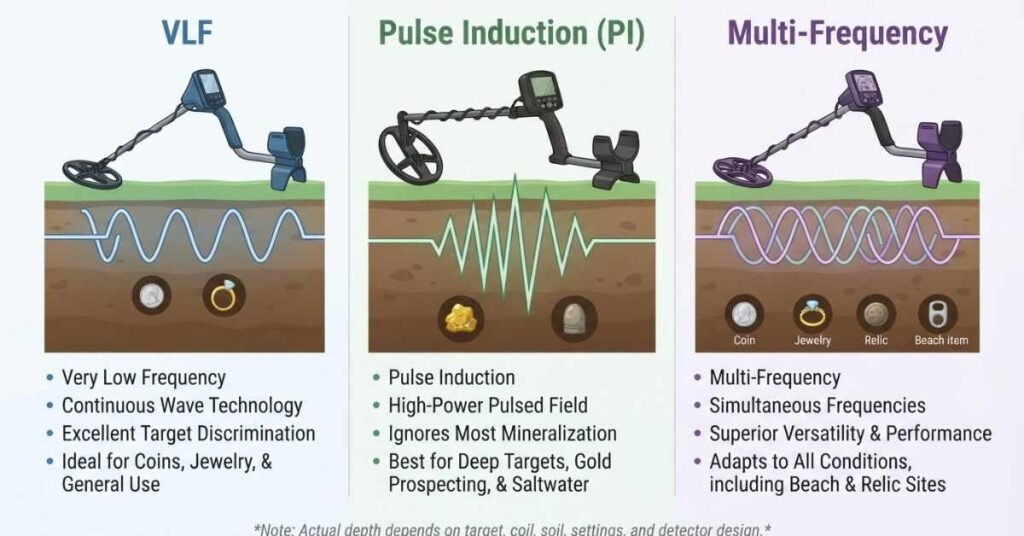
Metal detector technology affects how a detector handles depth, target size, and ground conditions. VLF, PI, and multi-frequency systems each have different strengths.
There isn’t one universal depth range for each technology. Actual performance depends on the target, coil, soil, settings, and detector design.
VLF Detectors Depth Range
Very Low Frequency (VLF) detectors are popular with beginners and general-purpose hobbyists. They work well for coins, jewelry, relics, and other relatively shallow targets.
For coin-sized targets, 6–12 inches is a reasonable practical range for many hobby detectors under favorable conditions. Some targets may register deeper or shallower depending on the detector and ground.
VLF detectors also offer useful target identification features. This makes them practical for parks, fields, and similar locations where target separation matters.
Pulse Induction (PI) Depth Range
Pulse induction detectors use a different detection method. They can perform particularly well in highly mineralized ground and saltwater environments.
PI systems can also detect certain larger or deeper targets effectively. However, depth still depends heavily on target size, coil design, soil, and detector settings.
PI detectors are often associated with deep relic hunting and gold prospecting, especially in difficult ground.
Multi-Frequency Systems
Multi-frequency detectors can operate across multiple frequencies simultaneously or switch between frequencies. This design can provide flexibility across different target types and ground conditions.
They can perform well for coins, jewelry, relics, and beach detecting. However, multi-frequency technology doesn’t guarantee greater depth than every VLF or PI detector.
How Ground Conditions Change Detection Depth
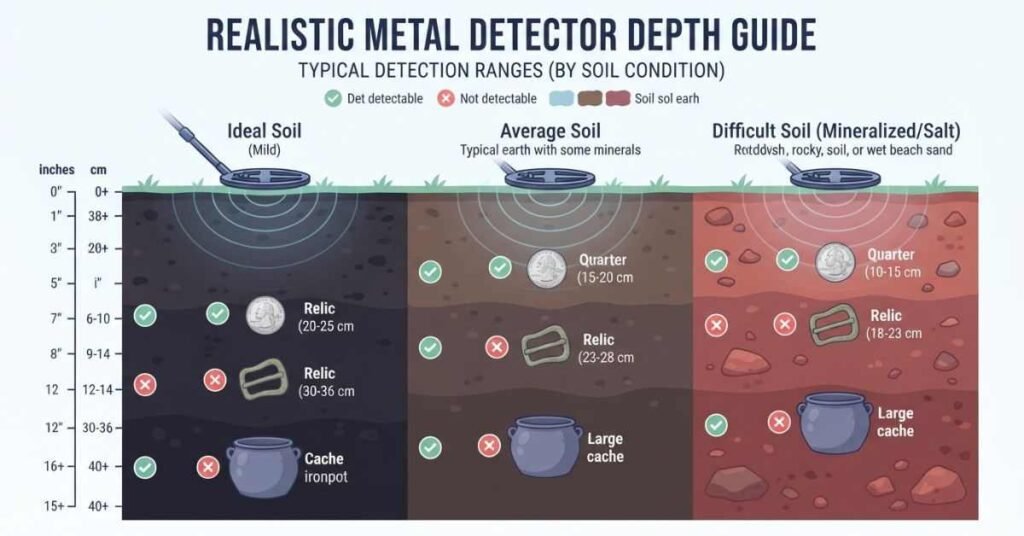
The same metal detector can perform differently from one location to another. Soil minerals, moisture, salt, rocks, and ground composition can affect detection depth and target identification.
This explains why a detector that performs well in one area may struggle somewhere else. Beginners should test their equipment locally instead of relying only on published depth claims.
Highly Mineralized Soil
Mineralized soil can create electromagnetic interference. This makes deeper targets harder to detect and identify accurately.
Iron-rich ground can be especially challenging for many VLF detectors. Ground balancing and appropriate sensitivity settings can help maintain stable operation.
Beach Sand
Dry beach sand often provides relatively easy detecting conditions. However, wet sand can behave differently, especially when salt is present.
Detector performance can change as you move from dry sand toward the shoreline. Ground balance and detector technology become increasingly important.
Saltwater
Saltwater creates a conductive environment that can produce unwanted responses. This can make stable detecting more difficult for some detectors.
PI and suitable multi-frequency systems often handle saltwater conditions better than many conventional single-frequency VLF detectors.
Rocky Terrain
Rocky ground can create physical challenges and mineralization issues. Hot rocks can sometimes produce false or confusing signals.
Uneven terrain also limits coil movement. A smaller coil may help maneuver around rocks, tight spaces, and other obstacles.
Pro Tip: Test your detector in the actual area you’ll search. Local soil conditions can reveal more than a laboratory depth claim.
Why Advertised Depth Claims Can Be Misleading
Metal detector depth claims can look impressive, but they don’t always represent normal field performance. Manufacturers may test detectors under controlled conditions that differ from real ground.
A detector’s maximum response can also depend on the target used during testing. A large metal object may produce a much stronger signal than a small coin.
Air Test vs Ground Test
An air test places a metal target near the coil without burying it. This removes soil interference and makes the target easier to detect.
A ground test places the target underground. Soil mineralization, moisture, and other factors can reduce the usable detection depth.
Ideal Testing Conditions
Controlled testing can produce consistent results. Real-world detecting rarely provides the same conditions.
Target orientation, soil composition, nearby metal, coil position, and detector settings can all affect performance.
Marketing Exaggeration
Some depth claims may describe a maximum response rather than a reliable identification depth. A detector might respond to a deep object without providing a clear target signal.
That distinction matters when comparing detectors. Don’t choose a detector based on one advertised depth number alone.
Look for independent field tests when available. Also consider the detector’s target identification, ground handling, coil options, and intended use.
Expert Tip: Compare detectors using similar targets and conditions. Realistic field performance matters more than an impressive maximum-depth claim.
Simple Depth Testing Method at Home
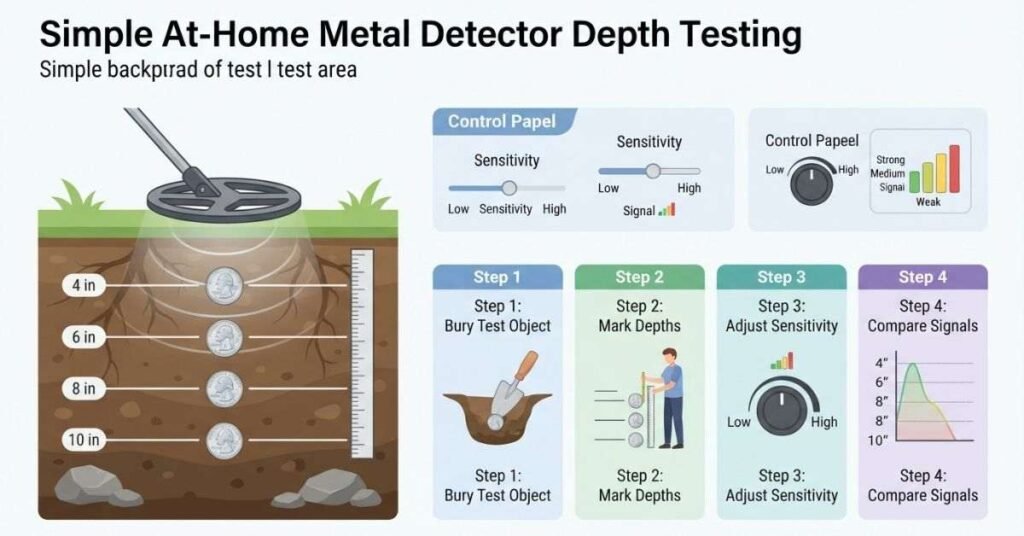
Testing your detector at home can help you understand its practical depth limits. A controlled test also shows how different settings affect target responses.
Choose a test location with minimal nearby metal and consistent soil. Use common targets, such as a coin or small piece of jewelry, for realistic results.
Bury a Test Object
Start with one familiar target. A coin works well because it’s small and easy to identify.
Bury it at a shallow depth first. Make sure the target sits naturally rather than resting directly against the surface.
Mark Different Depths
Create several test depths as you dig deeper. For example, you can test at 4, 6, 8, and 10 inches.
Use the same target and position at every depth. This keeps the comparison more consistent.
Adjust Sensitivity
Begin with moderate sensitivity and increase it gradually. Stop when the detector becomes unstable or produces excessive false signals.
A stable detector gives you a more useful baseline. Maximum sensitivity doesn’t always provide maximum usable depth.
Compare the Signals
Sweep over each target using the same speed and coil height. Record whether the detector gives a clear, repeatable response.
Pay attention to both signal strength and target identification. A weak response may indicate the practical limit for that target.
Pro Tip: Repeat the test after changing one setting at a time. This shows which adjustments actually improve performance.
6 Ways to Get More Depth from Your Metal Detector
You can’t eliminate every factor that limits detection depth. However, better settings and search techniques can help you get the most from your detector.
Focus on stable signals instead of chasing the deepest possible response. Small changes can improve performance without making your detector harder to control.
1. Use a Larger Coil
A larger compatible coil can improve coverage and may increase depth on suitable targets. However, it can reduce target separation in areas with heavy trash.
Choose the coil based on your hunting environment rather than size alone.
2. Reduce Discrimination
High discrimination can cause some targets to disappear from detection. Lowering it may help preserve responses from deeper or uncertain targets.
You may hear more unwanted signals, but you’ll also reduce the chance of filtering out useful targets.
3. Ground Balance Properly
Correct ground balance helps the detector handle mineralized soil. Follow your detector’s recommended ground-balancing procedure.
A properly balanced detector can operate more smoothly and make deeper signals easier to evaluate.
4. Sweep More Slowly
A controlled sweep gives the detector more opportunity to process the target response. Avoid rushing the coil across the ground.
Keep the coil close to the surface without striking rocks or obstacles.
5. Increase Sensitivity Carefully
Higher sensitivity can improve weak target responses in suitable ground. Too much sensitivity can create noise and false signals.
Increase it gradually until the detector becomes unstable. Then lower it slightly for more reliable operation.
6. Upgrade to PI if Needed
A PI detector may make sense for highly mineralized ground or specific deep-target applications. It isn’t automatically better for every type of detecting.
Choose PI technology based on your location, targets, and experience rather than depth claims alone.
Conclusion
So, how deep can a metal detector work? For many hobby detectors, coin-sized targets commonly fall around 6–12 inches. Larger objects can reach several feet under suitable conditions.
Actual depth depends on your detector, coil size, target, soil mineralization, settings, and search technique. VLF detectors work well for general coin and jewelry hunting. PI systems can offer advantages in highly mineralized ground and certain deep-target searches.
Don’t treat advertised depth as a guaranteed result. Real soil testing gives you a better idea of your detector’s practical performance.
Start with realistic expectations, learn your detector’s settings, and practice in your local ground. Share your deepest find or detecting experience in the comments.
Frequently Asked Questions
Most hobby metal detectors can detect coin-sized targets around 6–12 inches deep under favorable conditions. Larger objects can produce detectable signals at greater depths. Soil mineralization, target size, coil design, detector technology, and sensitivity settings all affect real-world depth. Always treat these ranges as practical estimates, not guaranteed limits.
Gold detection depth varies greatly by the target. Small gold jewelry can fall within typical shallow detection ranges. Larger gold objects or nuggets may produce stronger signals at greater depths. Highly mineralized soil can make gold detection more difficult. PI detectors often perform well in mineralized ground, especially for gold prospecting.
Not necessarily. A higher price doesn’t guarantee greater detection depth. Expensive detectors may offer better target identification, advanced ground handling, multi-frequency technology, or specialized features. Depth still depends on the target, coil, soil, settings, and detector design. Choose a detector based on your hunting needs rather than price alone.
A typical hobby metal detector generally cannot reliably detect a coin-sized target 10 feet underground. Very large metal objects may produce signals at greater depths under suitable conditions. However, depth claims for large targets don’t represent normal coin-hunting performance. Professional equipment can reach deeper in specific applications, but results vary considerably.
Professional detectors can reach greater depths for certain targets, but there is no single maximum depth. Specialized PI systems and large-coil setups can detect large or deep targets beyond typical hobby-detector ranges. Actual performance depends on target size, metal type, soil conditions, coil configuration, and detector technology.
For many hobby detectors, 6–12 inches provides a useful expectation for coin-sized targets in favorable soil. Jewelry may fall within a similar or shallower range. Medium relics can sometimes reach around 1–2 feet, while large objects may produce signals several feet deep. These are general ranges rather than guaranteed specifications.
Yes. A larger compatible coil can increase detection depth and ground coverage for suitable targets. However, larger coils can struggle more with trashy areas and mineralized soil. Smaller coils often provide better target separation. The best coil depends on the target, ground conditions, and detector model.
Wet ground can change detector performance, depending on the soil and detector technology. Moisture can improve conductivity in some soils, while wet saltwater sand can create significant interference. Ground balance and suitable detector technology become especially important near beaches and saltwater.
It depends on the type of sand and the detector. Dry, low-mineral beach sand can provide favorable conditions. Wet saltwater sand can be much more challenging because salt increases conductivity. PI and suitable multi-frequency detectors often handle these conditions better than many conventional VLF detectors.
You can improve usable depth by using a suitable larger coil, reducing excessive discrimination, ground balancing correctly, and sweeping slowly. Increase sensitivity only while keeping the detector stable. If you regularly search highly mineralized ground, a suitable PI detector may provide better performance for your specific targets.
Advertised depth should not be treated as a guaranteed field result. Manufacturers may test detectors under controlled conditions that differ from real soil. Air tests can also produce different results from buried targets. Target size, soil mineralization, orientation, coil design, and settings can all reduce practical detection depth.
Several factors affect detection depth, including coil size, target size, metal type, soil mineralization, detector frequency, sensitivity, target orientation, and ground conditions. No single factor determines depth. The combination of these variables explains why the same detector can perform differently across different locations.

Ethan Callaway is a passionate metal detecting enthusiast based in Savannah, Georgia, USA. Currently pursuing a B.S. in Archaeology & Historical Preservation at the University of Georgia, he combines his love for treasure hunting with research-backed insights on metal detecting techniques, safety practices, and site guidance.
Through MetalDetectingUSA.com, Ethan shares practical tips, honest product reviews, and beginner-friendly advice to help both new and experienced detectorists explore metal detecting across the United States with more confidence and understanding.