


Table of Contents
Introduction
Have you ever wondered how a metal detector can find a buried coin without ever touching the ground?
The metal detector working principle is based on electromagnetic induction, a simple but powerful concept in physics. Whether you’re new to metal detecting or curious about how the technology works, understanding this principle helps you use a detector more effectively. Many beginners in the USA want to know why detectors respond to some objects but ignore others.
In this guide, you’ll learn exactly how a metal detector creates and detects magnetic fields, why different metals produce different signals, and how the electronics turn those signals into sounds or target IDs. We’ll also explain key concepts like eddy currents, Faraday’s Law, Lenz’s Law, and the differences between VLF and Pulse Induction technologies in simple, beginner-friendly language. By the end, you’ll clearly understand the science behind metal detection and feel more confident choosing, using, and understanding any modern metal detector.
The Scientific Principle Behind Metal Detectors
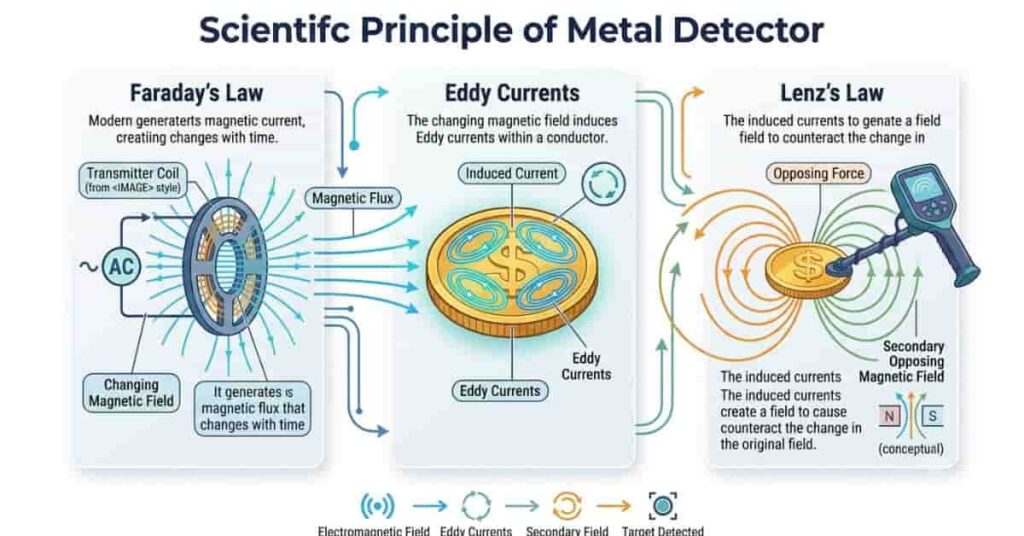
The metal detector working principle is based on electromagnetic induction, a key concept in physics. Every modern metal detector uses this principle to locate buried metal objects without making physical contact. Instead of “seeing” metal, the detector creates a magnetic field and measures how nearby objects affect it.
When the search coil sends an electromagnetic field into the ground, nothing unusual happens until the field reaches a metal object. The metal reacts by generating tiny electrical currents. These currents create a new magnetic field that interacts with the detector’s original field. The detector measures this interaction and determines whether a target is present.
Different metals respond in different ways because they have unique electrical and magnetic properties. For example, silver and copper produce stronger signals than many other materials because they conduct electricity well. Iron also reacts strongly, but its magnetic properties create a different signal pattern.
Understanding these scientific principles makes it easier to learn why detectors identify some targets better than others. It also explains why factors like soil conditions, target size, and detector settings affect performance in the field.
Electromagnetic Induction (Faraday’s Law)
Electromagnetic induction is the foundation of every modern metal detector. It was discovered by physicist Michael Faraday, who showed that a changing magnetic field can generate an electric current. This discovery, known as Faraday’s Law, explains why metal detectors can locate hidden objects underground.
Inside the detector, the transmitter coil carries alternating current. This current continuously creates and changes a magnetic field around the search coil. As you sweep the coil over the ground, the magnetic field moves through the soil.
When the changing field reaches a conductive metal object, the amount of magnetic flux passing through that object changes. This changing magnetic flux causes electrons inside the metal to move, creating a small electrical current called an induced current.
These induced currents are the first step in detecting metal. Without electromagnetic induction, the detector would have no way to recognize buried targets.
Pro Tip: A stable, smooth sweep creates more consistent magnetic field changes and helps the detector produce clearer signals.
Lenz’s Law and Opposing Magnetic Fields
Faraday’s Law explains how electrical currents form, but Lenz’s Law explains what happens next. It states that an induced current always creates a magnetic field that opposes the change that produced it.
When the detector’s magnetic field reaches a metal object, the induced current inside the object generates its own magnetic field. This new field is called the secondary magnetic field. Instead of matching the original field, it pushes back against it.
The receive coil detects this interaction between the transmitted field and the secondary field. Because the two fields are slightly different, the returning signal changes in timing and strength. These changes create signal shifts, which the detector analyzes to determine whether a target is present.
Different metals create different amounts of opposition. This is one reason why many detectors can distinguish between iron, aluminum, silver, and other metals.
Pro Tip: Stronger secondary magnetic fields usually produce clearer target responses, making larger or more conductive objects easier to detect.
Eddy Currents Explained
Eddy currents are small loops of electrical current created inside conductive metals. They form when a changing magnetic field passes through a metal object. These currents are essential because they generate the secondary magnetic field detected by the receiver coil.
As the detector’s electromagnetic field reaches a coin, ring, or relic, electrons begin moving in circular paths within the object. These moving electrons create eddy currents that continue for a short time while the magnetic field changes.
Not every metal produces the same response. Highly conductive metals, such as silver and copper, allow eddy currents to flow more easily, creating stronger signals. Metals with lower conductivity generate weaker currents and may produce less noticeable responses. Target size, shape, and thickness also affect the strength of these currents.
Understanding eddy currents helps explain why some buried objects are easier to detect than others, even when they are at the same depth.
Pro Tip: Small, thin targets create weaker eddy currents, so they often require higher sensitivity or higher operating frequencies.
How a Metal Detector Generates and Receives Signals
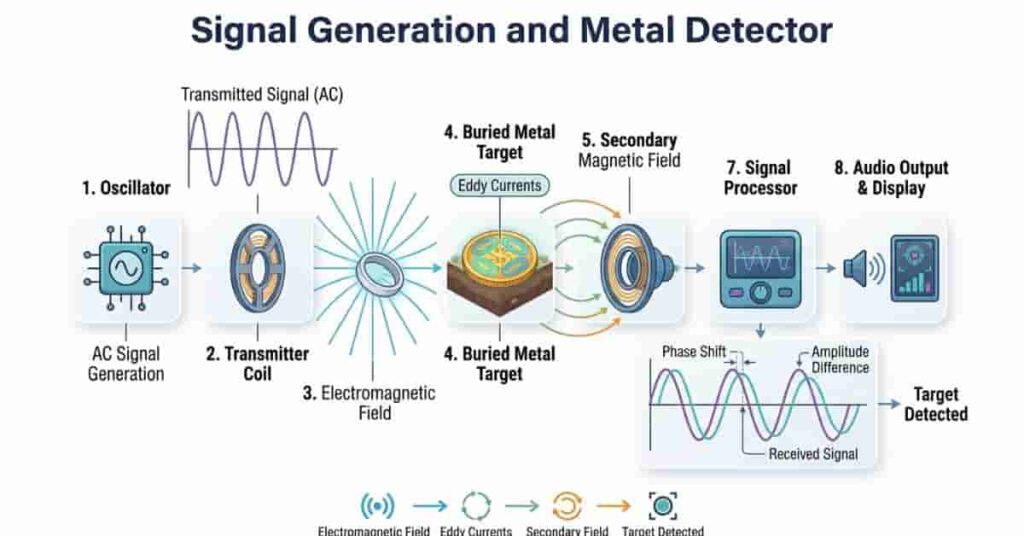
A metal detector does much more than create a magnetic field. It continuously sends, receives, and analyzes electromagnetic signals in real time. This process happens thousands of times each second, allowing the detector to identify hidden objects almost instantly.
The search coil contains transmitting and receiving components that work together. The transmitter creates a changing magnetic field that spreads into the ground. When this field reaches a metal object, it produces eddy currents that generate a secondary magnetic field. The receiver detects this returning signal and sends it to the detector’s electronic processor.
The processor compares the transmitted and received signals. It looks for differences in phase shift and amplitude, two important characteristics that reveal information about the target. These measurements help estimate the metal type, target size, and depth.
Modern detectors complete this entire process almost instantly, giving users fast audio tones, target IDs, or visual indicators while sweeping the search coil.
Transmitter Coil Function
The transmitter coil is responsible for creating the detector’s electromagnetic field. It receives alternating current from the control box and converts that energy into a constantly changing magnetic field.
As you sweep the search coil across the ground, this magnetic field spreads through the soil. If no metal is present, the field remains largely unchanged. When it encounters a conductive object, it triggers eddy currents inside the target.
The strength and frequency of the transmitted field influence detection performance. Lower frequencies generally reach deeper targets, while higher frequencies respond better to small or low-conductivity objects.
Pro Tip: Keep the search coil close to the ground without scraping it. This helps maintain a stronger magnetic field near buried targets.
Receiver Coil Function
The receiver coil listens for changes in the magnetic field after it interacts with a metal object. It does not transmit energy. Instead, it measures the weak secondary magnetic field produced by eddy currents.
Even very small changes can indicate a buried target. The receiver converts these magnetic variations into electrical signals and sends them to the detector’s processor for analysis.
High-quality receiver coils improve sensitivity and help reduce unwanted interference. This allows the detector to identify smaller targets more accurately in different soil conditions.
Pro Tip: External electrical interference can affect weak signals. Lower sensitivity or change locations if you experience constant false alerts.
Signal Processing Circuit
The signal processing circuit is the detector’s decision-making system. It compares the transmitted signal with the signal received from the target to determine whether metal is present.
One important measurement is phase shift. This is the small difference in timing between the transmitted and received signals. Different metals create different phase shifts because they respond to electromagnetic fields in unique ways. Many VLF detectors use this information to estimate the type of metal.
The processor also measures amplitude, which is the strength of the returning signal. Larger, shallower, or more conductive objects usually produce stronger signals than small or deeply buried targets. By combining phase shift and amplitude data, the detector decides whether to produce a tone, display a target ID, or ignore the signal as ground noise.
Pro Tip: Don’t rely on a single target ID. Scan the target from multiple directions to confirm a consistent signal before digging.
Different Working Principles in Metal Detector Technologies
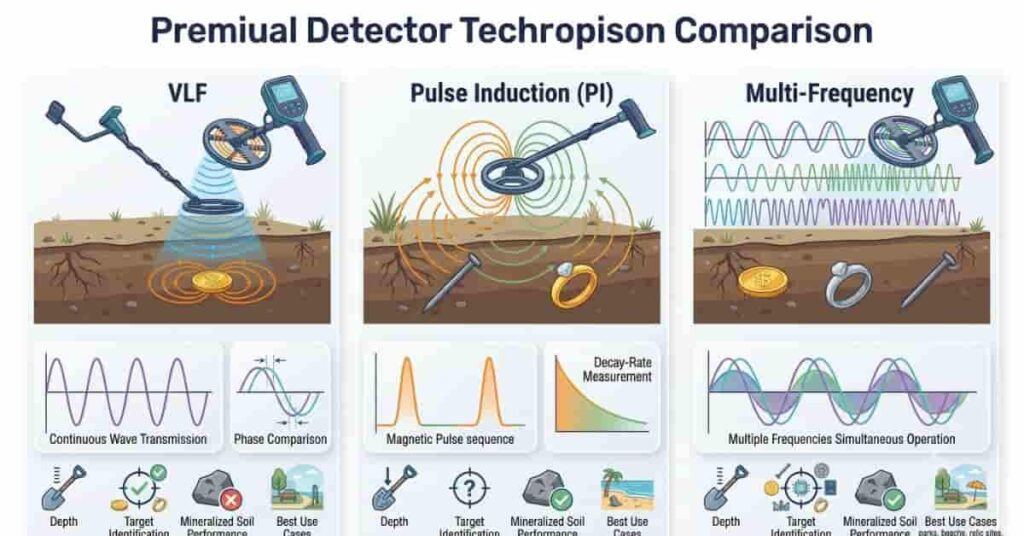
Although every modern detector relies on electromagnetic induction, different technologies process signals in different ways. The three most common systems are Very Low Frequency (VLF), Pulse Induction (PI), and Multi-Frequency detectors. Each uses a unique method to detect and identify metal targets.
The right technology depends on where you search and what you hope to find. Coin hunters often prefer VLF detectors because they provide excellent target identification. Gold prospectors and beach hunters frequently choose PI detectors because they perform better in highly mineralized soil. Multi-frequency detectors combine several frequencies to deliver balanced performance across many environments.
Understanding these technologies helps beginners choose the right detector and explains why two detectors can respond differently to the same buried object. While the science remains the same, the way each detector generates, receives, and analyzes signals varies significantly.
Takeaways
- All metal detectors use electromagnetic induction.
- VLF, PI, and Multi-Frequency systems process signals differently.
- Each technology has strengths for specific environments and target types.
- Choosing the right technology improves detection accuracy and overall performance.
Pro Tip: Match your detector technology to your hunting location. A detector designed for beaches may not perform as well in parks, and vice versa.
VLF (Very Low Frequency) Principle
Very Low Frequency (VLF) is the most widely used technology in hobby metal detectors. It works by transmitting a continuous electromagnetic wave into the ground while constantly monitoring the returning signal. This steady transmission allows the detector to detect targets quickly and accurately.
A VLF detector usually contains both a transmitter coil and a receiver coil. The transmitter creates a continuous magnetic field, while the receiver measures changes caused by nearby metal objects. The detector then compares the transmitted and received signals to identify potential targets.
One of the most important measurements is phase comparison. Different metals change the timing of the returning signal by different amounts. The detector analyzes this phase shift to estimate whether the target is likely iron, aluminum, copper, silver, or another metal. This process also supports discrimination features that help reduce unwanted targets.
VLF detectors work well for coins, jewelry, relics, and general-purpose detecting. However, heavy mineralization can reduce their performance if ground balance is not adjusted correctly.
Pro Tip: Use VLF technology for parks, schools, and yards where accurate target identification matters more than maximum depth.
Pulse Induction (PI) Principle
Pulse Induction (PI) detectors use a different approach. Instead of transmitting a continuous signal, they send powerful, short bursts of electromagnetic energy into the ground. Each pulse creates a magnetic field that quickly expands and then collapses.
When the magnetic field collapses, the detector measures how fast the signal disappears. If no metal is present, the signal fades at a predictable rate. When metal is nearby, eddy currents keep the magnetic field active for a little longer. The detector measures this decay rate to determine whether a target exists.
Because PI detectors focus on signal decay rather than phase comparison, they handle highly mineralized soil much better than most VLF detectors. This makes them popular for gold prospecting, saltwater beaches, and difficult ground conditions.
The trade-off is that many PI detectors provide less detailed target identification. As a result, users often dig more targets, including unwanted metal.
Multi-Frequency Systems
Multi-Frequency detectors transmit several frequencies at the same time instead of relying on just one. Each frequency responds differently to buried objects, allowing the detector to gather more information from every target.
Lower frequencies usually detect larger and deeper objects more effectively. Higher frequencies respond better to small targets and low-conductivity metals like thin gold jewelry. By combining these signals, the detector produces more reliable target identification across a wide range of conditions.
The detector’s processor performs simultaneous frequency analysis, comparing responses from multiple frequencies before displaying a target ID or producing an audio tone. This helps reduce false signals and improves accuracy in difficult soil.
Multi-frequency technology is popular among users who search in different environments because it offers a strong balance of depth, target identification, and ground stability without changing frequencies manually.
How Metal Type Affects the Detector’s Response
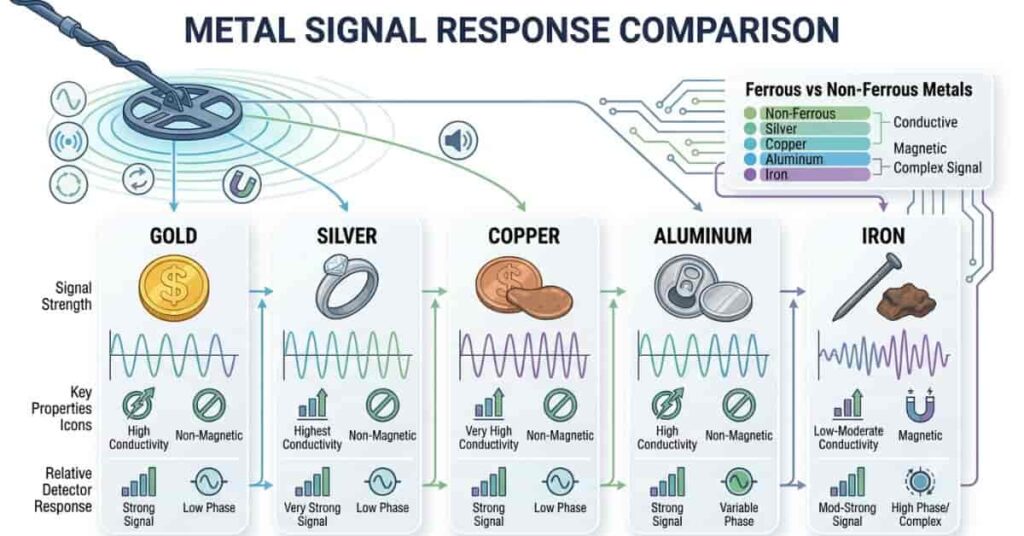
Not all metals produce the same signal. A metal detector responds differently depending on a target’s electrical conductivity, magnetic permeability, size, and shape. These properties influence how much energy the target absorbs and how strong a secondary magnetic field it creates.
Highly conductive metals, such as silver and copper, generate strong eddy currents that often produce clear, stable signals. Metals with lower conductivity, including some stainless steel alloys, usually create weaker responses. Gold can vary depending on its purity, size, and shape.
Magnetic permeability also affects detection. Ferrous metals, such as iron and steel, react strongly to magnetic fields because they contain iron. Non-ferrous metals, including aluminum, brass, copper, silver, and gold, respond mainly through electrical conductivity rather than magnetism. Modern detectors use these differences to help identify target types.
Target size and shape also play an important role. A large metal object usually creates a stronger signal than a small one at the same depth. Flat objects, rings, and irregularly shaped items can also produce different signal patterns depending on their orientation in the ground.
Understanding these factors helps explain why two buried objects at the same depth may produce very different detector responses.
What Determines Detection Depth in Physics Terms?
Many beginners believe a metal detector’s depth depends only on its power. In reality, detection depth depends on several physical factors that affect how electromagnetic fields travel through the ground. The metal detector working principle remains the same, but field strength, coil size, soil conditions, and signal loss all influence how deep a target can be detected.
A stronger electromagnetic field can penetrate farther into the ground and create more noticeable eddy currents in buried metal. However, increasing power alone does not guarantee greater depth. The returning signal must still be strong enough for the receiver coil to detect and the processor to analyze accurately.
The search coil also plays an important role. Larger coils create a wider and deeper magnetic field, making them better for locating large or deeply buried objects. Smaller coils produce a narrower field, which improves target separation and sensitivity to small items but usually reduces maximum detection depth.
Ground conditions have a major impact as well. Mineralized soil, wet sand, and other conductive materials absorb or distort part of the electromagnetic field. As the signal travels through the ground, it gradually loses energy. This natural reduction in signal strength is called signal attenuation. The weaker the returning signal becomes, the harder it is for the detector to recognize a target.
Understanding these physics principles helps explain why the same detector may reach different depths in different locations, even when searching for identical objects.
How Ground Mineralization Affects the Working Principle
Ground conditions can significantly change how a metal detector performs. Although detectors are designed to find buried metal, the soil itself can produce electromagnetic responses that interfere with target detection. This is why the same detector may work perfectly in one location but struggle in another.
One common challenge is magnetic soil. Some soils contain naturally occurring iron minerals, such as magnetite, that respond to the detector’s magnetic field. Instead of receiving signals only from buried metal, the detector also receives signals from the ground. These extra responses can reduce depth and create false alerts if they are not filtered correctly.
Another challenge is saltwater conductivity. Wet ocean sand contains dissolved salts that conduct electricity. As the electromagnetic field passes through this conductive layer, the detector may mistake the ground for a large metal target. This can cause unstable signals, constant noise, or reduced sensitivity, especially with some VLF detectors.
To solve these problems, modern detectors use ground balancing. Ground balance measures the soil’s natural response and adjusts the detector to ignore it. This allows the receiver to focus on signals from actual metal objects instead of background interference. Many advanced detectors perform this adjustment automatically, while others let users set it manually for greater control.
Learning how ground mineralization affects the metal detector working principle helps you understand why proper detector settings are just as important as choosing the right search location.
Basic Circuit Concept Behind a Metal Detector
A metal detector may seem complex, but its basic electronic circuit follows a simple sequence. Each component has a specific job, and together they create, detect, and process electromagnetic signals. Understanding these parts helps you see how the metal detector working principle works inside the control box without needing an engineering background.
The process begins with an oscillator, which generates an alternating electrical signal. This signal travels to the transmitter coil, where it creates the changing magnetic field used to search for buried metal. When that field encounters a conductive object, it produces eddy currents that generate a secondary magnetic field.
Next, the returning signal reaches the detector’s electronic circuit. An amplifier strengthens the weak signal so the detector can analyze it more accurately. A comparator then compares the transmitted signal with the received one, looking for differences in timing and strength that indicate the presence of metal. Finally, the detector converts this information into an easy-to-understand response, such as a beep, vibration, or target ID on the display.
Although modern detectors contain advanced processors and software, they all follow this same basic circuit concept. Every hidden target passes through these stages before you hear a signal or see a target identification.
Oscillator
The oscillator is the starting point of the detector’s electronic circuit. It produces a continuous alternating electrical signal at a specific frequency. This signal powers the transmitter coil and creates the changing magnetic field needed for metal detection.
The oscillator must generate a stable frequency because even small changes can affect detection accuracy. Different detector technologies use different operating frequencies depending on their intended purpose. For example, higher frequencies are often better for small targets, while lower frequencies generally improve depth on larger objects.
Without the oscillator, the detector would have no magnetic field to send into the ground, making metal detection impossible.
Pro Tip: Stable operating frequency helps produce more consistent target responses, especially in areas with electrical interference.
Amplifier
The signal returning from a buried object is usually very weak. The amplifier increases this signal so the detector can analyze it without losing important details.
A stronger signal allows the processor to measure characteristics such as phase shift and signal strength more accurately. At the same time, modern amplifiers work with filtering circuits to reduce unwanted electrical noise from the environment.
This balance between amplification and noise reduction helps improve sensitivity while minimizing false signals.
Pro Tip: Higher sensitivity settings amplify both target signals and background noise, so adjust them according to site conditions.
Comparator
After amplification, the signal reaches the comparator. Its job is to compare the transmitted signal with the returning signal from the receiver coil.
The comparator looks for differences in timing, known as phase shift, and differences in signal strength, called amplitude. These changes help the detector determine whether the signal comes from a real metal target or from ground interference.
The information gathered by the comparator is passed to the detector’s processor, which decides how to respond.
Pro Tip: Consistent target signals from multiple sweep directions are more likely to represent real metal than random electrical interference.
Audio Output
The audio output is the final stage of the detection process. After the processor identifies a target, it converts the electronic signal into feedback that the user can understand. Most detectors produce different tones, while many also display a target ID or depth estimate on the screen.
Different sounds often represent different types of targets. For example, many detectors use low tones for iron and higher tones for valuable non-ferrous metals. This allows users to make better digging decisions without seeing the buried object.
The audio system turns complex electronic measurements into simple alerts, making the detector easy to use even for beginners.
Pro Tip: Wear quality headphones in noisy environments. They make faint target signals easier to hear and help you avoid missing deep or small objects.
CONCLUSION
The metal detector working principle may seem technical at first, but it follows a clear scientific process. A detector creates an electromagnetic field, a buried metal object produces a secondary magnetic field, and the detector’s signal processing system analyzes the returning signal to identify a target. Understanding these basics helps you see why factors like detector technology, soil conditions, and target type affect detection results.
Whether you’re learning the science behind metal detection or choosing your first detector, this knowledge gives you a stronger foundation for successful searches. As you gain experience, these concepts will become easier to recognize in real-world detecting situations.
If you found this guide helpful, share it with other detector enthusiasts or leave a comment below with your questions or experiences. You can also explore our other beginner-friendly guides to learn more about metal detectors, search coils, frequencies, and detecting techniques.
1. What principle do metal detectors work on?
Metal detectors work on the principle of electromagnetic induction. The transmitter coil creates a changing magnetic field that passes through the ground. When this field reaches a metal object, it produces eddy currents inside the metal. These currents generate a secondary magnetic field, which the receiver coil detects. The detector then processes this signal and alerts the user with a sound, vibration, or target ID on the display.
2. Is electromagnetic induction the only principle used in metal detectors?
Electromagnetic induction is the core scientific principle behind all modern metal detectors. However, different detector technologies apply it in different ways. VLF detectors use continuous electromagnetic waves and compare phase shifts, while Pulse Induction detectors measure how quickly magnetic pulses decay. Multi-frequency detectors analyze several frequencies at once. Although the signal processing methods differ, they all rely on electromagnetic induction to detect buried metal.
3. Which law of physics explains how metal detectors work?
Metal detectors are mainly explained by Faraday’s Law of Electromagnetic Induction and Lenz’s Law. Faraday’s Law states that a changing magnetic field can induce an electric current in a conductor. Lenz’s Law explains that the induced current creates a magnetic field that opposes the original field. Together, these laws describe how a detector creates a magnetic field, how metal responds, and how the returning signal is detected.
4. What are eddy currents, and why are they important?
Eddy currents are small loops of electrical current created inside a conductive metal object when it is exposed to a changing magnetic field. These currents generate a secondary magnetic field that the detector’s receiver coil can detect. Without eddy currents, a metal detector would not receive a usable signal from buried objects. Their strength depends on the metal’s conductivity, size, shape, and the detector’s operating frequency.
5. How does phase shift help identify different metals?
Phase shift is the small difference in timing between the transmitted magnetic field and the returning signal from a metal object. Different metals affect electromagnetic fields in different ways, creating unique phase shifts. VLF detectors analyze these timing differences to estimate whether a target is ferrous or non-ferrous. This information helps the detector provide target IDs and supports discrimination features that reduce unwanted digging.
6. Why do some metals produce stronger signals than others?
Different metals have different electrical conductivity and magnetic properties. Highly conductive metals like silver and copper allow stronger eddy currents to form, producing clearer signals. Less conductive metals often generate weaker responses. Target size, thickness, shape, and burial depth also affect signal strength. This is why a large silver coin usually produces a stronger response than a small piece of thin aluminum at the same depth.
7. How does soil affect the working principle of a metal detector?
The detector’s working principle remains the same, but soil conditions can change how electromagnetic fields travel. Mineralized soil contains natural iron minerals that produce their own signals, while wet saltwater sand conducts electricity and can create interference. Modern detectors use ground balancing to reduce these unwanted signals, allowing the receiver to focus on buried metal instead of the surrounding ground.
8. What is the difference between VLF and Pulse Induction detectors?
VLF (Very Low Frequency) detectors transmit a continuous electromagnetic field and use phase comparison to identify different metals. They provide excellent target identification and discrimination for coins, jewelry, and relics. Pulse Induction (PI) detectors send short magnetic pulses and measure how quickly those pulses decay. PI detectors perform better in highly mineralized soil and saltwater beaches but often provide less detailed target identification.
9. Can metal detectors identify the exact type of metal?
No. A metal detector cannot identify the exact metal with complete certainty. Instead, it analyzes characteristics such as phase shift, signal strength, and conductivity to estimate the target type. Many modern detectors display a target ID that helps distinguish between ferrous and non-ferrous metals or suggests whether the target may be a coin, jewelry, or another object. Digging the target is the only way to confirm what it is.
10. Why is understanding the metal detector working principle important?
Understanding the metal detector working principle helps you use your detector more effectively. It explains why different metals create different signals, why soil conditions affect performance, and how settings like sensitivity, frequency, and ground balance improve detection. Learning the science behind your detector also makes it easier to choose the right equipment and interpret signals more accurately during every search.

Ethan Callaway is a passionate metal detecting enthusiast based in Savannah, Georgia, USA. Currently pursuing a B.S. in Archaeology & Historical Preservation at the University of Georgia, he combines his love for treasure hunting with research-backed insights on metal detecting techniques, safety practices, and site guidance.
Through MetalDetectingUSA.com, Ethan shares practical tips, honest product reviews, and beginner-friendly advice to help both new and experienced detectorists explore metal detecting across the United States with more confidence and understanding.