
Table of Contents
Introduction
Beginners struggle with underwater metal detecting because water acts differently than land. Signals shift, targets move, and valuables often sink deeper than expected. Without the right approach, it’s easy to waste hours and walk away with nothing.
I’ve seen many hunters miss gold simply because they searched in the wrong spots or used land-based habits in water. The good news? Once you understand how water moves targets, your success rate can improve fast. These proven, real-world strategies are based on what actually works in rivers, creeks, and shallow water—not theory.
In this guide, you’ll learn:
- Where valuable items like gold rings naturally settle
- How to read water movement and target high-probability zones
- Simple techniques to find more in less time
- Common mistakes that cause most beginners to fail
By the end, you’ll know precisely how to find valuable items more efficiently, avoid costly mistakes, and enjoy consistent success underwater.
Why Water Hunting Produces More Valuable Finds Than Land
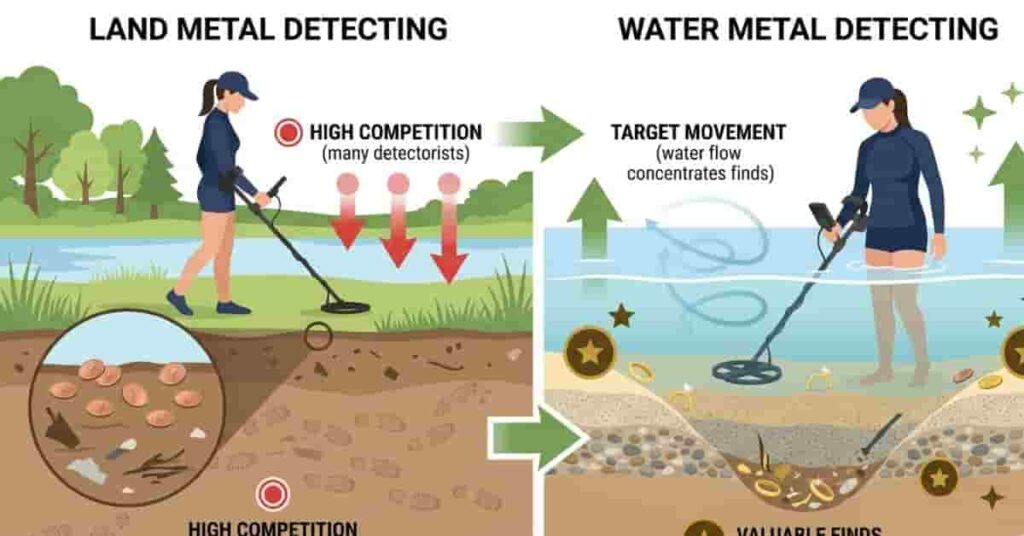
Many experienced hunters prefer water because water-tips often lead to better finds than land-tips. Water naturally moves, sorts, and concentrates targets in ways dry ground never can. Once you understand this behavior, your chances of finding valuable items increase fast.
When people swim, dive, or play in water, they lose items like rings, chains, and coins. These targets don’t stay where they fall. Waves, currents, and foot movement push them into specific zones. Over time, heavy items settle in predictable areas, such as drop-offs, slopes, and low points.
Gold and other dense metals sink faster than lighter objects. A gold ring, for example, quickly works its way down through sand or gravel. This means it’s less likely to be picked up by others and more likely to stay hidden until you find it. Land targets, on the other hand, are often shallow and have already been searched many times.
Another big advantage is lower competition. Most beginners stick to parks and dry beaches. Fewer people are willing to enter water, especially rivers or deeper areas. This leaves many high-value targets untouched for long periods.
High-probability jewelry zones form where human activity meets water movement. These include entry points, swimming areas, and underwater slopes. People lose items when they enter or exit water, and currents then carry them into collection zones.
For example, in many river hunts, items lost near a popular entry spot don’t stay there. The current slowly pushes them downstream until they settle behind rocks or in gravel bars. Hunters who understand this pattern often recover multiple targets from a small area.
Takeaways:
- Water naturally concentrates valuable targets into specific zones.
- Gold sinks deeper and stays hidden longer than land finds
- Less competition means more untouched opportunities.
- Learning water movement is key to consistent success.
Understanding Water Environments Before You Detect
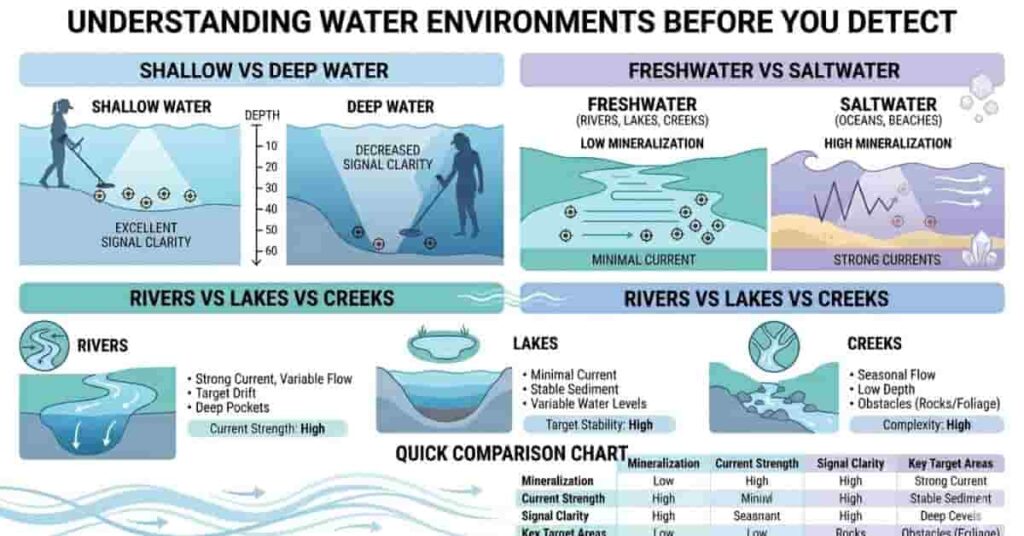
Before using any underwater metal detecting tips, you need to understand how different water environments behave. Each type of water changes how targets move, settle, and sound on your detector. If you ignore this, you’ll likely search in the wrong spots and miss valuable finds.
Water conditions affect signal strength, target depth, and recovery difficulty. A calm lake behaves very differently from a fast-moving river. Saltwater adds another layer of complexity due to its mineral content. Learning these differences helps you choose better locations and adjust your strategy for higher success.
Shallow Water vs Deep Water (Where Beginners Should Start)
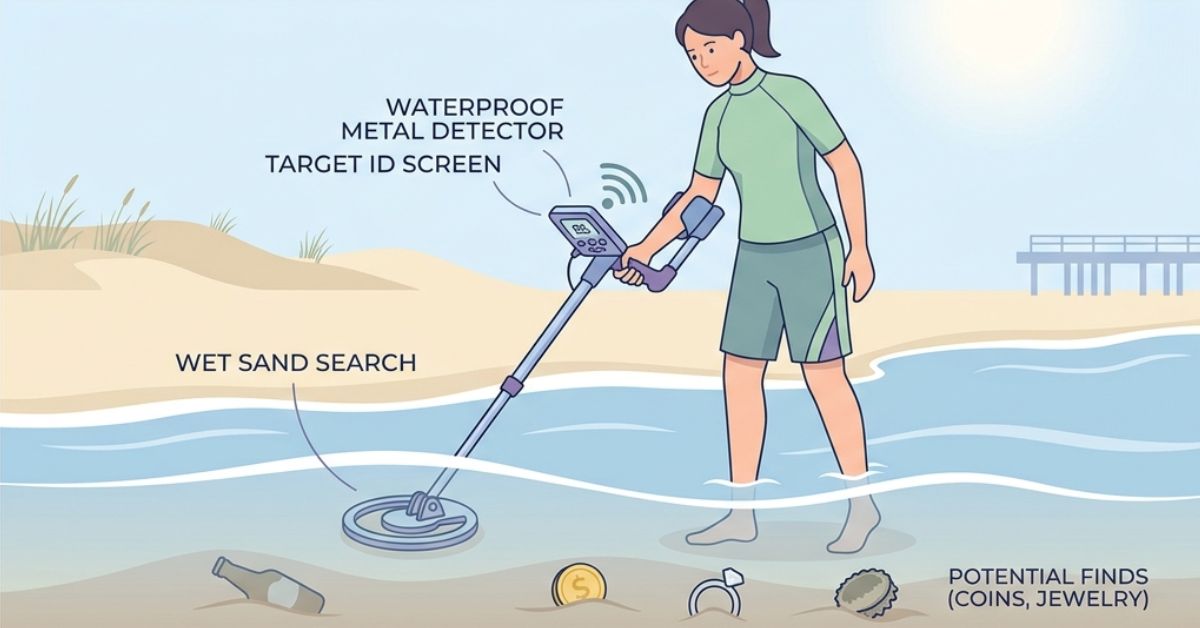
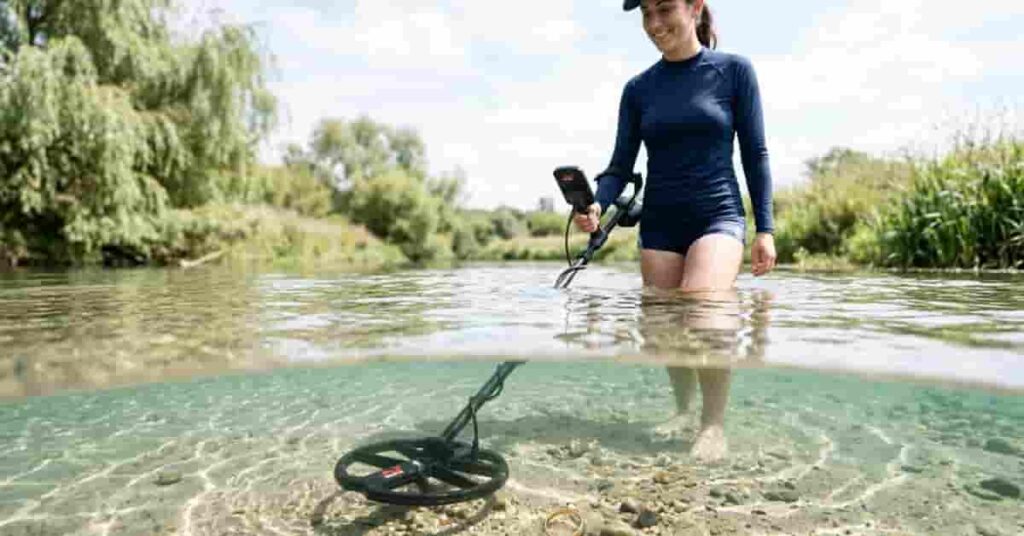
Shallow water is the best place for beginners to start. It offers a strong balance between safety, easy recovery, and high target probability. Most valuable items are lost close to shore, especially in waist-deep areas where people swim and play.
Deep water can hold older, less disturbed targets, but it also carries greater risk. Visibility drops, signals become harder to pinpoint, and recovery takes more effort. Without proper gear or experience, beginners often struggle in deeper zones.
Signal clarity is also better in shallow water. Your coil stays closer to the target, and there’s less interference from movement or pressure. In deeper water, signals can feel weaker or unstable, especially if currents are present.
Freshwater vs Saltwater Detecting Differences
Freshwater is easier for most beginners. Lakes, rivers, and creeks usually have lower mineral content, which means fewer false signals. Your detector runs smoother, and target identification is more accurate.
Saltwater, however, contains minerals that can confuse your detector. This often causes unstable signals or constant noise if settings are not adjusted correctly. To handle this, you need to lower the sensitivity and use proper ground balance.
Machine settings matter more in saltwater than freshwater. Many detectors have special modes for salt conditions. Using the wrong settings can make detecting frustrating and ineffective.
Rivers vs Creeks vs Lakes (Best Strategy for Each)
Each water type has its own behavior, and understanding it is key to finding more targets.
Rivers have moving currents that push and sort targets. Heavy items like gold settle in slow zones, behind rocks, or along bends. These areas act as natural traps where valuables collect over time.
Creeks are smaller but often more concentrated. Targets don’t spread as far, which means you can find multiple items in a tight area. Focus on bends, shallow crossings, and gravel patches.
Lakes are mostly still, so targets stay close to where they were lost. Popular swimming areas, docks, and entry points are the best spots. Since there’s little movement, you need to search more carefully and cover ground methodically.
15 Underwater Metal Detecting Tips That Actually Work
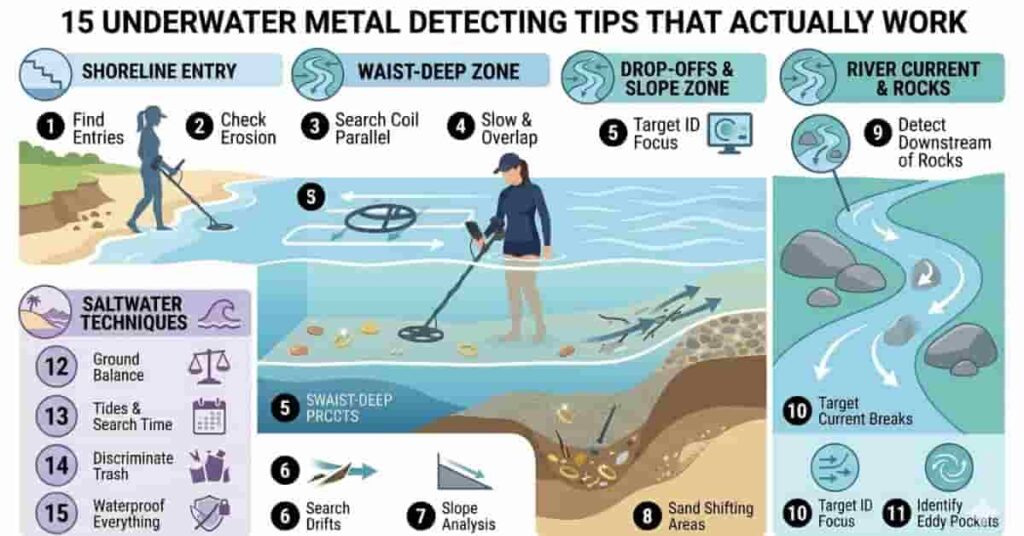
These underwater metal detecting tips are simple, proven, and based on real hunting behavior. Use them to find more targets in less time.
1. Start Where People Enter the Water
Most valuable items are lost right at entry points. People slip or dive into these areas, causing rings and chains to fall off. Focus on stairs, sandy edges, and popular access spots.
Pro Tips:
- Scan slowly around entry paths.
- Recheck the same area from different angles.
2. Hunt Waist-Deep Areas First
Waist-deep water offers the best mix of safety and high finds. This is where people swim, play, and lose jewelry most often. It’s also easier to recover targets here.
Pro Tips:
- Fully cover this depth before going deeper.
- Work in small, controlled sections
3. Sweep Parallel to the Shoreline
Targets often move along the shore due to waves and foot traffic. Sweeping parallel helps you follow natural drop paths and increases coverage.
Pro Tips:
- Keep your coil low and steady.
- Overlap each sweep for full coverage.
4. Focus on Drop-Off Edges
Drop-offs act as natural traps for heavy items. As the ground slopes down, gold and coins settle in these edges and stay there.
Pro Tips:
- Move slowly along slope changes.
- Scan both the top and bottom of the drop.
5. Detect After Busy Weekends
More people mean more lost items. Hunting after weekends or holidays gives you fresh targets before others arrive.
Pro Tips:
- Go early in the morning for the best results.
- Focus on high-traffic zones first.
6. Focus on Slow Current Zones
In rivers, fast water moves targets, but slow zones collect them. Look for calm areas where the current weakens and where heavy items can drop.
Pro Tips:
- Scan the edges of fast and slow water.
- Work slowly in these zones.
7. Search Behind Large Rocks
Large rocks block water flow and create calm pockets behind them. These spots act like natural gold traps where heavy items settle.
Pro Tips:
- Scan directly behind and beside rocks.
- Check deeper pockets around them.
8. Check Gravel Bars & Bends
Gravel bars and river bends slow down water movement. This causes heavier targets, such as coins and rings, to accumulate over time.
Pro Tips:
- Focus on inner bends where the flow is slower.
- Scan low spots in gravel areas.
9. Hunt Near Old Bridge Crossings
Old bridges are high-activity areas from the past. People crossed, stopped, and dropped items here, making them great target zones.
Pro Tips:
- Scan both upstream and downstream.
- Look for older structure remains.
10. Scan Historic Access Points
Old entry paths, boat launches, and crossing areas often hold lost items. These spots were used for years, increasing your chances of finding.
Pro Tips:
- Research older maps if possible.
- Focus on worn or visible paths.
11. Lower Sensitivity in Saltwater
Saltwater can cause false signals due to mineral content. Lowering sensitivity helps stabilize your detector and improve accuracy.
Pro Tips:
- Adjust settings until signals are stable.
- Test with known targets if unsure.
12. Ground Balance Frequently
Changing conditions affect your detector’s performance. Regular ground balancing keeps signals clear and reduces noise.
Pro Tips:
- Rebalance when moving areas
- Pay attention to signal changes.
13. Use a Long-Handle Sand Scoop
A long-handle scoop saves time and effort, especially in water. It allows faster recovery without bending or losing targets.
Pro Tips:
- Choose a sturdy, foot-assisted scoop.
- Practice quick recovery techniques.
14. Secure Your Finds Immediately
Water can easily take your finds back. Always store items safely as soon as you recover them.
Pro Tips:
- Use a secure pouch or zip pocket.
- Avoid holding loose items in your hand.
15. Track Tides & Water Movement
In saltwater areas, tides affect where targets settle. Knowing tide patterns helps you hunt at the right time and location.
Pro Tips:
- Hunt during low tide for better access
- Focus on newly exposed areas.
Best Equipment for Underwater Metal Detecting (Buyer-Focused)
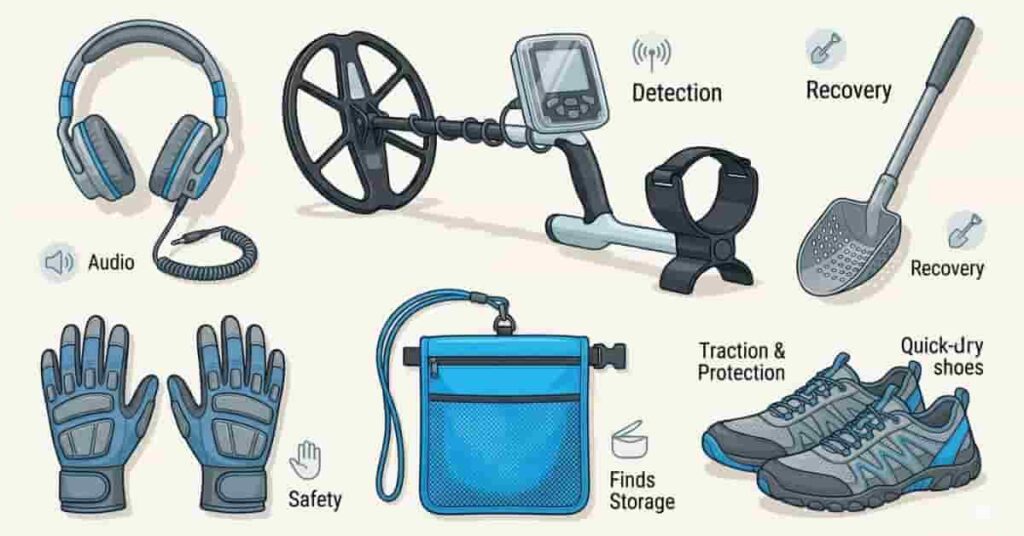
Using the right gear is critical if you want to succeed with underwater metal detecting. Water conditions are tougher than land, so standard equipment won’t perform well. The right setup helps you detect deeper, recover faster, and avoid losing valuable finds.
Below is a simple breakdown of essential gear and how to choose each item wisely.
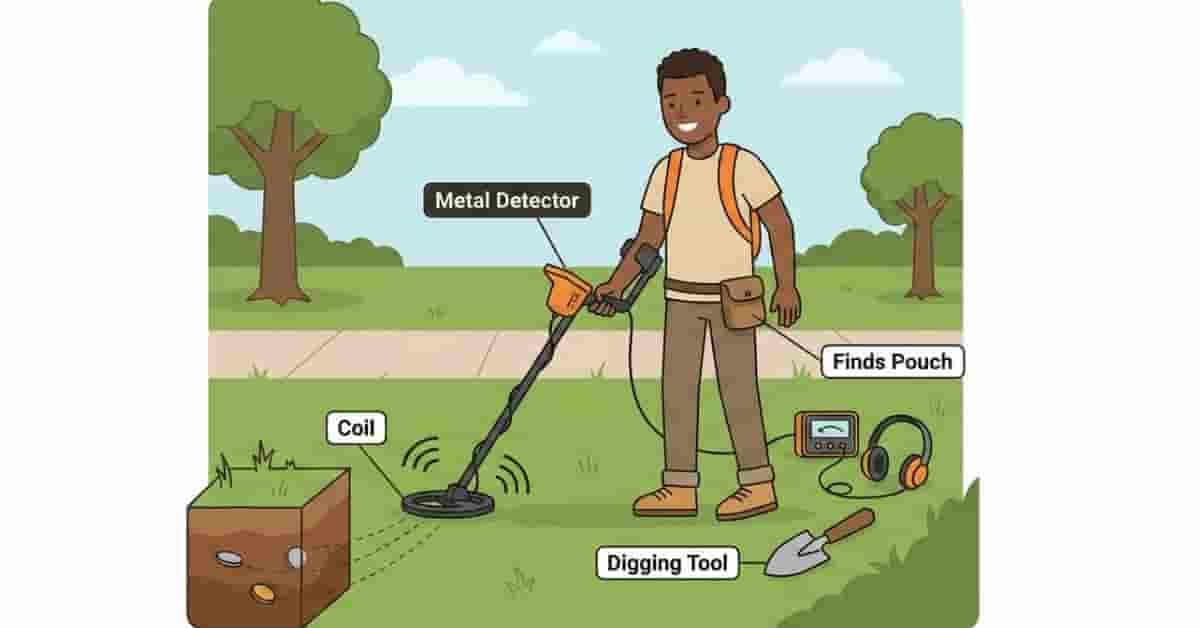
Fully Submersible Metal Detectors (What to Look For)
A fully waterproof detector is the most important tool. Many basic detectors only allow the coil to be submerged in water, not the entire unit. For real underwater hunting, you need full submersion capability.
Models like the Minelab Excalibur II are built for deep-water use and can withstand harsh salt conditions.
When choosing, look for:
- High waterproof rating (at least IP68)
- Multi-frequency technology for better depth and accuracy
- Stable performance in saltwater
Some detectors can even reach depths of 20–60 meters underwater, making them ideal for serious hunters.
Pro Tips:
- Avoid “water-resistant” models for underwater use.
- Choose multi-frequency detectors for saltwater stability.
Waterproof Headphones (Why They’re Critical)
Sound behaves differently underwater. Normal headphones lose clarity, making it hard to hear weak signals. Waterproof headphones solve this issue by delivering clear audio even when submerged.
Advanced options like bone conduction headphones transmit sound through vibration, improving clarity underwater.
These are especially useful in noisy water conditions where regular audio struggles.
Long-Handle Scoop (Efficiency Factor)
Recovery is harder in water because visibility drops fast. A strong sand scoop lets you recover targets quickly before they move again.
A well-built scoop with proper holes helps separate sand from targets efficiently.
Long handles are better because they reduce bending and improve control in moving water.
Floating Finds Pouch (Loss Prevention)
Water can easily take back your finds if you’re not careful. A floating pouch keeps your items secure while making them easy to access.
Look for:
- Mesh design for water drainage
- Strong clips or belt attachment
- Multiple compartments
This simple tool prevents one of the most common mistakes—losing recovered targets.
Wetsuit, Gloves & Footwear (Comfort + Safety)
Water conditions can change quickly, especially in rivers and oceans. Proper clothing protects you from cold, sharp objects, and fatigue.
Basic gear includes:
- Wetsuit for temperature control
- Gloves for grip and protection
- Water shoes or boots for stability
These items improve comfort and allow longer hunting sessions without risk.
🛠️ How to Choose the Right Gear (Quick Guide)
If you’re just starting, don’t overcomplicate your setup. Focus on essentials first, then upgrade as needed.
Beginner Setup:
- Fully waterproof detector (entry-level)
- Basic waterproof headphones
- Strong scoop + pouch
Intermediate Setup:
- Multi-frequency detector
- Long-handle scoop
- Protective gear
Advanced Setup:
- Deep-water detector
- Specialized headphones (bone conduction)
- Full diving gear
Safety Tips for Metal Detecting in Water
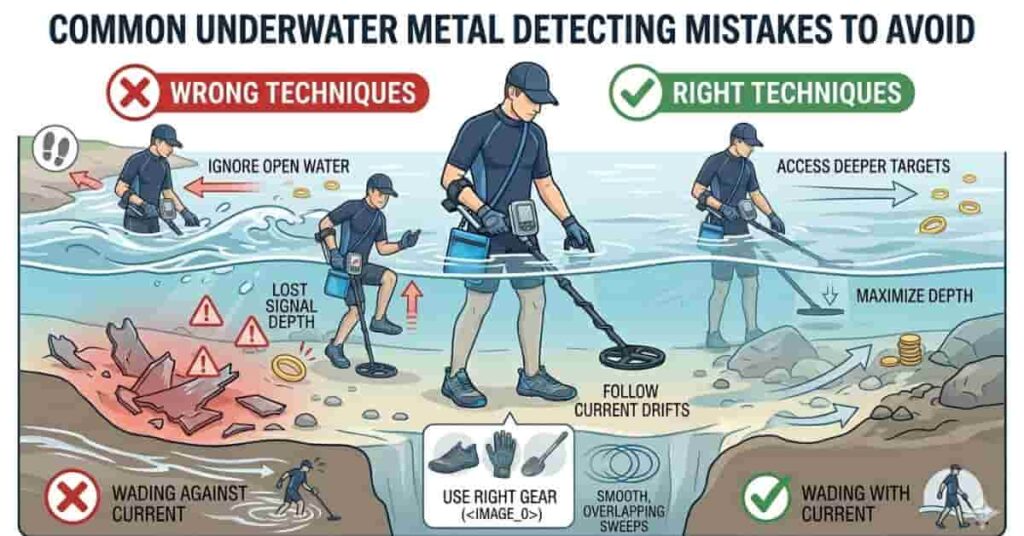
Safety should always come first when using underwater metal detecting tips. Water conditions can change quickly, and small mistakes can turn risky. By understanding common hazards, you can protect yourself and enjoy longer, stress-free hunts.
Strong currents are one of the biggest dangers, especially in rivers. Even if the surface looks calm, underwater flow can pull your legs or shift your balance. Many beginners step into deeper water without realizing how fast the current is moving.
Never detect alone in deep water. If something goes wrong, like slipping into a drop-off or getting stuck, having someone nearby can make a huge difference. Solo hunting may seem convenient, but it adds unnecessary risk.
Sudden drop-offs are another common hazard. In lakes and rivers, the ground can change from shallow to deep within a step. This can cause you to lose footing instantly, especially when focused on signals.
Weather and tides also play a major role. Calm water can turn rough quickly due to wind or changing tides. Ignoring weather conditions often leads to dangerous situations.
Protective footwear is essential. Sharp rocks, glass, or hidden debris can easily injure your feet. Proper shoes give you grip and prevent cuts.
Real Risk Scenarios:
- A detectorist steps into a calm river but gets pulled by a hidden current and loses balance.
- A sudden drop-off causes a quick fall into deeper water while focusing on a signal.
- Loose items slip from the hand and are lost due to unstable footing.
- Sharp debris on the bottom causes foot injuries without proper footwear.
Where to Find Gold Jewelry in Water
Finding gold is the main goal of most underwater metal-detecting tips. The key is not luck—it’s understanding human behavior and how water moves lost items. Gold doesn’t scatter randomly. It follows patterns based on where people gather and how water shifts targets.
When people enter, swim, or jump into water, they often lose rings, chains, and bracelets. These items slip off due to cold water, movement, or impact. Once lost, gold quickly sinks and settles in nearby low areas.
Swimming Zones (Why Gold Drops Here)
Swimming areas are the most reliable spots to find gold. People stay active here, constantly moving their hands and arms. Cold water also shrinks fingers, making rings loose.
This combination leads to frequent jewelry loss, especially in shallow to waist-deep water.
Rope Swings & Diving Spots
Rope swings and jumping areas are high-impact zones. When people hit the water, the force often knocks loose items off instantly. Rings and chains are especially vulnerable here.
These targets usually sink straight to the bottom or settle nearby.
Boat Docks & Entry Points
Docks and entry points see constant movement. People adjust gear, climb in and out, or handle equipment. During these actions, jewelry can easily slip off.
Since water movement is often slower here, targets tend to stay close to where they were lost.
Popular Tubing Areas
Tubing spots involve strong currents and constant movement. People drift, spin, and lose control, increasing the chance of dropping valuables.
Water flow then carries these items downstream until they settle in slower zones.
Underwater Slopes & Drop-Offs
Slopes and drop-offs act as natural collection points. As gold sinks, gravity pulls it down these slopes until it reaches a stable position.
This makes the bottom of slopes one of the best places to find heavier items, such as rings.
Conclusion
You’ve learned how water movement, human behavior, and the right strategy lead to better finds. These proven techniques show where targets settle and how to recover them faster.
By applying these underwater metal detecting tips, you can avoid common mistakes and start finding more gold in rivers, creeks, and shallow water. Focus on high-activity zones, read the environment, and stay consistent with your approach.
If you found this guide helpful, share it with fellow detectorists. Have a question or a success story? Drop it in the comments—I’d love to hear about your finds.

Ethan Callaway is a passionate metal detecting enthusiast based in Savannah, Georgia, USA. Currently pursuing a B.S. in Archaeology & Historical Preservation at the University of Georgia, he combines his love for treasure hunting with research-backed insights on metal detecting techniques, safety practices, and site guidance.
Through MetalDetectingUSA.com, Ethan shares practical tips, honest product reviews, and beginner-friendly advice to help both new and experienced detectorists explore metal detecting across the United States with more confidence and understanding.