
Table of Contents
Introduction
Do you ever wonder why seasoned detectorists uncover historic coins while your finds are mostly spare change?
Many beginners in the USA start excited, but miss where real coins hide. Parks seem “hunted out,” signals are confusing, and results are frustrating quickly. The truth is, small strategy changes can make a big difference when coin hunting.
These coin-detecting tips help you find more targets, especially older and silver coins. Learn where to search, how to read signals, and what mistakes to avoid. I’ll share simple techniques experienced detectorists use across the USA.
Take these tips and start applying them on your next outing to dig better finds.
Why Coin Hunting Is the Most Popular Type of Metal Detecting

Coin hunting remains the top choice for beginners because it offers quick wins and steady learning. You don’t need advanced gear or deep technical knowledge to start finding coins. With a few coin-metaling tips, even your first outing can yield results.
Another big reason for coin hunting’s popularity is the high success rate. Coins are found everywhere—parks, schools, sidewalks, and old gathering spots. Unlike relic hunting, you don’t need remote locations, making it perfect for hobbyists in busy areas across the USA.
Additionally, coin hunting is easy to learn. Most detectors clearly identify coin signals, so beginners quickly build confidence. Within a few hunts, you’ll start recognizing common tones and target IDs, which keeps motivation high.
Another aspect that keeps coin hunting engaging is the real excitement of finding valuable old coins. Discovering a silver dime or a wheat penny connects you to history, and some coins have collector value, especially those from the early 1900s or earlier.
Finally, coin hunting offers strong silver and collectible potential. Many experienced detectorists still focus on coins for this reason alone. Even “hunted out” parks can produce hidden treasures with the right approach.
Takeaways
- Coin hunting is beginner-friendly and easy to learn.
- High success rate keeps motivation strong.
- Old coins add historical and collectible value.
- Silver finds offer real excitement and reward.
The 15 Best Metal Detecting Tips for Finding Coins
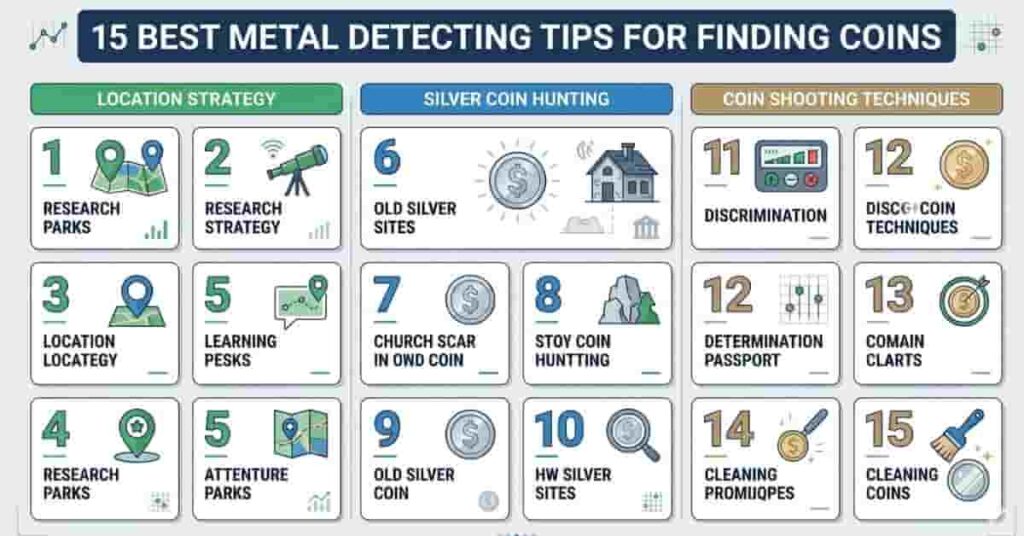
Finding more coins is not about luck—it’s about smart strategy. These metal detecting coin hunting tips focus on location, signals, and technique. Follow them step by step, and your results will improve fast.
🔹 SECTION A – Location Strategy (Most Important)
1. Hunt Older Parks First
Older parks give you the best chance to find old and silver coins. Focus on parks built before 1950, especially those with a long community history. These places saw decades of foot traffic, which means more lost coins.
Look for original park sections, not newly renovated areas. Old picnic spots, walkways, and entrances are strong targets. Many beginners make the mistake of hunting random areas without thinking about age.
A simple habit helps a lot—research the park’s history before you go. If people used it 50–100 years ago, coins are likely still there.
Pro Tip: Start near old paths or benches where people rested.
2. Research Historic Maps & Sanborn Maps
Historic maps reveal locations that no longer exist but once thrived. Old schools, homes, and fairgrounds often turn into empty land or modern parks.
Use free tools like USGS maps or Sanborn maps to find these spots. Compare old maps with current satellite views to locate hidden coin hotspots.
This method separates casual hunters from serious ones. It takes extra time but leads to better finds, especially older coins.
Pro Tip: Look for areas marked as “gathering places” or “public use” in old maps.
3. Focus on Old Schools & Fairgrounds
Old schools and fairgrounds are rich in coins. Kids and crowds regularly drop coins, especially in high-energy environments.
Focus on:
- Playgrounds (older ones, not new plastic setups)
- Edges of sports fields
- Entry and exit points
Fairgrounds are even better if they hosted events decades ago. Temporary booths and rides often led to coin losses.
These areas are often overlooked today, but still hold many targets.
Pro Tip: Hunt the edges, not just the center. Coins scatter outward over time.
4. Detect Near Large Shade Trees
Large, old trees are silent coin magnets. People sat under them for shade, picnics, and rest for decades.
Look for trees with thick trunks and wide canopies. These usually indicate age. The ground around them often holds coins at different depths.
Sweep slowly in circles around the tree base. Many coins settle near roots or slightly outward.
This simple trick works in almost every old park.
Pro Tip: Focus on the shady side, where people preferred to sit.
5. Target High-Traffic Gathering Areas
Coins drop where people gather. Always think like a crowd.
Best spots include:
- Picnic areas
- Event zones
- Near food vendors
- Path intersections
Even modern parks can produce coins if foot traffic is high. But older high-traffic areas give better chances for silver.
Avoid empty open spaces unless you have a reason to search them.
Pro Tip: Follow the “people pattern,” not random ground.
🔹 SECTION B – Finding Old & Silver Coins
6. Listen for Faint Deep Signals
Old coins are usually deeper, which means weaker signals. Beginners often ignore faint tones, thinking they are trash.
Train your ear to notice soft but repeatable signals. These often indicate deeper, older targets.
Slow down your swing speed to catch these signals clearly. Fast swinging can cause you to miss them completely.
Pro Tip: If a signal repeats from multiple directions, dig it—even if it’s faint.
7. Dig Repeatable High Tones
High tones often indicate coins, especially silver. But consistency matters more than sound alone.
If a signal repeats clearly from different angles, it’s worth digging. Even if the ID number jumps slightly, a repeatable tone is a strong sign.
Avoid chasing random, broken signals unless you are experienced.
Pro Tip: Turn 90 degrees and scan again. A good coin signal stays consistent.
8. Lower Discrimination to Avoid Missing Silver
High discrimination settings can block trash—but also valuable coins. Many silver coins fall into ranges that get filtered out.
Lower your discrimination slightly to allow more signals through. Yes, you’ll dig more trash, but you’ll also find better targets.
Balance is key. Don’t go full “all-metal” unless you are comfortable.
Pro Tip: Test your detector on known coins to understand their signal range.
9. Hunt After Rain for Better Depth
Moist soil improves signal conductivity. After rain, your detector can “see” deeper targets.
Coins that were once out of reach may now give clear signals. This makes rainy days perfect for serious hunting.
Just make sure the ground is safe and not too muddy.
Pro Tip: Hunt a familiar area after rain—you may find targets you missed before.
10. Revisit “Hunted Out” Parks
No park is ever truly empty. Many detectorists miss deep or tricky signals.
Return to old locations with a slower approach. Change your pattern, lower discrimination, or use a smaller coil if possible.
You’ll be surprised how many coins still remain.
Pro Tip: Hunt at a different angle than before. It reveals hidden targets.
🔹 SECTION C – Coin Shooting Techniques
11. Use a Tight Grid Pattern
A grid pattern ensures full coverage of an area. Without it, you’ll miss spots.
Divide the ground into small sections and scan each one carefully. Move in straight lines, then cross-check from another direction.
This method works best in high-potential areas.
Pro Tip: Mark your grid mentally or use landmarks to stay consistent.
12. Overlap Your Sweeps
Gaps between swings cause missed targets. Always overlap each sweep slightly.
This ensures no ground is left unchecked. It may feel slower, but it improves accuracy.
Most beginners swing too wide and miss coins.
Pro Tip: Imagine your coil covering 80% of the previous sweep.
13. Master Target ID Numbers
Target ID helps identify coins without having to dig everything. Each coin type has a typical number range.
Spend time learning these ranges on your detector. Practice with real coins to build confidence.
However, don’t rely on numbers alone. Depth and tone also matter.
Pro Tip: Create a simple chart of common coin IDs for quick reference.
14. Check Mixed Signals Carefully
Mixed signals often mean multiple objects in one spot. Sometimes trash hides a coin.
Scan from different angles and slow down your sweep. A clean tone may appear within the noise.
Many valuable finds come from “messy” signals.
Pro Tip: If part of the signal sounds good, investigate further.
15. Re-Scan Every Hole
After digging a target, scan the hole again. Coins often appear in clusters.
You might find a second or even third coin in the same spot. This step takes seconds but adds big value.
Many beginners skip this and miss easy finds.
Pro Tip: Always check both the hole and the removed soil.
Best Detector Settings for Coin Hunting
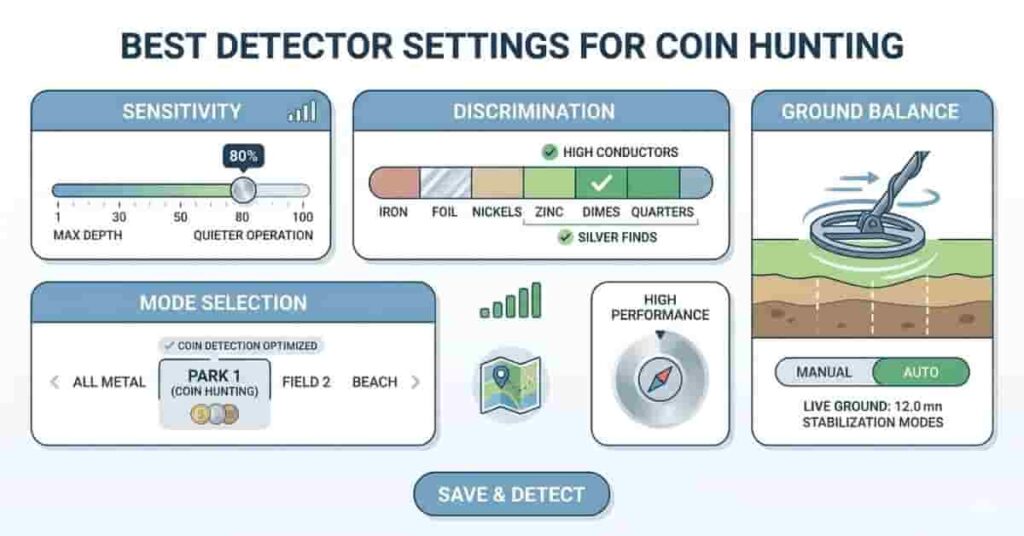
The right settings can turn weak signals into clear coin finds. Many beginners struggle here, but you don’t need complex tweaks. These simple metal-detecting tips for coins will help you get better results faster.
Start with sensitivity. Set it as high as possible without causing constant noise. High sensitivity helps detect deeper coins, especially older ones. If your detector becomes unstable, lower it slightly until it runs smoothly.
Next is discrimination. This setting filters out unwanted metals, such as iron. For coin hunting, keep discrimination moderate. Too high, and you may miss valuable coins like nickels or even silver. Too low, and you’ll dig too much trash.
Now choose between all-metal mode and discrimination mode. Beginners should start with the discrimination mode for cleaner signals. All-metal mode finds everything, including deep coins, but it can feel overwhelming at first.
Don’t ignore ground balance. Proper ground balance helps your detector adjust to soil minerals. Many modern detectors have auto ground balance, which works well in most parks.
A simple setup works best:
- Sensitivity: High but stable
- Discrimination: Medium
- Mode: Discrimination (beginner-friendly)
- Ground Balance: Auto or slightly adjusted
These settings give you a strong starting point for coin hunting without confusion.
Modern Coins vs Old Coins – What’s the Difference?
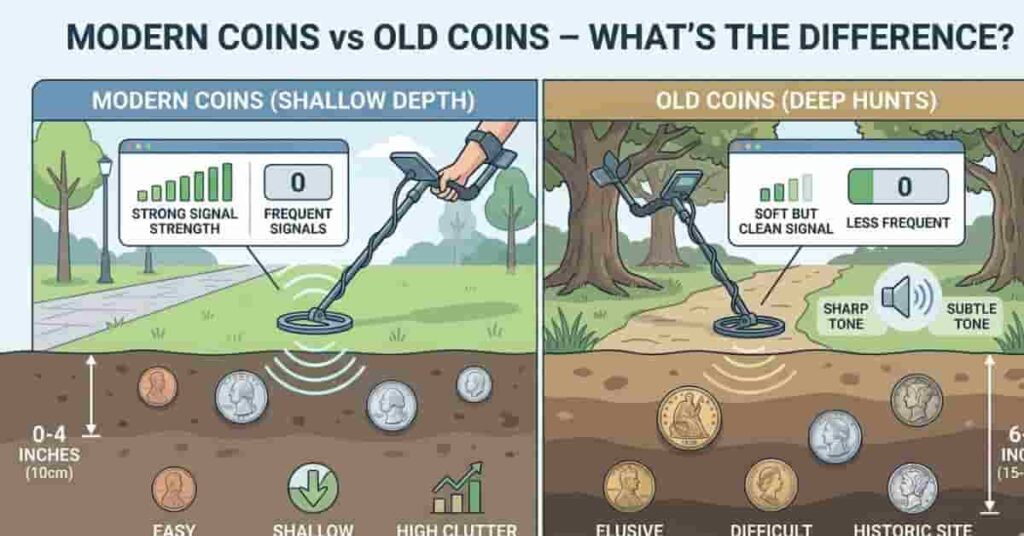
Not all coins sound or sit the same underground. Knowing the difference helps you focus on better targets. These metal detecting tips for coins make it easier to spot older finds.
First, look at depth. Modern coins usually sit in the top 2–4 inches. You’ll find them in active areas with recent foot traffic. Older coins sink deeper over time, often 5–10 inches or more. Soil movement and years of buildup push them down.
Next is the signal tone. Modern coins often give strong, sharp signals. Old coins can sound softer due to depth. However, silver coins still produce a smooth, clean tone. That “clean” sound is a key clue many beginners miss.
Location also matters. Modern coins show up in:
- Busy playgrounds
- Sports fields
- Near benches and paths
Older coins appear in:
- Historic parks
- Old sidewalks
- Areas used decades ago.
Finally, why do silver coins sound cleaner? Silver is a highly conductive metal. It produces a clear, stable signal with less “breakup” than trash or mixed metals.
Common Coin Hunting Mistakes
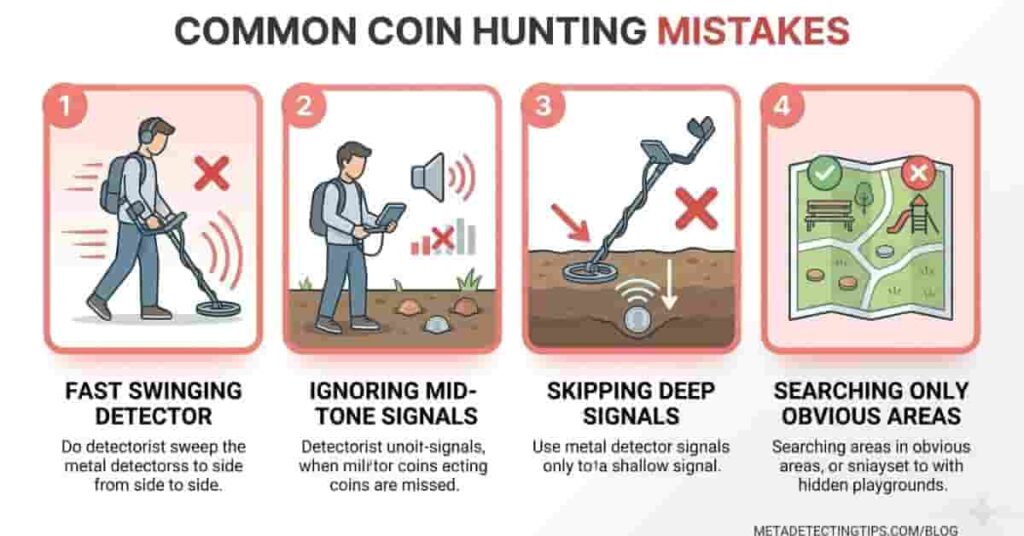
Many beginners miss good coins because of simple habits. Fixing these mistakes can quickly improve your results. These metal detecting tips for coins will help you avoid costly errors in the field.
One common mistake is ignoring mid-tones. Not all coins give perfect high tones. Nickels and some older coins often fall in the mid-range. If you skip them, you leave good finds behind.
Another issue is skipping deep signals. Deep coins sound faint, but they are often older and more valuable. Beginners tend to chase only loud signals, which usually means modern coins or trash.
Speed also matters. Swinging too fast causes missed targets. Your detector needs time to process signals. Slow, controlled sweeps help you hear weak tones clearly.
Finally, many people hunt only in obvious areas, such as open fields or near benches. While these spots can produce coins, they are often overhunted. The real finds are usually in less obvious places nearby.
How to Increase Your Silver Coin Finds
Finding more silver coins takes focus, patience, and smart decisions. These metal detecting tips for coins will help you target the right places and signals. Small changes in your approach can lead to big upgrades in your finds.
Start by focusing on the 1800s and early 1900s. Silver coins were commonly used in daily life during that time. Old parks, early neighborhoods, and historic town centers are your best bets. If a place had activity before 1950, it still holds potential.
Next, research old town maps. Look for sidewalks, schools, and gathering spots that existed decades ago. Many of these areas still exist today, even if they look modern. Matching old maps with current layouts helps you find hidden hotspots.
Pay close attention when you detect near sidewalks. People dropped coins while walking, waiting, or socializing. Focus on edges, corners, and intersections where traffic was highest.
Finally, hunt slow and deep. Silver coins are often buried deeper than modern coins. Move your coil slowly and listen for faint, clean signals. Rushing through an area will cost you good finds.
Pro Tips
- Revisit the same area from a new angle to find missed targets.
- Hunt early morning when ground noise is lower
- Use slightly lower discrimination to avoid missing silver.
conclusion
Coin hunting becomes easier when you use the right locations, settings, and techniques. You’ve learned how to read signals, avoid mistakes, and target deeper, older coins.
These metal detecting tips for coins give you a clear path to better finds. Stay patient, move slowly, and focus on high-potential areas. Over time, your skills will improve, and your results will grow. Many beginners in the USA see success once they apply these simple strategies consistently.
Now it’s your turn. Get out there, test these tips, and see what you uncover. If you find something exciting, share your experience in the comments or explore more guides on our site to keep improving.

Ethan Callaway is a passionate metal detecting enthusiast based in Savannah, Georgia, USA. Currently pursuing a B.S. in Archaeology & Historical Preservation at the University of Georgia, he combines his love for treasure hunting with research-backed insights on metal detecting techniques, safety practices, and site guidance.
Through MetalDetectingUSA.com, Ethan shares practical tips, honest product reviews, and beginner-friendly advice to help both new and experienced detectorists explore metal detecting across the United States with more confidence and understanding.