
Table of Contents
Introduction
Ever wondered why your metal detector finds a coin at 8 inches but misses a larger target nearby?
How deep can a metal detector detect depends on several factors, including the target size, soil conditions, coil, and detector technology. For beginners in the USA, understanding these factors can prevent unrealistic expectations when hunting for coins, jewelry, or relics.
Most hobby metal detectors work best on smaller targets within a limited depth. Larger metal objects can sometimes produce signals much deeper. However, depth claims from manufacturers don’t always match real-world results.
In this guide, you’ll learn how deep metal detectors can realistically detect different types of targets. We’ll cover typical coin depth, large-object detection, soil conditions, coil size, and detector technology.
You’ll also discover what affects detection depth and how to get better results in the field. By the end, you’ll know what depth to expect from your detector before heading out on your next hunt.
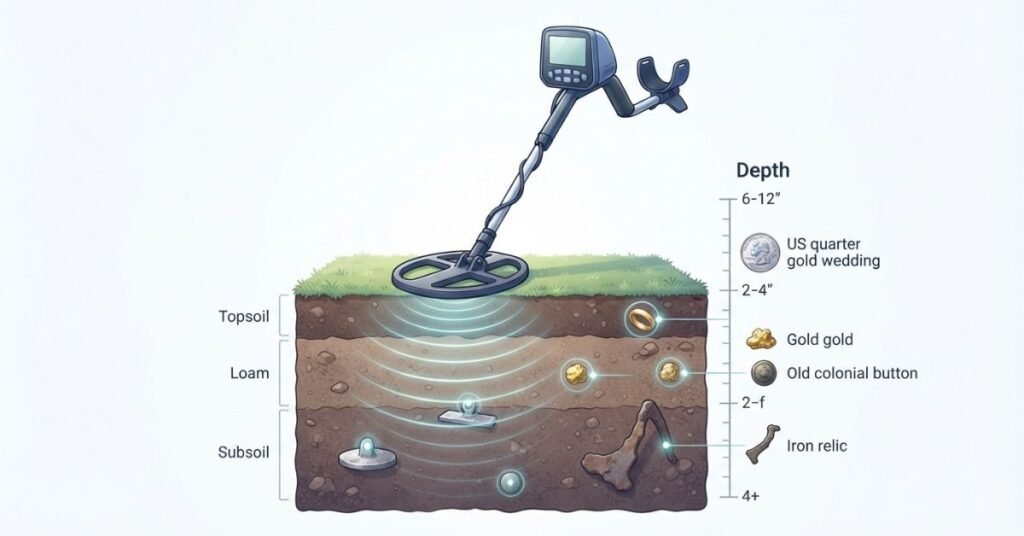
Most hobby metal detectors find coin-sized targets around 6–12 inches deep. Larger objects can reach 2–4 feet, while small gold nuggets often appear shallower. Specialized detectors may detect large metal caches 4+ feet deep, depending on soil, target size, coil, and detector technology.
- Coins: 6–12 inches
- Large objects: 2–4 feet
- Gold nuggets: 4–10 inches
- Large caches: 4+ feet with specialized detectors
What Affects How Deep a Metal Detector Can Detect?
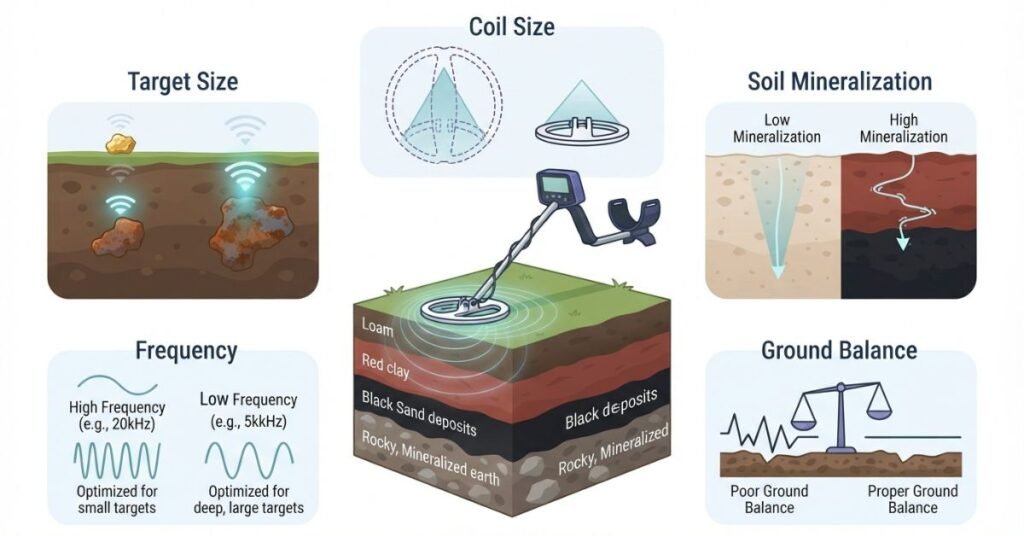
Detection depth doesn’t depend on the detector alone. Target size, soil, coil design, frequency, and ground balance all affect how deep a signal can reach. Understanding these factors helps beginners set realistic expectations and choose better settings for different hunting conditions.
If you’re specifically searching for gold, our guide explains [how deep a metal detector can detect gold] and what can influence that depth.
1. Size of the Target
Target size strongly affects detection depth. Small objects, such as tiny gold pieces, usually produce weaker signals and become harder to detect at greater depths.
Larger metal objects create stronger responses because they interact with more of the detector’s electromagnetic field. However, target shape, orientation, and composition also influence the signal.
Expert tip: Don’t judge depth by target size alone. A large object positioned poorly can produce a weaker signal than a smaller, well-oriented target.
2. Soil Mineralization
Mineralized soil can reduce detection depth and make targets harder to identify. Common examples include red clay in parts of the southern U.S., black sand on beaches, and rocky mineralized ground in the western U.S.
Highly mineralized ground can also create false signals or interfere with target identification. A detector with effective ground balancing can handle these conditions more reliably.
3. Coil Size
A larger search coil can generally detect larger targets deeper under suitable conditions. However, larger coils may struggle more with target separation in areas containing many nearby objects.
Smaller coils cover less ground but can separate closely spaced targets more effectively. They also work well around rocks, trees, and other obstacles.
4. Frequency
Detector frequency affects how the machine responds to different targets. Higher frequencies tend to improve sensitivity to small, low-conductivity targets such as tiny gold.
Lower frequencies often perform well on larger, higher-conductivity targets. However, frequency alone doesn’t determine maximum depth. Detector design and operating conditions also matter.
5. Ground Balance Settings
Ground balance helps a detector account for naturally occurring minerals in the soil. Correct settings can reduce ground interference and improve target detection.
If ground balance is poorly adjusted, mineralized soil may create unstable signals or mask deeper targets. Use the detector’s recommended ground-balancing method for the soil you’re hunting in.
Pro Tip: Recheck ground balance when soil conditions change, especially when moving between different hunting locations.
How Deep Does a Metal Detector Penetrate or Reach?
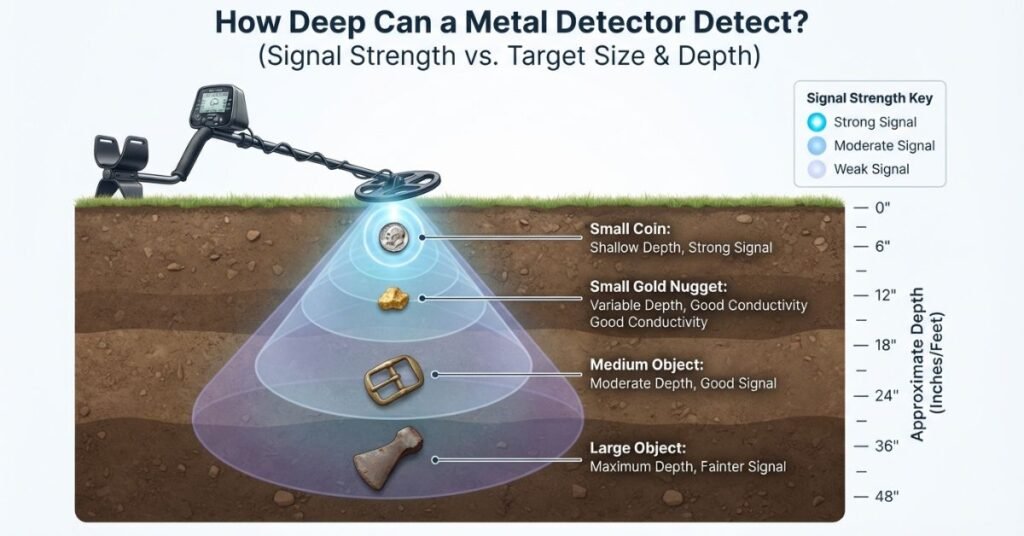
When people ask how deep does a metal detector penetrate, they usually mean how far its electromagnetic field can detect a metal target. The detector doesn’t send a narrow beam straight downward. Its search field spreads through the ground around the coil, with sensitivity changing by coil design and detector technology.
Once you understand detection depth, you can focus on the other side of the equation: [where to find gold with a metal detector] for better search opportunities.
A detector’s effective detection field is often described as roughly cone-shaped. However, the actual field varies by coil type, target, soil conditions, and operating frequency. Signal strength generally decreases as the target gets farther from the coil.
Small objects become harder to detect at depth because they produce weaker signals. Larger or more conductive targets can create stronger responses and remain detectable farther away.
So, how deep can a metal detector reach? There isn’t one fixed depth for every target. Target conductivity, size, orientation, soil mineralization, coil size, and detector settings all matter.
Understanding these factors also explains how deep do metal detectors work in real-world conditions. Manufacturer depth claims may not match what you’ll achieve in the field.
How Deep Can a Metal Detector Detect Coins?
Coins are among the most common targets for hobby metal detecting. Their detection depth varies based on the coin’s size, metal composition, orientation, soil conditions, and detector setup.
Modern clad coins made from common copper, nickel, and other alloys can produce clear signals at moderate depths. Silver coins often respond strongly because silver has high electrical conductivity, although depth still depends on several conditions.
Old coins buried in parks can sometimes sit deeper because of years of soil buildup, landscaping, and natural ground changes. However, you shouldn’t assume every deep coin will produce a detectable signal.
In practice, 6–12 inches provides a useful general expectation for many coin-sized targets with hobby detectors. Actual results can vary significantly between machines and locations.
How Deep Can a Metal Detector Detect Gold?
Gold detection depth varies greatly with target size, shape, detector frequency, and soil conditions. Tiny gold nuggets usually produce weaker signals than larger targets.
Gold rings can often produce stronger responses because they contain more metal. Highly mineralized soil can reduce sensitivity and make small gold harder to detect.
For a deeper look at nugget hunting, detection settings, and gold-specific machines, consider adding an internal link to your future gold metal detecting guide.
Entry-Level vs Professional Detectors – Depth Comparison
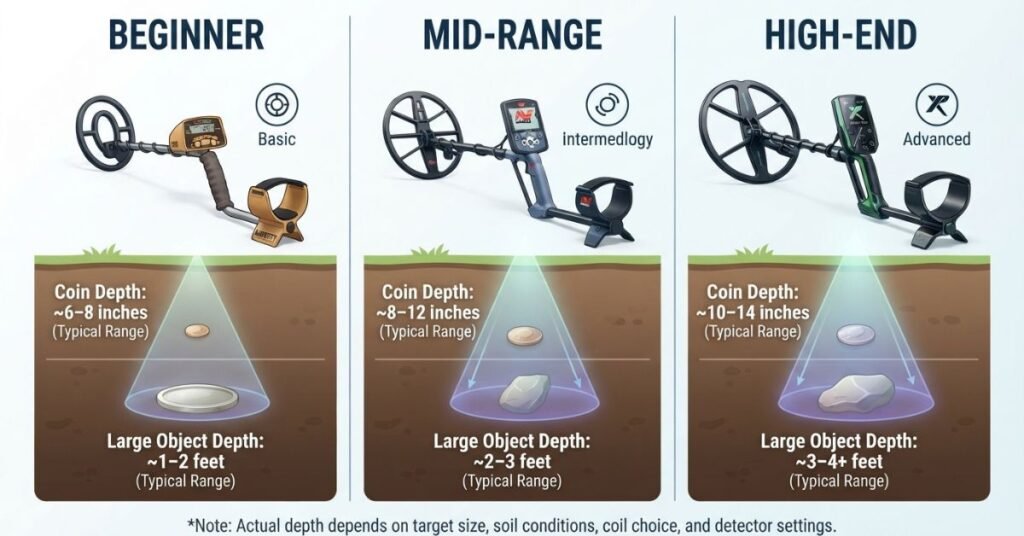
Detector price and technology can influence real-world detection depth. However, no detector guarantees a specific depth in every soil type.
The ranges below work as general comparison estimates, not guaranteed performance figures. Target size, soil conditions, coil choice, and detector settings can change results significantly.
| Detector Type | Typical Coin Depth | Large Object Depth |
|---|---|---|
| Beginner | 6–8 inches | 1–2 feet |
| Mid-range | 8–12 inches | 2–3 feet |
| High-end | 10–14 inches | 3–4+ feet |
Professional and high-end detectors may offer better sensitivity, advanced ground handling, larger coils, or specialized detection technologies. These features can improve performance in challenging conditions.
Still, more expensive doesn’t always mean dramatically deeper detection. Beginners should consider target type, soil conditions, discrimination, ground balance, and ease of use before focusing only on depth.
Pro Tip: Choose a detector based on your typical hunting location and targets, not its advertised maximum depth alone.
Can a Metal Detector Detect 10 Feet Deep?
Claims about a metal detector 10 feet deep often sound impressive, but they need careful interpretation. Most standard hobby detectors cannot reliably detect coin-sized targets anywhere near 10 feet underground.
Detection depth depends heavily on target size, conductivity, soil mineralization, coil design, and detector technology. A very large metal object can produce a signal much deeper than a small coin.
Specialized equipment can reach greater depths when searching for large buried objects. These systems may use large coils, pulse-induction technology, or other specialized designs. However, their performance still depends on the target and ground conditions.
So, how deep will metal detectors go? There is no universal maximum depth. A detector’s useful depth depends on what you’re searching for and where you’re searching.
Be cautious with advertisements promising extreme depth. Marketing claims may describe ideal conditions or very large targets rather than normal coin hunting.
Why You’re Not Getting Maximum Depth
Even a capable detector may perform poorly when settings or technique aren’t right. Beginners often lose depth because they focus on maximum sensitivity instead of stable operation.
Common causes include:
- Swinging too fast: Moving the coil quickly can reduce target response and make weak signals harder to hear.
- Sensitivity too high: Excessive sensitivity can create noise and unstable signals, especially in mineralized soil.
- Poor ground balance: Incorrect ground balance can increase interference and reduce usable detection performance.
- Cheap detector: Basic detectors may offer fewer controls and less effective ground handling than advanced models.
Pro Tip: Lower sensitivity slightly when your detector becomes unstable. A quieter detector can help you hear genuine deep targets more clearly.
Realistic Depth Expectations for Beginners
During your first 10 hunts, focus on learning your detector rather than chasing maximum depth. You need time to recognize target sounds, understand settings, and adjust to different ground conditions.
Common beginner mistakes include swinging too quickly, keeping the coil too high, changing several settings at once, and digging only strong signals. These habits can make deeper or weaker targets easier to miss.
Start with stable settings and learn how your detector responds to known targets. Practice over shallow coins before testing greater depths. Gradually adjust sensitivity as you become comfortable with ground noise and target signals.
Keep your coil close to the ground without scraping obstacles. Maintain a steady swing and overlap each pass slightly.
Takeaway: Better technique often improves results more than simply increasing sensitivity. Build confidence first, then experiment with advanced settings and deeper targets.
Conclusion
Metal detector depth depends on the target, soil conditions, coil size, frequency, and detector settings. Most hobby detectors find coins at moderate depths, while larger targets can reach much deeper.
Understanding how deep can a metal detector detect helps you set realistic expectations before every hunt. Good technique and proper ground balance can also improve your results.
Don’t get discouraged if you don’t find deep targets right away. Spend time learning your detector, practice different settings, and improve your swing technique gradually.
Ready for your next hunt? Explore more metal detecting guides on our website, or share your deepest find in the comments. Your experience could help another beginner improve their skills.
Frequently Asked Questions
Most hobby metal detectors can detect coin-sized targets around 6–12 inches deep under suitable conditions. Actual depth varies with target size, metal composition, soil mineralization, coil size, frequency, and detector settings.
In real conditions, many hobby detectors find coins within roughly 6–12 inches. Soil mineralization, moisture, target orientation, and detector settings can affect usable depth. Large metal objects may produce signals several feet underground.
A standard hobby detector usually won’t reliably detect small targets at 5 feet deep. Specialized equipment may detect very large metal objects at greater depths. Target size and conductivity play a major role in extreme-depth detection.
Most standard hobby detectors cannot reliably detect coin-sized targets at 10 feet deep. Specialized deep-seeking equipment may detect very large objects at extreme depths. Always treat advertised maximum depths as condition-dependent rather than guaranteed results.
More expensive detectors can offer better sensitivity, ground handling, coils, and advanced features. However, price alone doesn’t guarantee dramatically greater depth. Target size, soil conditions, coil choice, and detector settings also determine real-world performance.
Gold detection depth depends heavily on nugget size, shape, soil mineralization, frequency, and detector technology. Small gold nuggets usually produce weaker signals and may be detected at shallower depths. Gold rings can produce stronger responses because they contain more metal.
Target size, soil mineralization, coil size, frequency, and ground balance all affect detection depth. Larger targets generally produce stronger signals. Mineralized soil can reduce performance, while proper ground balance can improve stability and usable detection depth.
Use a steady coil swing, keep the coil close to the ground, and maintain proper ground balance. Avoid setting sensitivity so high that the detector becomes unstable. Learning your detector’s settings and practicing regularly can improve real-world performance.
A larger coil can generally improve depth on larger targets under suitable conditions. However, larger coils may provide less target separation in areas with many nearby objects. Smaller coils can work better around obstacles and heavily contaminated ground.
Yes. Highly mineralized soil can interfere with detection and reduce usable depth. Red clay, black sand, and mineralized rocky ground can create challenging conditions. Proper ground balance and suitable detector settings can help manage this interference.
Frequency affects how a detector responds to different targets. Higher frequencies tend to be more sensitive to small, low-conductivity targets such as tiny gold. Lower frequencies often perform well with larger, high-conductivity targets. Frequency alone doesn’t determine maximum depth.
Fast swinging, excessive sensitivity, poor ground balance, unsuitable settings, and difficult soil can reduce performance. Target size and orientation also matter. A stable detector with good technique often performs better than one running at maximum sensitivity.

Ethan Callaway is a passionate metal detecting enthusiast based in Savannah, Georgia, USA. Currently pursuing a B.S. in Archaeology & Historical Preservation at the University of Georgia, he combines his love for treasure hunting with research-backed insights on metal detecting techniques, safety practices, and site guidance.
Through MetalDetectingUSA.com, Ethan shares practical tips, honest product reviews, and beginner-friendly advice to help both new and experienced detectorists explore metal detecting across the United States with more confidence and understanding.