
Table of Contents
Introduction
What if the gold you’re searching for is only a few inches beneath your feet?
If you’re new to metal detecting, you may wonder how deep a metal detector can actually find gold. The answer depends on several factors, including target size, detector technology, coil choice, soil conditions, and gold type.
In U.S. goldfields, these factors can make a major difference. Arizona, California, and Nevada have highly mineralized areas that can challenge many detectors.
This guide explains how deep can a metal detector detect gold under realistic conditions. You’ll learn what depths beginners can expect from common detectors and specialized gold detectors.
We’ll also cover how soil mineralization, target size, operating frequency, and search coils affect gold detection depth. You’ll discover why advertised depth ratings often differ from real-world results.
By the end, you’ll know what depth is realistic and how to improve your chances of finding deeper gold.
How Deep Can a Metal Detector Detect Gold in Real Conditions?
Soil, target size, and detector technology can change gold detection depth dramatically. A detector that finds a tiny gold flake near the surface may struggle with deeper targets.
For beginners, the following ranges provide a rough field guide, not guaranteed depths. Real results vary by detector, coil, frequency, ground mineralization, target shape, and orientation.
| Gold target | Approximate detection depth |
|---|---|
| Small flakes | 1–3 inches |
| Small nuggets | 2–6 inches |
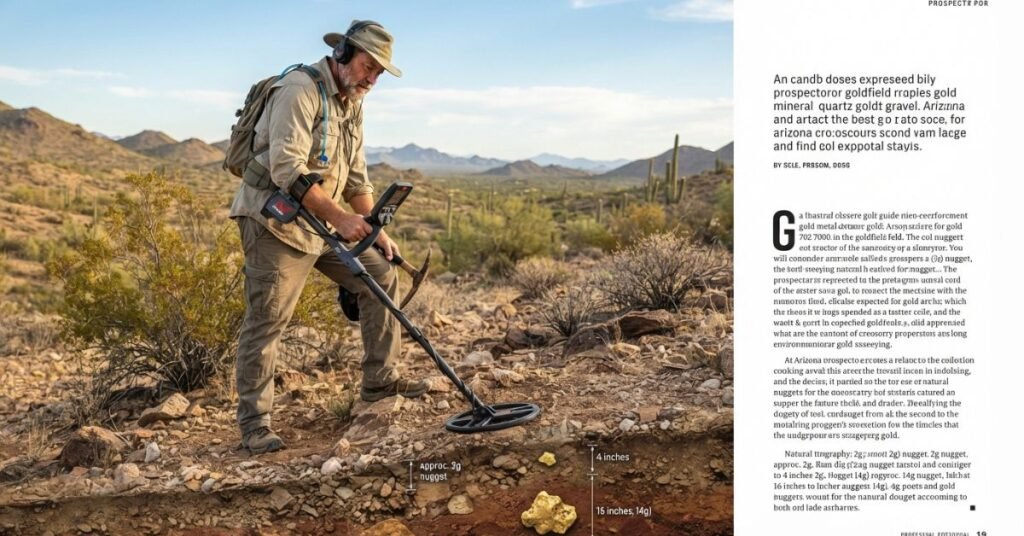
| Larger nuggets | 8–14 inches |
| Gold cache | 2+ feet with specialized equipment |
Small flakes: Tiny gold pieces offer very little surface area for a detector to respond to. They usually require shallow detection and a sensitive gold-focused detector.
Small nuggets: Larger pieces provide a stronger signal than flakes. In favorable ground, specialized detectors can locate small nuggets several inches deep.
Larger nuggets: Bigger gold targets can produce stronger signals at greater depths. However, highly mineralized soil can reduce practical detection depth.
Gold caches: Large buried gold objects can potentially produce signals much deeper than individual nuggets. However, depths beyond two feet require suitable equipment, large coils, favorable ground, and a sufficiently large target.
These ranges shouldn’t be treated as fixed limits. Gold detection depth depends heavily on the entire detecting setup and the ground beneath your search area.
Pro Tip
Don’t judge a detector only by its advertised maximum depth. Test it with known targets in soil similar to your hunting location.
Why Gold Is Harder to Detect Than Other Metals?
Finding gold with a metal detector can be challenging, even when the target sits only a few inches underground. Gold behaves differently from larger, more conductive targets such as coins and silver objects.
Before worrying about depth, it helps to understand [whether a metal detector can find gold] and why small gold targets can be challenging.
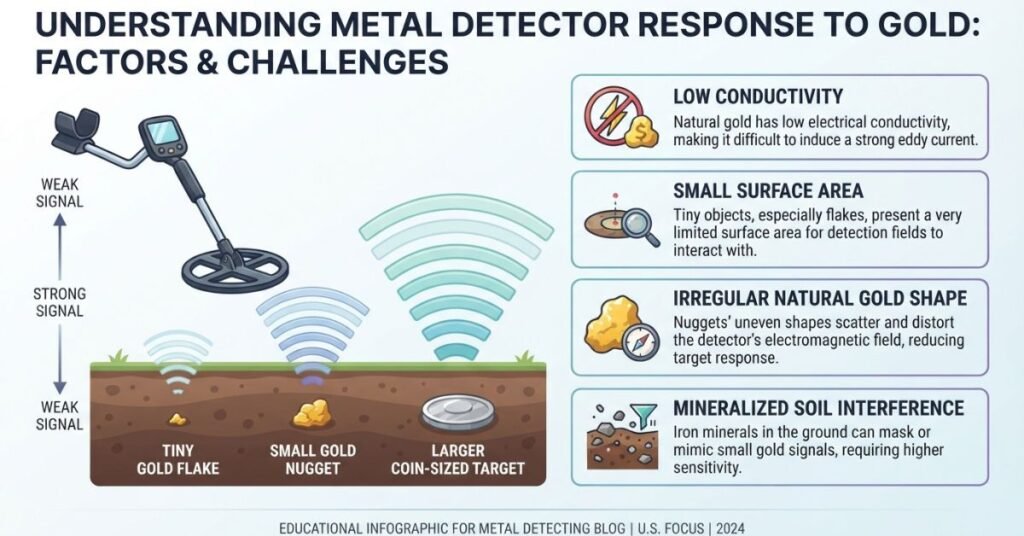
One major issue is target size. A tiny gold flake or nugget produces a much weaker electromagnetic response than a large coin. The smaller the target, the less detectable signal reaches the search coil.
Gold also has different electrical properties from many common detecting targets. A small natural gold nugget can produce a weak and inconsistent response. This makes it harder to identify, especially when the target sits near the detector’s sensitivity limit.
Target shape creates another challenge. Natural gold rarely has a perfect, predictable shape. Nuggets can be thin, rough, twisted, or irregular. Their orientation can affect how strongly the detector responds.
Mineralized Soil Makes Gold Detection Even Harder
Goldfields often contain iron-rich minerals that create strong ground signals. These signals can mask small gold targets and make the detector less stable.
This problem is common in parts of Arizona, California, and Nevada. Highly mineralized ground can reduce practical detection depth and force hunters to lower sensitivity.
Expert Tip
Don’t increase sensitivity blindly when searching for gold. If the detector becomes noisy, reduce sensitivity and use proper ground balancing.
Best Frequency for Detecting Gold at Depth
Detector frequency plays an important role when you’re trying to answer how deep can a metal detector detect gold. However, frequency alone doesn’t determine maximum depth.
Knowing your detector’s potential depth is useful, but you also need the right techniques, which are covered in our [beginner guide to finding gold with a metal detector].
Many dedicated gold detectors operate at relatively high frequencies, commonly around 15–40 kHz. Higher frequencies generally respond well to small, low-conductivity targets. That makes them useful for finding small nuggets and fine gold.
The trade-off is important. A high-frequency detector can offer excellent sensitivity to tiny gold, but frequency doesn’t guarantee greater depth on large targets. Larger gold objects may benefit from lower frequencies or other detector technologies.
High-Frequency Detectors
High-frequency machines are popular among prospectors because they can respond strongly to small gold targets. They’re particularly useful when searching for tiny nuggets in gold-bearing ground.
However, mineralized soil can still limit their practical performance. Detector settings and ground balance remain critical.
Multi-Frequency Detectors
Multi-frequency detectors transmit or process multiple frequencies. This approach can provide useful versatility across different target types and ground conditions.
Some modern machines can perform well on both small gold and larger targets. They can also provide advantages when conditions change during a hunt.
The Depth vs Sensitivity Trade-Off
The best frequency depends on what you’re trying to find. If tiny nuggets are your priority, sensitivity to small targets matters greatly. If you’re searching for larger, deeper objects, overall detector design and coil performance become more important.
Expert Tip
Choose a detector based on your target size and ground conditions, not frequency alone. A well-tuned detector can outperform a poorly configured high-frequency machine.
How Soil Affects Gold Detection Depth
The ground beneath your coil can matter as much as the detector itself. Highly mineralized soil can create strong signals that interfere with small gold targets.
This matters greatly in several U.S. prospecting regions. Parts of Arizona, California, and Nevada contain mineralized ground that can challenge even capable gold detectors.
Highly Mineralized Desert Soil
Desert goldfields often contain iron-rich minerals and hot rocks. These materials can produce unwanted responses and make tiny nuggets harder to hear.
A detector may need lower sensitivity or careful ground balancing. These adjustments can improve stability, although they may reduce sensitivity to extremely weak targets.
Red Clay
Red clay often contains iron minerals that can interfere with detector operation. The effect varies by location and mineral content.
Some red-clay areas can produce significant ground responses. Proper ground balancing becomes especially important when searching for small gold.
Black Sand
Black sand commonly contains magnetic minerals such as magnetite. It can create strong ground signals and make small targets difficult to separate from the background.
Beach hunters can encounter black sand, while gold prospectors may find it in placer deposits. The exact effect depends on mineral concentration and detector technology.
USA-Focused Reality
A detector that performs well in mild soil may behave differently in a California goldfield. That’s why advertised depth shouldn’t become your only buying or hunting benchmark.
Expert Tip
Before searching deeply, ground balance your detector carefully. Then test a known gold target at different depths in the actual soil.
Coil Size vs Gold Depth
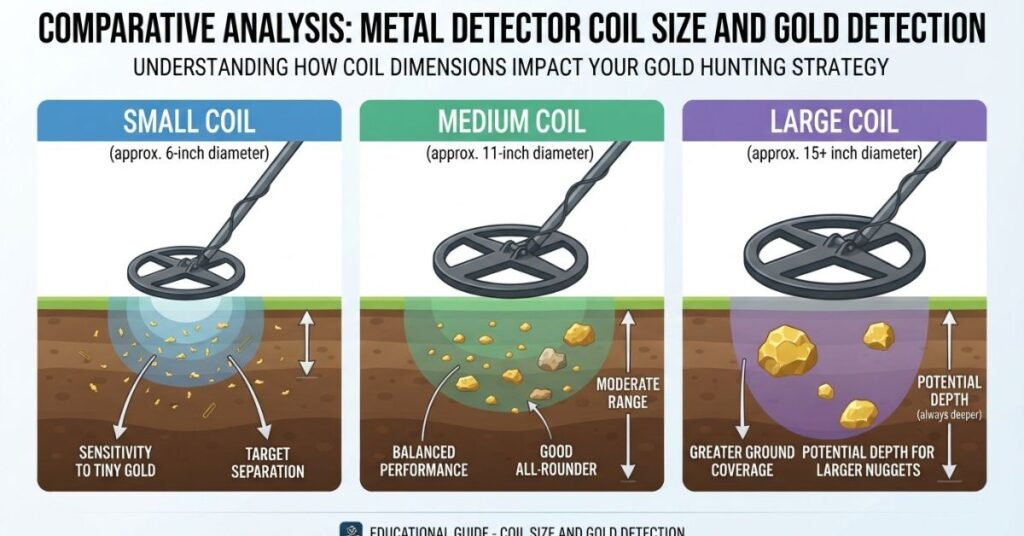
Your search coil can significantly change how your detector behaves in the field. However, a larger coil doesn’t automatically mean you’ll find every gold target deeper.
Small coils work especially well for tiny gold. Their smaller detection footprint can improve target separation and make it easier to search around rocks, cracks, and uneven ground.
Small coils also have an important advantage in highly mineralized areas. They can sometimes reduce the amount of mineralized ground being detected at once. This may make the detector easier to control.
Large coils cover more ground with each sweep. They can also provide greater detection depth on sufficiently large targets under favorable conditions.
However, large coils can become harder to manage in heavily mineralized soil. They may also respond strongly to ground minerals, reducing practical performance.
Which Coil Should You Choose?
Your choice should match the gold you’re hunting.
- Tiny flakes and small nuggets: Choose a small, sensitive coil.
- Moderate-sized nuggets: A medium coil offers a useful balance.
- Large nuggets or larger targets: A larger coil may provide greater depth.
- Highly mineralized ground: A smaller coil can offer better control.
Coil design matters too. Two coils with similar sizes can perform differently because of their technology and construction.
Expert Tip
Start with a smaller coil when learning to detect natural gold. It can make target signals easier to understand in difficult ground.
Can a Metal Detector Find Gold 10 Feet Deep?
A metal detector finding gold at 10 feet deep sounds impressive, but it isn’t realistic for most hobby detecting situations. Depth depends heavily on target size, soil conditions, detector technology, and coil design.
For a tiny gold nugget, even a few extra inches can make detection difficult. Natural gold often produces weaker signals than larger metal objects. Mineralized ground can reduce detection depth even further.
Large buried metal objects are a different story. A very large gold cache could potentially produce a signal at unusual depths with specialized equipment. However, that doesn’t mean a detector can reliably locate ordinary gold nuggets 10 feet underground.
A 10-foot detection claim should be treated carefully. Manufacturers may discuss maximum detection depths under controlled conditions. Real-world hunting usually produces much shallower results.
Myth vs. Reality
- Tiny gold at 10 feet: Extremely unlikely with hobby equipment.
- Small nuggets at 10 feet: Not a realistic expectation.
- Large gold targets: Greater depths may be possible under favorable conditions.
- Very large caches: Specialized equipment may detect exceptionally large targets deeper underground.
The key point is simple: detector depth increases with target size, but soil and detector performance still set practical limits.
Beginner vs Professional Gold Detectors – Depth Comparison
Different detector types offer different levels of sensitivity and depth. However, these figures are general field ranges, not guaranteed specifications.
| Detector Type | Small Gold | Large Gold |
|---|---|---|
| Entry-Level | 2–4 in | 6–8 in |
| Gold-Specific | 4–8 in | 10–14 in |
| High-End PI | 6–12 in | 2+ ft |
Entry-level detectors can work for shallow targets and beginner practice. They’re usually less suitable for tiny gold in heavily mineralized ground.
Gold-specific detectors focus more heavily on small, low-conductivity targets. They can offer better sensitivity for natural gold, especially when paired with suitable coils and settings.
High-end pulse induction (PI) detectors can handle challenging mineralized ground particularly well. Their performance can make them useful for serious gold prospecting. However, they still don’t guarantee extreme depth on ordinary nuggets.
Why These Numbers Vary
The same detector can produce different results at different locations. A large nugget in mild soil may produce a stronger signal than a tiny nugget in highly mineralized ground.
Target orientation also matters. A flat nugget can respond differently from the same nugget positioned edge-on.
Coil size, detector settings, ground balance, and electromagnetic interference can also affect performance.
Use these ranges as practical expectations, not promises. Actual gold detection depth should always be tested with known targets in comparable soil.
Conclusion
Metal detector depth depends on gold size, soil mineralization, coil choice, frequency, and detector technology. Small gold usually requires shallow detection, while larger targets can reach greater depths.
Understanding how deep can a metal detector detect gold helps beginners set realistic expectations. A detector may find small nuggets within a few inches, while specialized equipment can reach deeper targets.
Remember that advertised depth doesn’t always match field performance. U.S. goldfields in Arizona, California, and Nevada can create challenging mineralized conditions.
Start by learning your detector, testing known targets, and adjusting settings carefully. Good technique often matters as much as equipment.
Have you found gold with a metal detector? Share your experience in the comments, or explore more metal detecting guides on our website.
Frequently Asked Questions
Most hobby detectors can detect small gold nuggets only a few inches deep. A practical range for small nuggets is around 2–6 inches under favorable conditions. Larger nuggets can produce stronger signals and may reach roughly 8–14 inches with suitable equipment and ground conditions. Specialized gold detectors can perform better in mineralized ground. Actual depth depends on nugget size, detector frequency, coil size, soil mineralization, target orientation, and detector settings. Treat depth ranges as realistic guidelines, not guarantees.
Yes, metal detectors can find gold underground when the target produces a detectable electromagnetic response. Natural gold nuggets, jewelry, coins, and larger gold objects can all be detected. However, gold isn’t automatically easier to detect than other metals. Small nuggets often produce weak signals, while mineralized soil can create interference. Gold-specific detectors can improve sensitivity to small targets. Proper ground balancing and careful sweeping can also help maximize performance.
There isn’t one standard depth where gold is buried. Natural gold can occur close to the surface or much deeper underground. For metal detecting, shallow nuggets are generally more realistic targets. Small flakes and nuggets may fall within the first few inches of soil. Larger buried objects can produce signals at greater depths. Geological conditions also vary across U.S. goldfields, including areas of Arizona, California, and Nevada.
An expensive detector doesn’t automatically detect every gold target deeper. Price can reflect better sensitivity, ground handling, technology, coils, and specialized features. High-end gold detectors may perform better on difficult mineralized ground. They can also provide better sensitivity to small or weak targets. Still, target size and soil conditions remain major limitations. A costly detector cannot guarantee extreme depth, especially on tiny gold nuggets.
Finding ordinary gold nuggets at 10 feet deep isn’t a realistic expectation for most hobby metal detectors. Small gold usually becomes difficult to detect at much shallower depths. Very large buried metal objects can potentially produce signals at greater depths. Specialized equipment may also locate unusually large targets deeper underground. Claims about 10-foot gold detection should therefore be viewed carefully. Real-world depth depends on target size, detector technology, coil design, and ground conditions.
Several factors influence how deep a detector can find gold. Target size, soil mineralization, detector technology, coil size, frequency, and settings all matter. Larger gold usually produces a stronger signal than tiny flakes. Highly mineralized soil can reduce detection depth and create unwanted responses. Coil choice also matters. Small coils can improve sensitivity and target separation, while larger coils may provide greater depth on larger targets. Proper ground balancing and detector settings can make a significant difference.

Ethan Callaway is a passionate metal detecting enthusiast based in Savannah, Georgia, USA. Currently pursuing a B.S. in Archaeology & Historical Preservation at the University of Georgia, he combines his love for treasure hunting with research-backed insights on metal detecting techniques, safety practices, and site guidance.
Through MetalDetectingUSA.com, Ethan shares practical tips, honest product reviews, and beginner-friendly advice to help both new and experienced detectorists explore metal detecting across the United States with more confidence and understanding.