
Table of Contents
Introduction
Have you ever wondered how deep your metal detector can actually find a hidden target?
Knowing how deep can metal detectors detect metal helps beginners set realistic expectations before heading into a field, beach, or backyard. Detection depth can vary greatly depending on the target’s size, metal type, soil conditions, and detector settings.
A small gold ring may be harder to detect at depth than a larger silver coin. Highly conductive metals can also produce stronger signals under certain conditions. Soil mineralization can further reduce detection depth, especially in challenging ground.
In this guide, you’ll learn how deep a metal detector can find different metals, including gold, silver, copper, and iron. We’ll compare typical detection depths and explain the factors that affect performance.
You’ll also learn practical ways to improve your detector’s depth without relying on unrealistic claims. This will help you understand your machine and search more effectively.
Detection Depth by Metal Type (Quick Comparison)
Metal detectors don’t have one fixed detection depth for every target. A detector may find one object deeper than another under the same conditions. Target size, metal properties, soil, coil size, and detector settings all affect the result.
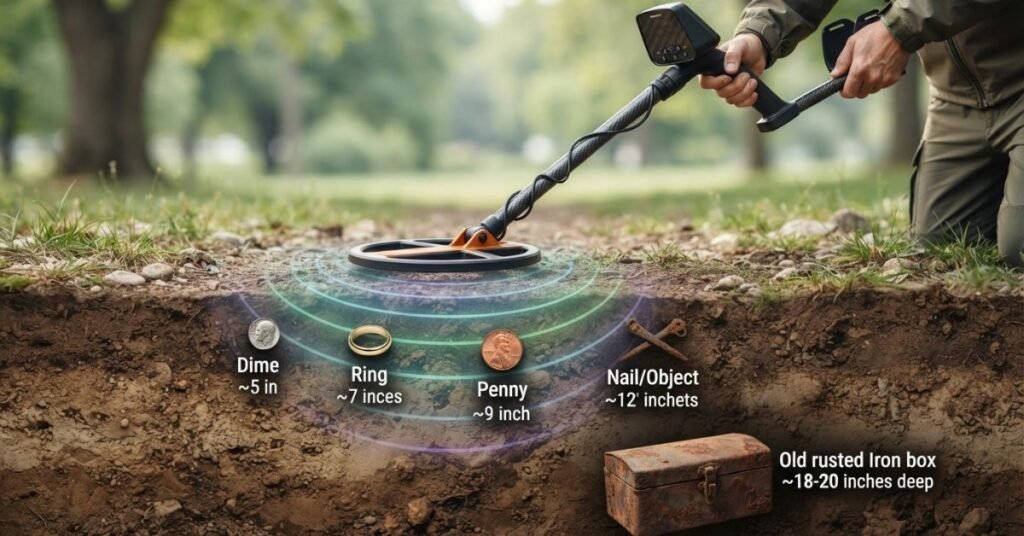
For a quick comparison, the following ranges can serve as rough examples, not guaranteed depths:
- Silver coins: about 8–14 inches
- Copper objects: about 8–12 inches
- Gold objects: about 4–10 inches
- Iron objects: about 6–10 inches
- Large metal objects: about 2–4 feet
These ranges can vary widely between detectors and targets. A large metal object can produce a stronger signal than a small coin. A tiny gold item may also become difficult to detect at relatively shallow depths.
For beginners, depth numbers should serve as a general guide rather than a promise. Your actual results may differ significantly in mineralized soil, wet sand, or areas with heavy metal trash.
A useful way to think about detection depth is target strength, rather than metal type alone. A large silver object may be easier to detect than a tiny gold ring. The detector’s coil and operating frequency can also influence which targets respond well.
Why Some Metals Are Detected Deeper Than Others
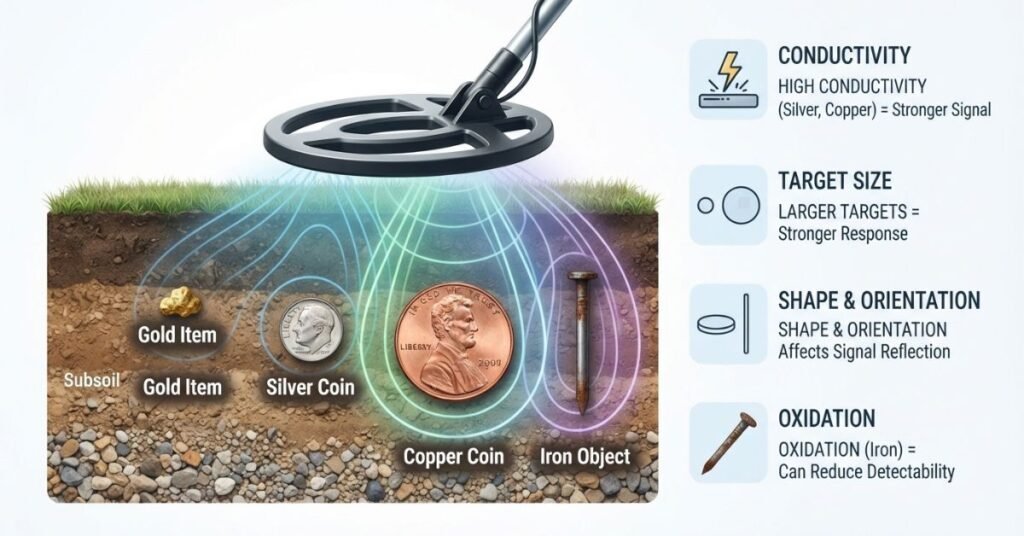
Different metals can produce different detector responses because their electrical properties and physical characteristics vary. However, metal type alone doesn’t determine detection depth.
Conductivity plays an important role. Highly conductive metals can often produce stronger electromagnetic responses. Silver and copper generally conduct electricity better than gold and iron. Detector design also affects how these differences appear in the signal.
Target size matters just as much. Larger objects usually interact with more of the detector’s electromagnetic field. A large metal object can therefore produce a stronger response than a tiny coin or jewelry item.
Shape can change the signal too. A flat coin may respond differently from a thin wire or irregular metal fragment. The target’s orientation underground can also influence the strength and consistency of the signal.
Oxidation and corrosion can affect how an object responds. Iron commonly develops rust, which can change its electrical characteristics and make identification more difficult.
How Deep Can a Metal Detector Detect Silver?
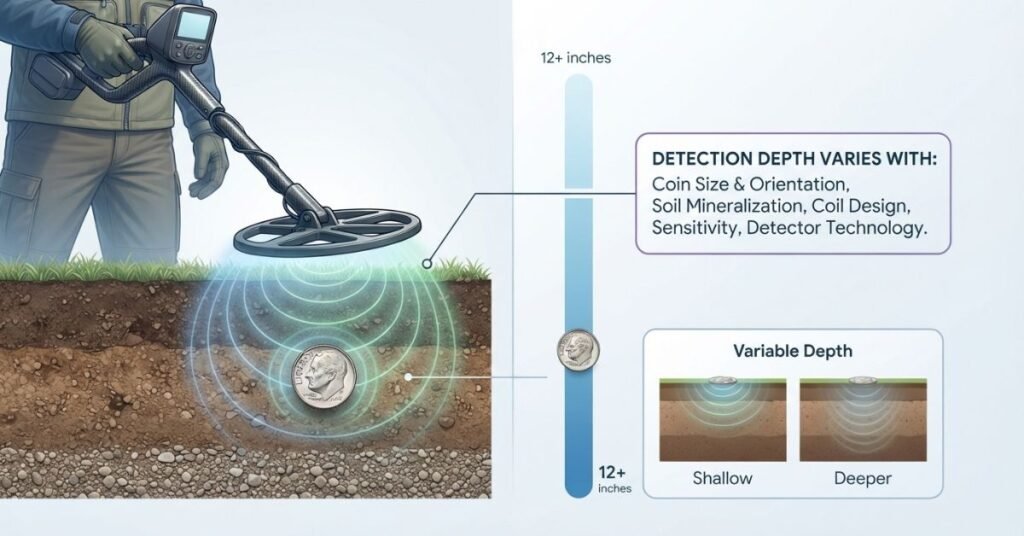
Silver is one of the most conductive metals, so many metal detectors can produce a strong response from silver targets. However, conductivity alone doesn’t determine how deep the detector can find a silver object.
If gold is your main target, our guide on [how to find gold with a metal detector] covers the techniques and conditions that can improve your search.
A silver coin may be detectable around 8–14 inches under favorable conditions. This range is only a general guide. Your actual depth depends on the coin’s size, orientation, soil mineralization, search coil, and detector settings.
Larger silver objects may produce signals deeper than small coins. Highly mineralized ground can reduce detection depth, while suitable settings can improve target response.
For beginners, don’t treat 8–14 inches as a guaranteed maximum. Think of it as a practical reference range for certain silver targets.
How Deep Can a Metal Detector Detect Copper?
Copper is also highly conductive and can produce a strong signal on many metal detectors. Common copper targets include coins, wire, fittings, and other buried objects.
A copper coin or similarly sized target may be detectable around 8–12 inches in favorable conditions. The actual depth can change significantly based on target size, soil conditions, detector frequency, coil design, and sensitivity settings.
A large copper object may produce a response at greater depth than a small coin. However, increasing sensitivity doesn’t always improve results in difficult soil. It can also increase unwanted signals.
If you’re searching for copper coins, use a stable setup and listen for repeatable signals. Consistent target responses are usually more useful than simply chasing the deepest possible signal.
How Deep Can a Metal Detector Detect Iron?
Iron behaves differently from highly conductive metals such as silver and copper. Detectors can often identify iron through target identification and discrimination features.
An iron object may be detectable around 6–10 inches, depending on its size and shape. Large iron objects can produce signals much deeper, while small nails may become difficult to detect as depth increases.
Discrimination can reduce the practical detection depth for iron. When you reject iron targets, the detector may ignore or reduce their audio response. This helps reduce trash signals but can also hide desirable targets with similar characteristics.
Rusty iron can create especially confusing signals. Large or oddly shaped iron objects may also produce unusual target IDs.
Pro Tip
Avoid using maximum discrimination when searching unfamiliar ground. A low-discrimination setting can help you investigate questionable signals before deciding what to ignore.
How Deep Can a Metal Detector Detect Large Metal Objects?
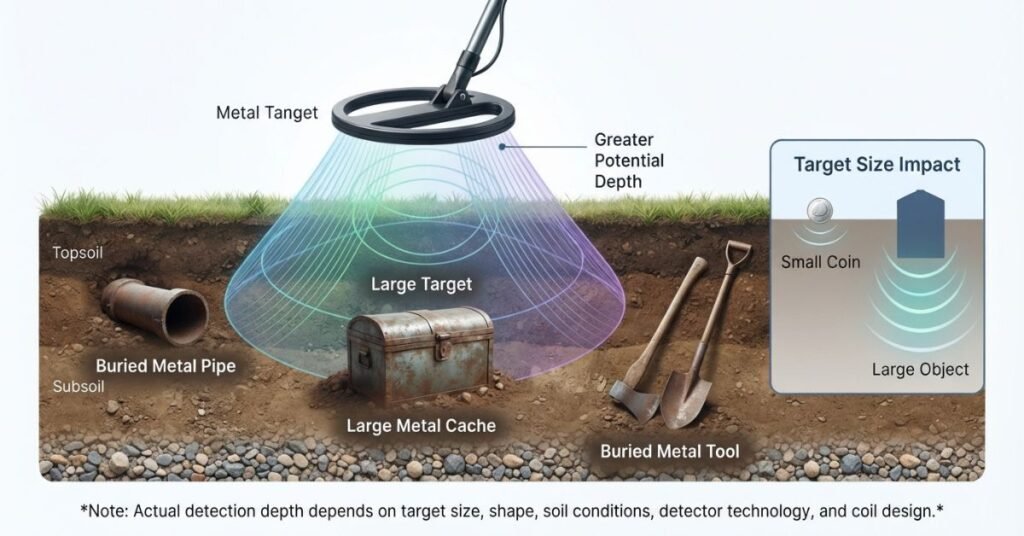
Large metal objects can be detected much deeper than small coins or jewelry. Their larger size allows them to interact with more of the detector’s electromagnetic field.
Under favorable conditions, large objects may produce detectable signals around 2–4 feet deep. However, this is a broad reference range, not a guaranteed performance limit. Detector technology, target size, soil conditions, and coil selection can make a major difference.
Common large targets include:
- Caches: Buried groups of coins or metal items can create stronger signals than individual pieces.
- Pipes: Large metal pipes may produce broad or inconsistent signals depending on their material and orientation.
- Buried tools: Shovels, machinery parts, and other large tools can produce strong responses at greater depths.
Target shape and orientation matter here. A long pipe may produce a different response from a compact metal cache. Nearby metal objects can also interfere with the signal.
For deep targets, avoid assuming that a stronger signal always means a valuable object. Large iron, pipes, and other buried scrap can produce powerful signals too.
Does Metal Type Affect Signal Strength?
Yes, metal type can affect the strength and character of a detector’s signal. Different metals interact with the detector’s electromagnetic field in different ways.
Depth is only one part of successful gold detecting. Choosing productive locations is equally important, so learn [where to find gold with a metal detector].
Conductive metals can create stronger electromagnetic responses because they allow electrical currents to develop within the target. These currents produce a secondary field that the detector’s coil can sense.
However, signal strength doesn’t depend on metal type alone. Target size, shape, orientation, depth, soil mineralization, and coil design also matter. A large iron object can produce a much stronger signal than a tiny gold item.
Signal strength can also decrease as the target gets deeper. The detector receives less energy from a distant target, making the response weaker and harder to interpret.
For beginners, a strong signal doesn’t automatically mean a valuable metal. A powerful response could come from large iron, buried pipes, machinery, or other metal objects.
Can a Metal Detector Detect Metal 5–10 Feet Deep?
Most standard consumer metal detectors aren’t designed to reliably detect small targets 5–10 feet underground. Claims of extreme depth often involve unusually large targets, specialized equipment, or controlled conditions.
For typical coin, jewelry, and relic hunting, useful detection depths are usually much shallower. A detector may detect a large buried object deeper than a coin because its larger size creates a stronger electromagnetic response.
At several feet deep, target size becomes especially important. A large pipe or metal cache may produce a detectable signal, while a small coin at the same depth may remain invisible.
Specialized deep-seeking detectors can search for larger metal objects at greater depths. Their performance still depends heavily on target size, soil conditions, detector technology, and search coil design.
Bottom line: Don’t expect a regular metal detector to reliably find small objects 5–10 feet deep. Extreme-depth claims should always specify the target size and testing conditions.
Conclusion
Metal detector depth depends on the target’s metal type, size, shape, soil conditions, and detector settings. Silver, copper, gold, and iron can produce different responses, while larger objects may reach greater depths.
Understanding how deep can metal detectors detect metal helps beginners set realistic expectations. Standard detectors usually work best for coins, jewelry, and other targets within practical detecting ranges. Very deep targets often require larger objects or specialized equipment.
Don’t focus only on maximum depth when choosing or using a detector. Learn your machine, adjust settings carefully, and practice with known targets.
Share your own metal detecting experiences in the comments. You can also explore more beginner-friendly metal detecting guides and calculators on our website.
Frequently Asked Questions
What metal can be detected the deepest?
Large metal objects can generally be detected deeper than small coins or jewelry. Target size, shape, soil conditions, coil design, and detector settings all affect depth. Highly conductive metals like silver and copper can produce strong signals, but metal type alone doesn’t determine maximum depth.
Does gold show up deeper than silver?
Not necessarily. Silver is generally more conductive than gold, so silver targets can produce strong detector responses. However, target size matters greatly. A large gold object may be detected deeper than a tiny silver coin. Soil conditions, detector frequency, coil size, and settings also affect the result.
Can metal detectors detect stainless steel?
Yes, many metal detectors can detect stainless steel. However, stainless steel has different electrical and magnetic properties than common targets. Some stainless-steel objects may produce weaker or less predictable signals. Detection also depends on the object’s size, composition, shape, depth, and detector technology.
How deep can metal detectors detect large objects?
Large metal objects can sometimes be detected around 2–4 feet under favorable conditions. These objects may include pipes, buried tools, caches, and machinery parts. This isn’t a guaranteed depth range. Larger targets usually create stronger signals, while soil mineralization and detector design can reduce detection depth.
Can a metal detector detect metal 5–10 feet deep?
Standard consumer metal detectors usually aren’t designed to reliably detect small targets at 5–10 feet. Specialized deep-seeking detectors may detect much larger objects at greater depths. Claims about extreme depth should always identify the target’s size and testing conditions.
Does metal type affect metal detector depth?
Yes, metal type can affect signal strength and target response. Conductive metals can produce strong electromagnetic responses. However, depth also depends on target size, shape, orientation, soil mineralization, coil design, and detector settings. A large iron object can therefore produce a stronger signal than a tiny gold target.
Why can large objects be detected deeper?
Large objects interact with more of the detector’s electromagnetic field. This can create a stronger response that remains detectable at greater depths. A buried pipe or large metal cache may therefore produce a signal deeper than a small coin. Shape and orientation can also affect the response.
How deep can a metal detector detect a silver coin?
A silver coin may be detectable around 8–14 inches under favorable conditions. This is a general reference, not a guaranteed maximum. Coin size, orientation, soil mineralization, coil design, sensitivity, and detector technology can all change the actual detection depth.
How deep can a metal detector detect gold?
Small gold targets can be challenging to detect at depth. A general reference range for gold objects is around 4–10 inches, but actual performance varies significantly. Larger gold objects may be detected deeper than small jewelry. Soil conditions and detector technology also play important roles.
Can discrimination reduce detection depth?
Discrimination can affect which targets produce an audible response. When you reject certain metals, the detector may ignore or reduce their signals. This can make searching easier in areas with iron trash. However, excessive discrimination can cause you to miss targets that share similar characteristics.

Ethan Callaway is a passionate metal detecting enthusiast based in Savannah, Georgia, USA. Currently pursuing a B.S. in Archaeology & Historical Preservation at the University of Georgia, he combines his love for treasure hunting with research-backed insights on metal detecting techniques, safety practices, and site guidance.
Through MetalDetectingUSA.com, Ethan shares practical tips, honest product reviews, and beginner-friendly advice to help both new and experienced detectorists explore metal detecting across the United States with more confidence and understanding.