

Table of Contents
Introduction
Can a simple metal detector really uncover a gold nugget hidden beneath the ground?
If you’re new to metal detecting in the USA, you may wonder whether gold is something your detector can actually find. The answer isn’t as simple as detecting coins, jewelry, or other common metals.
Can a metal detector find gold? Yes, but several factors affect how well it works. Gold nuggets can be tiny, deeply buried, or surrounded by mineralized soil. These conditions can make gold much harder to detect.
In this guide, you’ll learn how metal detectors detect gold and which factors affect performance. We’ll also explain what types of detectors work best for gold prospecting.
You’ll discover how gold’s size, shape, depth, and conductivity affect detection. By the end, you’ll know what to expect before taking your detector into the field.
Can a Metal Detector Find Gold?
Yes, a metal detector can find gold, but performance varies by detector and target. Gold’s size, shape, conductivity, depth, and surrounding soil all affect detection. Small natural gold can be especially difficult to detect because it produces a weaker signal than larger metal objects.
If you’re completely new to gold detecting, our [beginner guide to finding gold with a metal detector] is a good place to learn the basics.
How Do Metal Detectors Detect Gold?
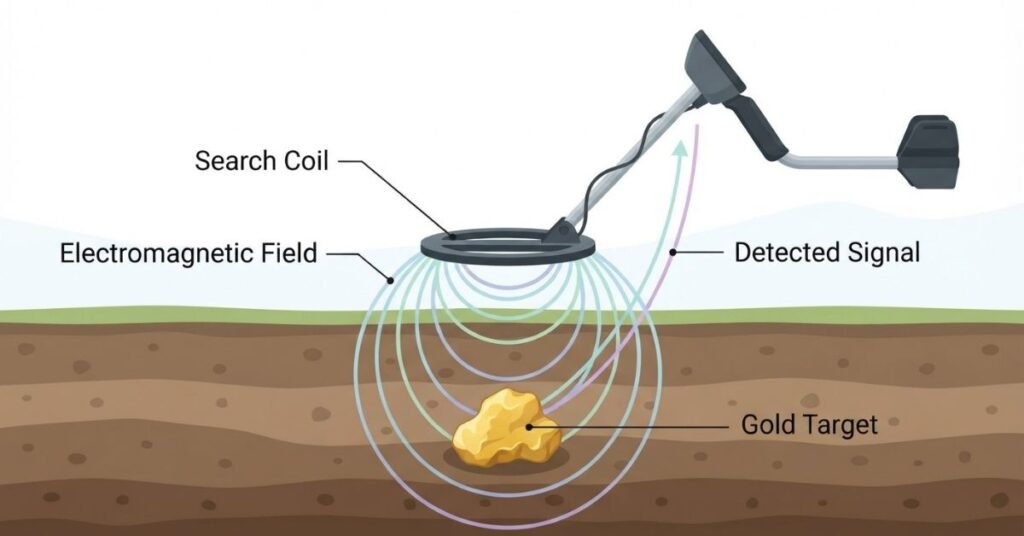
Metal detectors use an electromagnetic field to locate conductive metal targets below the ground. When the field reaches a metal object, it creates a response that the detector’s electronics can detect.
The detector then processes this response and produces an audio or visual signal. The strength and characteristics of that signal can vary based on the target and ground conditions.
Gold can produce a detectable response, but tiny nuggets may create very subtle signals. This makes gold detection different from finding larger coins or other common metal objects.
How Gold Responds to a Detector’s Electromagnetic Field
A metal detector creates an electromagnetic field around its search coil. When this field reaches a conductive gold target, it interacts with the metal.
The gold produces a secondary electromagnetic response. The detector’s coil receives this returning signal and sends it to the detector’s electronics.
The detector analyzes the response and provides a target signal. The strength of that response depends on several factors, including the gold’s size, shape, depth, and conductivity.
Why Gold Can Be Difficult to Detect
Gold can be challenging to detect because natural gold nuggets often have very small sizes. Smaller targets generally produce weaker responses than larger pieces of metal.
Gold also has lower electrical conductivity than highly conductive metals such as silver and copper. Its irregular natural shape can further affect how the detector responds.
Depth creates another challenge. As a target gets deeper, its signal generally becomes weaker. Highly mineralized ground can make small gold even harder to distinguish from the surrounding soil.
Why Soil Conditions Matter
Soil can strongly affect a metal detector’s ability to detect small gold targets. Mineralized ground contains naturally occurring minerals that can produce their own detector response.
This ground response can interfere with the signal from a small gold nugget. In difficult soil, the detector may struggle to separate the gold signal from the mineral response.
This is why a detector that performs well in ordinary soil may behave differently in gold-bearing areas. Ground conditions, target size, and detector characteristics all influence the final response.
Can All Metal Detectors Find Gold?
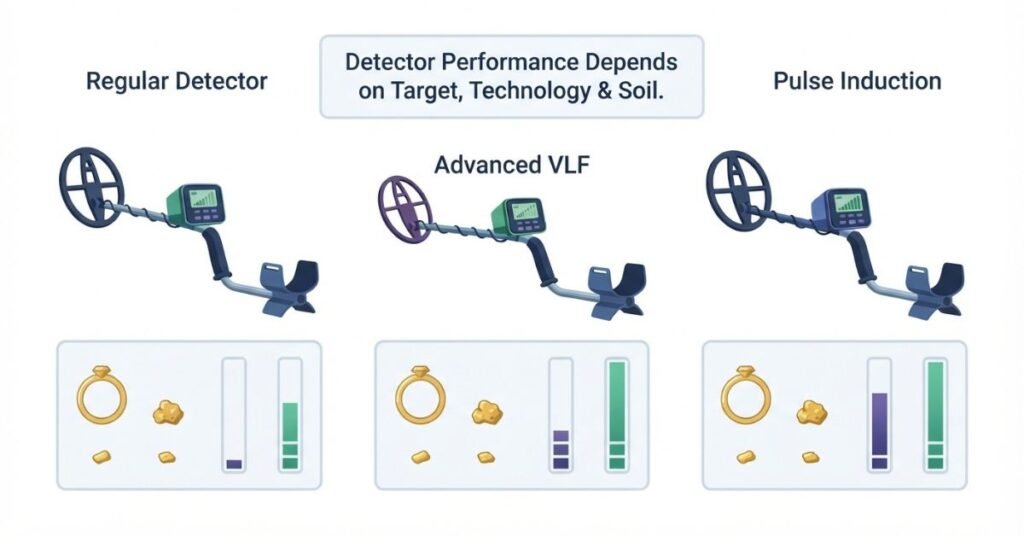
Not all metal detectors perform equally well when searching for gold. Many regular detectors can detect larger gold objects, such as rings, coins, and jewelry. However, tiny natural gold nuggets can be much harder to detect.
The key difference is target size and signal strength. A large gold ring contains much more metal than a tiny nugget. It can therefore produce a stronger and easier-to-recognize response.
This means a detector that finds gold jewelry successfully may not perform as well on small natural gold. Gold prospecting often requires equipment and settings designed to respond to very small targets.
Do Regular Metal Detectors Detect Gold?
Yes, many general-purpose metal detectors can detect gold. Their ability depends on the size, shape, depth, and location of the gold target.
A gold ring is usually easier to detect than a tiny natural nugget. The ring contains more metal and presents a larger target to the detector’s electromagnetic field.
General-purpose detectors can also detect other gold objects, including jewelry and larger pieces. However, natural gold often occurs as small flakes or nuggets with irregular shapes.
A detector may therefore respond clearly to a gold ring while giving a much weaker response to a small nugget. This difference doesn’t mean the detector cannot detect gold. It means the target falls closer to the detector’s limits.
Why Some Detectors Are Better for Gold
Several detector characteristics can affect gold detection performance:
- Operating frequency: Higher frequencies can improve sensitivity to very small, low-conductivity targets.
- Sensitivity: Greater sensitivity can help detect weaker signals from small gold.
- Ground balancing: Good ground balancing helps reduce the detector’s response to mineralized soil.
- Detector technology: Different technologies handle weak targets and difficult ground in different ways.
These features work together rather than determining performance individually. A detector’s overall design, coil, electronics, and operating conditions also influence its response.
Small Gold vs. Large Gold
A tiny gold nugget and a large gold ring can produce very different detector responses. Target size strongly affects the amount of electromagnetic response the detector receives.
A small nugget may produce a weak signal that is difficult to distinguish from ground noise. Its irregular shape can also change the detector’s response as the search coil moves across it.
A larger gold ring presents more metal to the detector. It can therefore produce a stronger and more consistent response.
Depth adds another difference. As either target becomes deeper, its signal generally becomes weaker. This explains why gold detection depends on more than simply whether the target contains gold.
VLF vs. Pulse Induction Metal Detectors for Gold
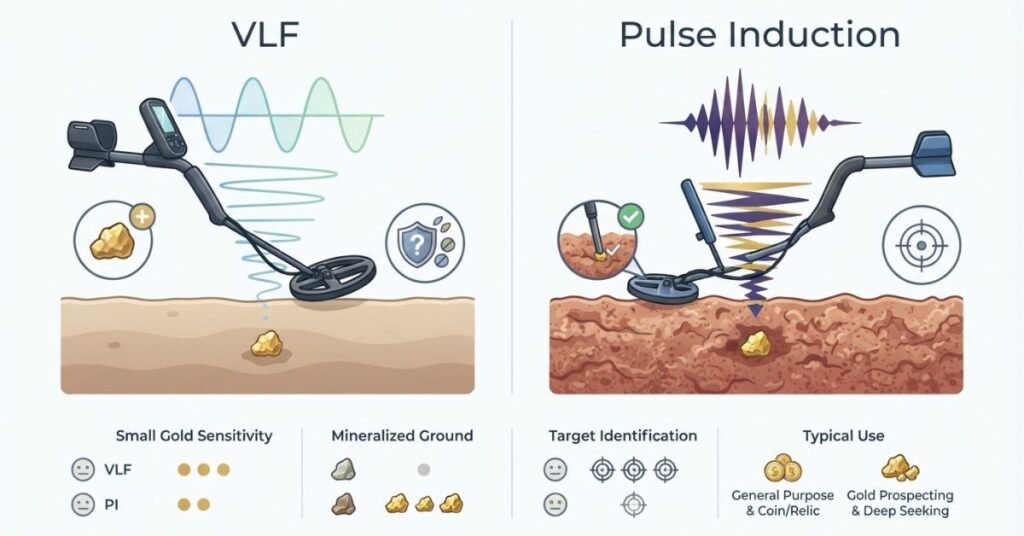
Two major detector technologies used for gold detection are very low frequency (VLF) and pulse induction (PI). Each technology handles targets and ground conditions differently.
| Feature | VLF | Pulse Induction |
|---|---|---|
| Small gold sensitivity | Often provides strong sensitivity to small gold, especially at suitable frequencies. | Can detect small gold, but performance depends on pulse design, coil, and other factors. |
| Mineralized ground | Mineralized soil can create interference and make small targets harder to detect. | Generally handles highly mineralized ground better and can maintain performance in difficult soil. |
| Target identification | Usually provides more information for distinguishing target characteristics. | Target identification is often more limited compared with many VLF detectors. |
| Typical use | Common for general detecting and gold hunting where ground conditions allow. | Often useful for gold prospecting in heavily mineralized ground. |
Neither technology is automatically better in every situation. Soil conditions, target size, detector design, and the type of gold all affect the result.
What Is a VLF Detector?
A VLF detector uses a continuous electromagnetic field to detect conductive targets. Its search coil transmits and receives electromagnetic signals as it moves across the ground.
VLF detectors can offer good sensitivity to small targets. This makes the technology useful for detecting small gold in suitable ground conditions.
Many VLF detectors also provide target identification features. These features analyze the received signal and help distinguish different types of metal targets.
However, mineralized soil can create its own electromagnetic response. This can interfere with weak signals from tiny gold nuggets.
Ground balancing helps the detector compensate for some of this mineral response. Proper operation becomes especially important when searching in gold-bearing areas with difficult soil.
What Is a Pulse Induction Detector?
A pulse induction (PI) detector works differently from a VLF detector. Instead of maintaining a continuous electromagnetic field, it sends short electrical pulses through the search coil.
After each pulse, the detector monitors the returning response. A conductive metal target can affect this response, allowing the detector to recognize the target.
One major advantage of PI technology is its ability to operate effectively in highly mineralized ground. This can be valuable when searching for gold in soil that creates strong interference.
PI detectors can detect gold targets, including small gold, but their performance varies between detector designs. They also typically provide less detailed target identification than many VLF systems.
Which Technology Is Better for Gold?
Neither VLF nor PI technology is universally best for gold. The better choice depends on the gold target, soil conditions, and detection goals.
A VLF detector can be highly useful when small-gold sensitivity and target information are important. It can work especially well in ground that does not create excessive mineral interference.
A PI detector can have an advantage in heavily mineralized ground. Its ability to handle difficult soil can make weak gold targets easier to detect in those conditions.
For beginners, the main lesson is simple: detector technology matters, but the ground and target matter too. Small gold in mild soil presents a different challenge from deeper gold in highly mineralized ground.
What Types of Gold Can a Metal Detector Find?
Metal detectors can detect different types of gold targets, but not every target responds equally well. Natural gold and manufactured gold objects can behave very differently under a search coil.
Target size, shape, depth, conductivity, and soil conditions all affect the detector’s response. These factors explain why a gold ring may be easier to detect than a tiny natural nugget.
Gold Nuggets
Gold nuggets are natural pieces of gold found in soil, gravel, or rock. Their size and shape can vary greatly.
Tiny nuggets can be especially difficult to detect because they produce weak signals. Irregular shapes can also change how the target responds as the coil moves over it.
Larger nuggets generally produce stronger responses. However, depth and mineralized ground can still make detection challenging.
Gold Rings
Gold rings are generally easier targets than tiny gold nuggets. Their larger size and solid structure can produce a stronger detector response.
A ring’s detection also depends on its size, gold content, depth, and surrounding soil. A small ring buried deeply may still produce a weak signal.
This is why finding gold jewelry doesn’t necessarily mean a detector will perform equally well on natural gold.
Gold Jewelry
Metal detectors can detect many types of gold jewelry, including:
- Pendants
- Bracelets
- Chains
- Earrings
Larger and thicker jewelry usually produces a stronger response than very thin pieces. Thin gold chains can be particularly challenging because individual links contain relatively little metal.
The chain’s orientation can also affect its response. A thin chain lying in a certain position may produce a weaker signal than a larger, more compact gold object.
Gold Coins
Gold coins are often larger and more solid than small natural gold pieces. This can make them detectable under suitable conditions.
However, detection depends on the coin’s size, depth, detector capability, and surrounding soil. A deeply buried coin can produce a much weaker response than a shallow coin.
The coin’s composition and design can also influence the signal. There is no single detection depth that applies to every detector or gold coin.
Why Is Gold Harder to Detect Than Other Metals?
Gold can be harder to detect than many common metal targets, especially when it occurs as tiny natural pieces. Several physical and environmental factors affect the detector’s response.
Gold Has Relatively Low Conductivity
Electrical conductivity describes how easily a material allows electric current to flow. Metal detectors use this property when responding to conductive targets.
Gold is conductive, so a detector can detect it. However, gold has lower conductivity than highly conductive metals such as silver and copper.
This doesn’t mean gold is invisible to metal detectors. Target size, shape, frequency, depth, and soil conditions also influence the signal.
Target Size Makes a Major Difference
Target size can have a major effect on detection. A larger piece of gold generally produces a stronger response than a tiny piece.
For example, these targets can present very different challenges:
- Tiny gold flake: Extremely small target with a very weak response.
- Small nugget: More detectable than a flake but still challenging.
- Large nugget: Larger mass can produce a stronger response.
- Gold ring: Usually a larger, more compact target.
- Gold coin: Solid and relatively large compared with tiny natural gold.
These examples show why asking whether a detector can find gold requires more context. The type and size of the target matter greatly.
Mineralized Ground Can Mask Small Gold
Mineralized soil contains naturally occurring minerals that can produce a strong detector response. This response can interfere with signals from small gold targets.
The problem becomes more noticeable when the gold signal is already weak. A tiny nugget may become difficult to separate from the surrounding ground response.
Ground conditions therefore play an important role in gold detection. A detector’s performance can change significantly between mild soil and highly mineralized ground.
Depth Reduces Signal Strength
As a metal target moves deeper underground, the detector generally receives a weaker response. The signal must travel farther between the search coil and the target.
This effect applies to gold as well as other metals. A small gold target at greater depth can become particularly difficult to detect.
There is no universal depth at which a detector stops finding gold. Detector design, coil characteristics, target size, soil conditions, and other factors all affect detection.
How Deep Can a Metal Detector Find Gold?
There is no single maximum depth for detecting gold with a metal detector. Detection depth changes with the target, detector, coil, soil, and operating conditions.
Gold can occur at different depths, so learning [how deep a metal detector can detect gold] can help you set realistic expectations in the field.
Several factors can affect how deep a detector can respond to gold:
- Gold target size: Larger targets generally produce stronger signals.
- Target shape: Irregular shapes can produce different responses.
- Target orientation: A target’s position relative to the coil can affect its signal.
- Detector technology: Different technologies respond differently to gold and mineralized soil.
- Coil size: Coil design and size can affect detection characteristics.
- Soil mineralization: Highly mineralized ground can interfere with weak gold signals.
- Ground conditions: Moisture, minerals, rocks, and other factors can change detector performance.
- Detector settings: Sensitivity and ground-balancing settings can affect the usable response.
Because these factors vary, advertised depth should not be treated as a guaranteed gold-detection depth.
Can a Metal Detector Find Tiny Gold Deep Underground?
A metal detector can detect tiny gold underground, but greater depth makes the challenge harder. Small gold already produces a relatively weak response.
As the distance between the coil and target increases, the detector generally receives less response from the target. Mineralized ground can make this weak signal even harder to separate from ground noise.
A detector may therefore detect a tiny nugget near the surface but fail to respond to the same target at greater depth. The result depends on the detector, coil, soil, target characteristics, and settings.
Are Larger Gold Targets Easier to Detect at Depth?
Larger gold targets are generally easier to detect at depth than tiny gold pieces. More metal can produce a stronger electromagnetic response for the detector to receive.
However, larger size doesn’t guarantee detection. Depth, orientation, soil mineralization, detector technology, coil characteristics, and operating settings still affect performance.
| Gold Target | Relative Detection Difficulty |
|---|---|
| Tiny gold flake | Very difficult |
| Small nugget | Difficult |
| Larger nugget | Moderate |
| Gold ring | Usually easier |
| Large gold object | Generally easier |
This table shows relative difficulty rather than guaranteed detection performance. Actual results can vary significantly between targets and environments.
Can a Metal Detector Find Gold in Different Environments?
Gold can occur naturally in ground, sediment, and rock, while gold jewelry can become lost in places where people gather. A metal detector can respond to both types of targets.
The detection challenge changes with the environment. Soil minerals, rocks, moisture, target depth, and other metal objects can all affect the detector’s response.
Gold in Rivers and Streams
Natural gold can occur in river and stream sediments. Small pieces may become concentrated in areas where moving water slows down.
These targets can be challenging because natural gold may be very small. Wet ground, rocks, and mineralized sediment can also affect detector performance.
Gold in Dry Creek Beds
Dry creek beds can contain sediment left behind by earlier water movement. Natural gold may occur among gravel, sand, and other materials.
Small nuggets can be difficult targets when they have weak signals or sit among mineralized material. Detection depends on both the gold and the surrounding ground.
Gold in Mineralized Ground
Mineralized ground can produce strong responses that interfere with small gold signals. This creates an additional challenge for detectors searching for natural gold.
The effect depends on the type and level of mineralization. Difficult ground can make small targets harder to separate from the soil response.
Gold Jewelry on Beaches and Parks
Gold jewelry represents a different type of target from natural gold. Rings, bracelets, chains, and other items may become lost in areas where people spend time.
Beaches and parks can contain both gold jewelry and many non-gold metal objects. Sand, soil conditions, trash, and target depth can influence detection.
Natural gold deposits and lost gold objects should therefore be considered separately. The first involves naturally occurring gold, while the second involves manufactured items that people have lost.
Why Doesn’t My Metal Detector Find Gold?
Not finding gold doesn’t necessarily mean your metal detector cannot detect it. The target or ground conditions may simply make the signal too weak to recognize.
The Gold Target Is Too Small
Tiny gold can produce an extremely weak response. Small flakes and tiny nuggets may fall near the practical sensitivity limits of a detector.
A detector may respond to larger gold while missing much smaller pieces.
The Target Is Too Deep
Depth reduces the strength of the detector’s response. A small gold target can become difficult to detect when buried farther below the coil.
The same target may be detectable at a shallower depth but produce little or no recognizable response deeper underground.
The Soil Is Highly Mineralized
Mineralized soil can create its own detector response. This ground signal can interfere with the weaker response from small gold.
Highly mineralized conditions can therefore make gold detection more difficult, even when gold is present.
The Detector Is Not Sensitive Enough
Different detectors have different capabilities and sensitivity to small targets. A general-purpose detector may detect larger gold but struggle with tiny natural nuggets.
Detector technology, coil characteristics, and operating conditions all contribute to sensitivity.
The Gold Is Outside the Detector’s Effective Detection Range
Every detector has practical limits that depend on the target and environment. A target can fall outside the detector’s effective range because of its size, depth, soil, or other conditions.
For detailed detector settings and gold-searching techniques, see the separate How to Find Gold With a Metal Detector guide.
How Common Is It to Find Gold With a Metal Detector?
Finding gold with a metal detector is possible, but it isn’t guaranteed. Your results depend heavily on where you search, what you’re looking for, and how well your detector handles the conditions.
Natural gold can be uncommon in many areas. Research helps you understand whether an area has a realistic chance of containing gold before you spend time searching.
Experience also matters. As you use a detector, you become better at recognizing subtle signals and understanding how different targets respond.
Your detector’s capability can affect your results too. Small natural gold often requires more sensitivity than larger manufactured gold objects.
Patience is another important part of gold detecting. You may search for long periods without finding a valuable target.
Gold detecting should therefore be viewed as a hobby and prospecting activity, not a guaranteed way to make easy money. Good research, suitable equipment, careful searching, and realistic expectations give you a better starting point.
Can You Find Gold With a Cheap or Regular Metal Detector?
Yes, a cheap or regular metal detector can detect some gold targets. Larger gold objects, such as rings and other substantial jewelry, may produce detectable signals.
Small natural gold nuggets are a much greater challenge. Their tiny size can create weak signals that some general-purpose detectors struggle to recognize.
Detector quality and technology also matter. Features such as operating frequency, sensitivity, ground balancing, and detector design can affect performance.
Ground conditions can make an even bigger difference. Highly mineralized soil may interfere with weak signals from small gold and make detection more difficult.
So, the answer isn’t simply about whether a detector is cheap or expensive. The target, detector capabilities, soil, depth, and search conditions all influence the result.
If you want to search specifically for natural gold, learn more in our detailed How to Find Gold With a Metal Detector guide. It covers the basic techniques, detector considerations, and practical steps for beginners.
Conclusion
A metal detector can find gold, but results depend on the target, detector, soil, depth, and search conditions. Small natural nuggets are much harder to detect than larger gold objects.
So, can a metal detector find gold? Yes, but successful gold detecting requires realistic expectations and patience. Researching your search area and understanding your detector can also improve your chances.
Whether you’re using a regular detector or specialized gold-detecting technology, experience matters. Learning how different targets respond helps you recognize subtle signals.
Once you understand how gold responds to a detector, the next step is choosing [the best places to find gold with a metal detector].
Ready to start searching? Explore our detailed gold detecting guide for practical beginner tips. You can also share your gold-finding experiences or questions in the comments.
Frequently Asked Questions
Find clear answers to common questions about detecting gold with a metal detector.
Can a metal detector find gold?
Yes, a metal detector can find gold. However, detection depends on the gold’s size, shape, depth, conductivity, detector technology, and surrounding soil. Small natural gold nuggets can be much harder to detect than larger gold rings, coins, or jewelry.
Can all metal detectors find gold?
Not all metal detectors perform equally well on gold. Many general-purpose detectors can detect larger gold objects, such as rings and jewelry. Tiny natural nuggets are more challenging because they produce weaker signals and may be affected by mineralized soil.
Do regular metal detectors detect gold?
Yes, many regular metal detectors can detect larger gold objects. Gold rings, coins, and substantial jewelry may produce detectable signals. Very small natural gold can require greater sensitivity and may be harder to detect with a general-purpose detector.
Can a cheap metal detector find gold?
A cheap or basic metal detector may detect larger gold objects, especially gold jewelry. Small natural nuggets are considerably more difficult. Detector technology, sensitivity, coil characteristics, target size, depth, and soil conditions all affect detection.
What types of gold can a metal detector find?
Metal detectors can detect gold nuggets, rings, jewelry, and coins when conditions allow. Larger and more compact gold objects generally produce stronger responses. Tiny flakes, thin chains, and small nuggets can be much harder to detect.
Why is gold harder to detect than some other metals?
Gold can be difficult to detect because natural gold is often very small and irregularly shaped. Its relatively low conductivity compared with highly conductive metals can also affect the response. Depth and mineralized soil can make weak gold signals even harder to detect.
How deep can a metal detector find gold?
There is no universal maximum depth for detecting gold. Detection depth depends on target size, shape, orientation, detector technology, coil characteristics, soil mineralization, ground conditions, and detector settings. Larger targets are generally easier to detect at depth.
Can a metal detector find tiny gold?
Yes, some metal detectors can detect tiny gold, but small targets produce weaker signals. Detection becomes more difficult as the target gets deeper or the ground becomes highly mineralized. Detector sensitivity and technology can also affect the result.
Is VLF or pulse induction better for finding gold?
Neither technology is universally better. VLF detectors can offer good sensitivity to small gold and useful target information. Pulse induction detectors often perform well in highly mineralized ground. The better technology depends on the target and environment.
Why doesn’t my metal detector find gold?
The gold may be too small, too deep, or outside the detector’s effective range. Highly mineralized soil can also mask weak gold signals. Detector sensitivity, technology, coil characteristics, and ground conditions can all affect whether gold produces a detectable response.
How common is it to find gold with a metal detector?
Finding gold with a metal detector is possible, but it is not guaranteed. Results depend on the location, target, detector capability, ground conditions, research, and experience. Natural gold can be uncommon in many areas, so gold detecting should not be treated as easy money.

Ethan Callaway is a passionate metal detecting enthusiast based in Savannah, Georgia, USA. Currently pursuing a B.S. in Archaeology & Historical Preservation at the University of Georgia, he combines his love for treasure hunting with research-backed insights on metal detecting techniques, safety practices, and site guidance.
Through MetalDetectingUSA.com, Ethan shares practical tips, honest product reviews, and beginner-friendly advice to help both new and experienced detectorists explore metal detecting across the United States with more confidence and understanding.